

(UroToday.com) The 2025 ASCO annual meeting featured a prostate cancer session and a presentation by Dr. Simon Chowdhury discussing the impact of germline versus somatic BRCA mutation status on the efficacy of rucaparib versus physician’s choice in the TRITON3 study of patients with metastatic castration-resistant prostate cancer (mCRPC). Rucaparib significantly improved radiographic progression-free survival in men with BRCA-mutated chemotherapy-naïve mCRPC versus a control arm of physician’s choice of therapy (docetaxel or androgen receptor pathway inhibitor therapy: abiraterone acetate or enzalutamide) in the randomized, multicenter, open-label, phase 3 TRITON3 study.1 Importantly, patients with germline BRCA1/2 mutations have an increased risk of developing mCRPC, and these mutations are associated with more aggressive disease. At the 2025 ASCO annual meeting, Dr. Chowdhury and colleagues presented results of their analysis determining the impact of germline versus somatic mutation status on the efficacy of rucaparib.
In TRITON3, patients were randomized 2:1 to receive rucaparib 600 mg BID or physician’s choice of docetaxel or androgen receptor pathway inhibitor following progression while on 1 prior second-generation androgen receptor pathway inhibitor in any setting. The primary endpoint was radiographic progression-free survival, and treatment-emergent adverse events were reported for the BRCA subgroup:

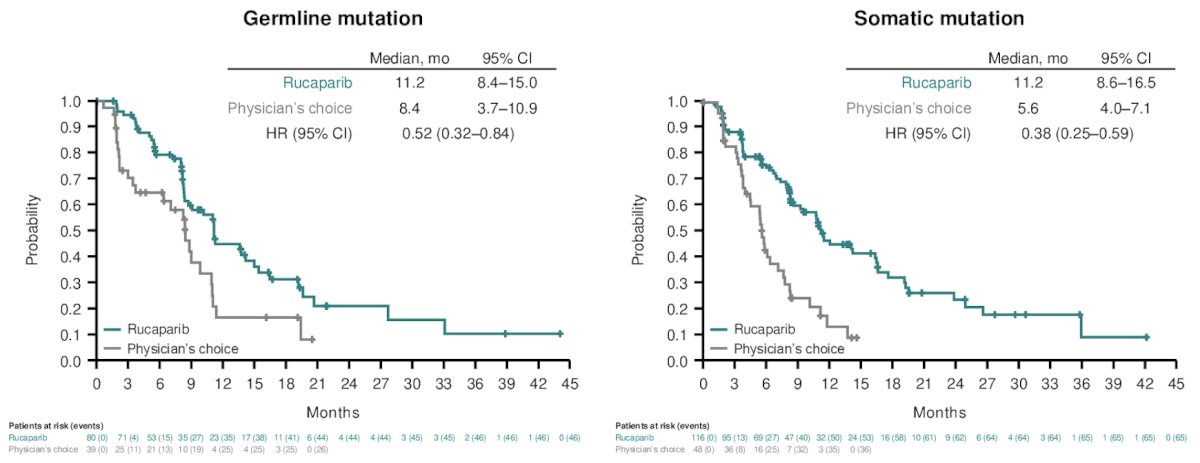
In the rucaparib arm, 201/270 patients had BRCA mutations, and in the physician’s choice arm, 101/135 patients had BRCA mutations. Of patients with BRCA mutations: in the rucaparib arm, 80/201 (40%) were germline and 116/201 (58%) were somatic with 5/201 (2%) BRCA mutation status unknown, while in the physician’s choice arm, 39/101 (39%) were germline and 48/101 (48%) were somatic with 14/101 (14%) BRCA mutation status unknown. Radiographic progression-free survival was significantly improved with rucaparib treatment versus physician’s choice in both the germline and somatic mutation groups (HR 0.50, 95% CI, 0.36–0.69):

In the BRCA population, rucaparib improved radiographic progression free survival versus physician’s choice in both the germline (HR 0.52, 95% CI 0.32-0.84) and somatic (HR 0.38, 95% CI 0.25-0.59) mutation groups:
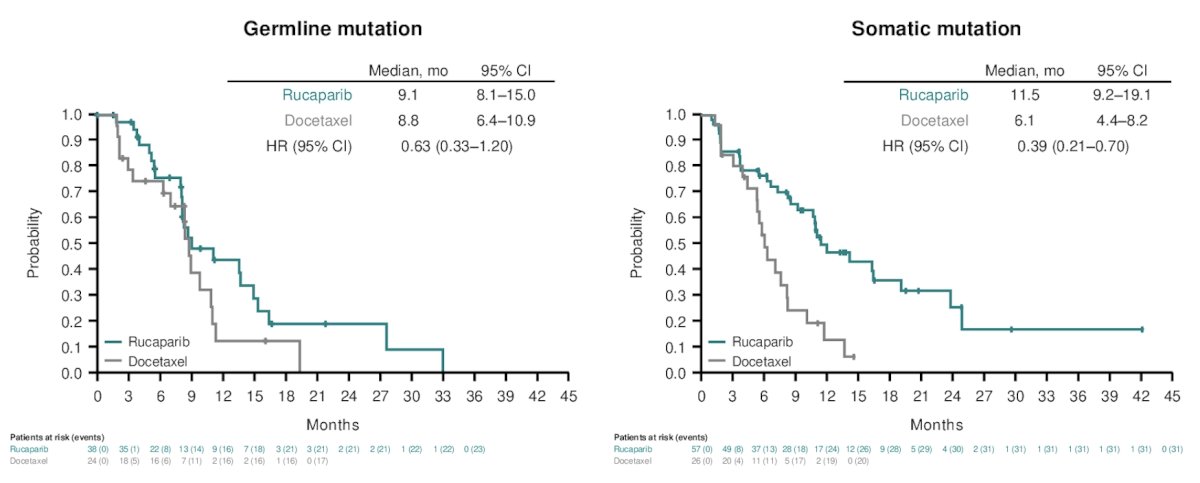
In patients in the rucaparib arm who would have received docetaxel if randomized to physician’s choice, radiographic progression free survival was numerically improved with rucaparib treatment versus docetaxel in the germline mutation group (HR 0.63, 95% CI 0.33-1.20), and significantly improved in the somatic mutation group (HR 0.39, 95% CI 0.21-0.70):
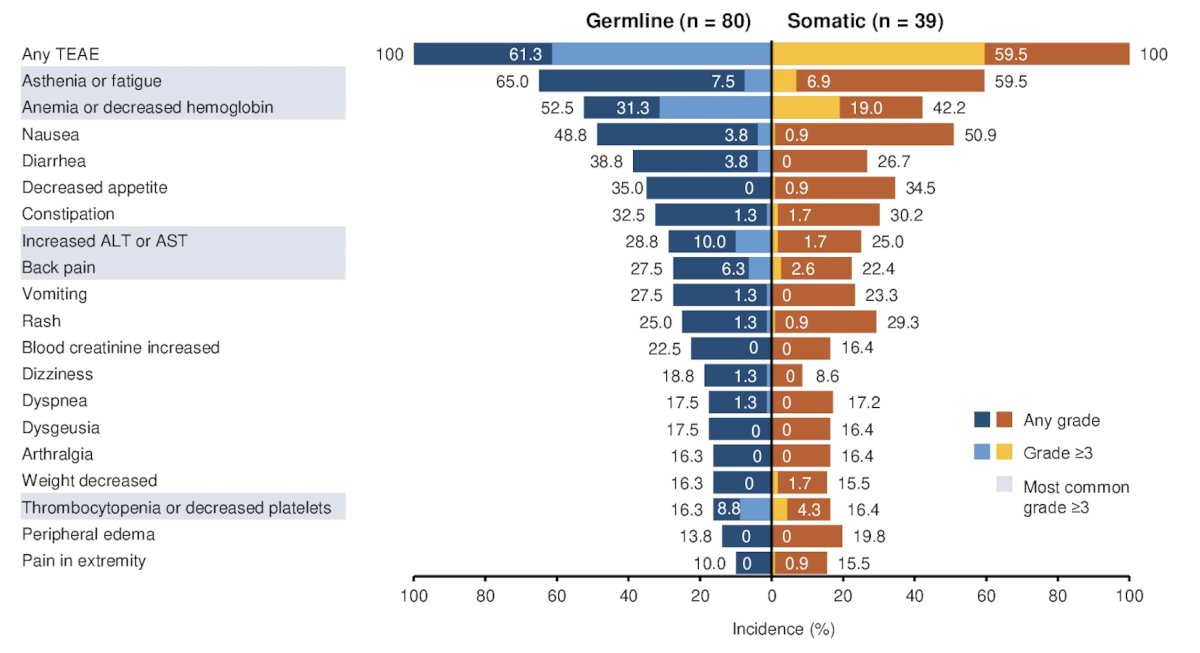
Within each treatment arm, most treatment emergent adverse event incidence rates were generally similar overall and between patients with germline and somatic mutations. The most frequent any grade treatment emergent adverse event in the germline mutation and somatic mutation groups was asthenia or fatigue (65.0% and 59.5%, respectively. The most frequent grade 3+ treatment emergent adverse event was anemia or decreased hemoglobin in germline mutation (31.3%) and somatic mutation (19.0%):
Dr. Chowdhury concluded his presentation discussing the impact of germline versus somatic BRCA mutation status on the efficacy of rucaparib versus physician’s choice in the TRITON3 study of patients with mCRPC, with the following take home points:
- To date, rucaparib is the only PARP inhibitor to have shown improved radiographic progression free survival versus a docetaxel chemotherapy containing arm in mCRPC
- Rucaparib improves radiographic progression free survival for patients with germline or somatic BRCA-mutated mCRPC, with an equally manageable safety profile
- These data support the use of rucaparib as a beneficial treatment option for patients with BRCA-mutated mCRPC with germline or somatic mutations
Presented by: Simon Chowdhury, MD, Guy's and St. Thomas' NHS Foundation Trust, London, United Kingdom
Written by: Zachary Klaassen, MD, MSc – Urologic Oncologist, Associate Professor of Urology, Georgia Cancer Center, Wellstar MCG Health, @zklaassen_md on Twitter during the American Society of Clinical Oncology (ASCO) 2025 Annual Meeting, Chicago, IL, Fri, May 30 – Tues, Jun 3, 2025.
References:
- Fizazi K, Piulats JM, Reaume MN, et al. Rucaparib or Physician’s Choice in Metastatic Prostate Cancer. N Engl J Med. 2023 Feb 23;388(8):719-732.