

(UroToday.com) The 2025 ASCO annual meeting featured a kidney cancer rapid oral abstract session and a presentation by Dr. Jad Chahoud discussing results from an expansion cohort of the phase 1b STELLAR-002 study assessing zanzalintinib + nivolumab ± relatlimab in patients with previously untreated clear cell RCC. VEGFR-targeted tyrosine kinase inhibitors (TKIs) in combination with immune checkpoint inhibitors are standard of care for previously untreated metastatic clear cell RCC. Zanzalintinib (XL092) is a novel, oral, multi-targeted TKI of VEGFR, MET, and TAM kinases (TYRO3, AXL, MER), with a short half-life that may have an improved therapeutic index: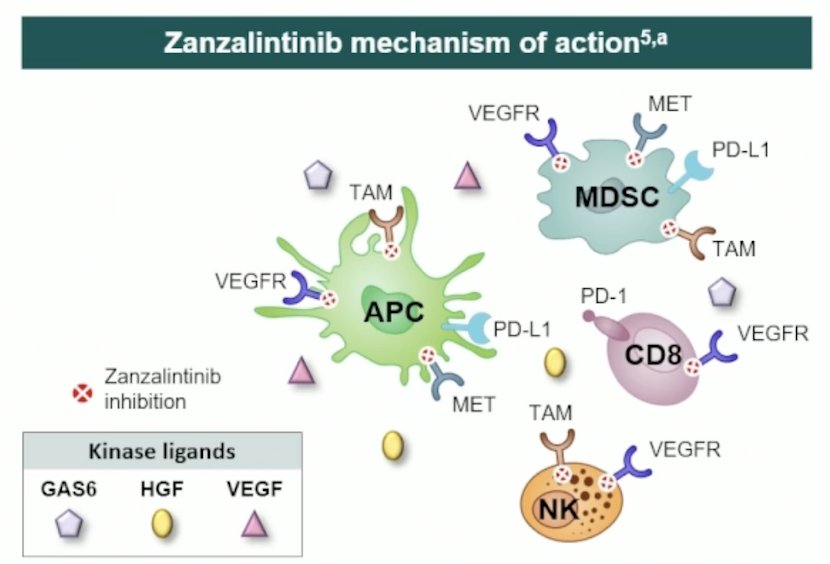
In the phase 1 STELLAR-001 study, the tolerability profile of single-agent zanzalintinib was manageable and antitumor activity was observed in patients with previously treated advanced clear cell RCC. STELLAR-002 is a phase 1b, open-label study evaluating the tolerability and activity of zanzalintinib alone and in combination with immune checkpoint inhibitors in patients with advanced solid tumors. At the 2025 ASCO annual meeting, Dr. Chahoud and colleagues presented data from the expansion cohort of patients with previously untreated clear cell RCC receiving zanzalintinib + nivolumab ± relatlimab.
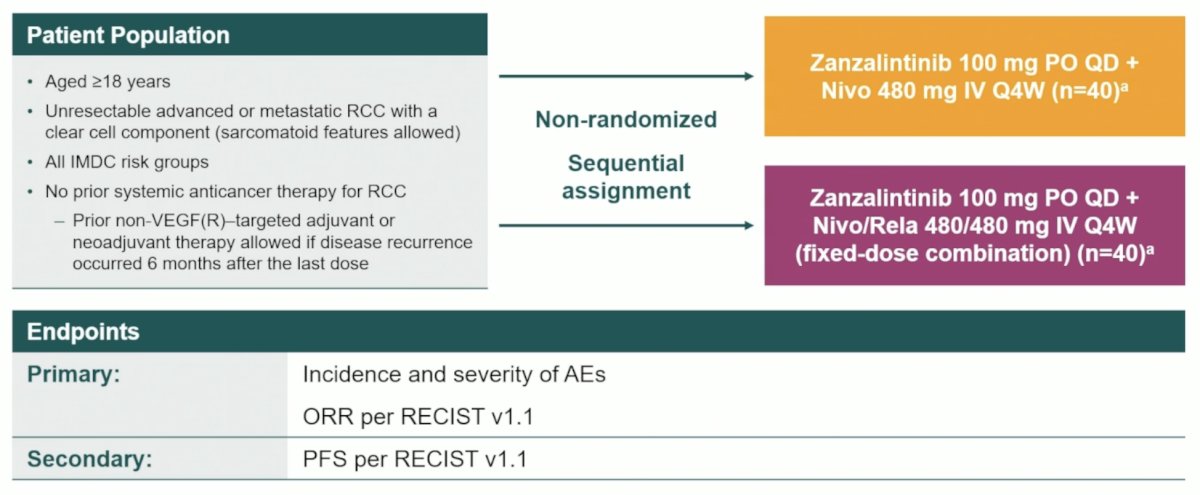
Adult patients with unresectable advanced or metastatic clear cell RCC of any IMDC risk, and no prior systemic anticancer therapy for advanced or metastatic clear cell RCC were enrolled into one of two non-randomized arms. Patients received zanzalintinib 100 mg orally with either nivolumab 480 mg IV every 4 weeks or nivolumab/relatlimab 480/480 mg IV every 4 weeks (fixed-dose combination). Primary endpoints were investigator-assessed objective response rate per RECIST 1.1 and safety. The STELLAR-002 trial schema is as follows:
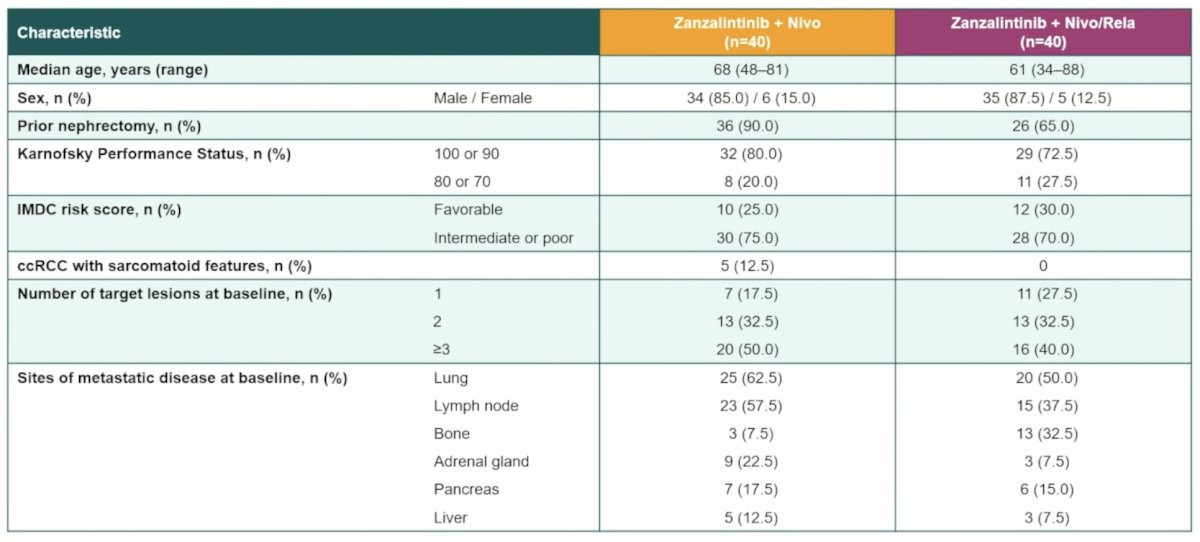
In the zanzalintinib + nivolumab arm (n = 40), 75% had intermediate or poor IMDC risk disease. In the zanzalintinib + nivolumab/relatlimab arm (n = 40), 70% had intermediate or poor IMDC risk disease:
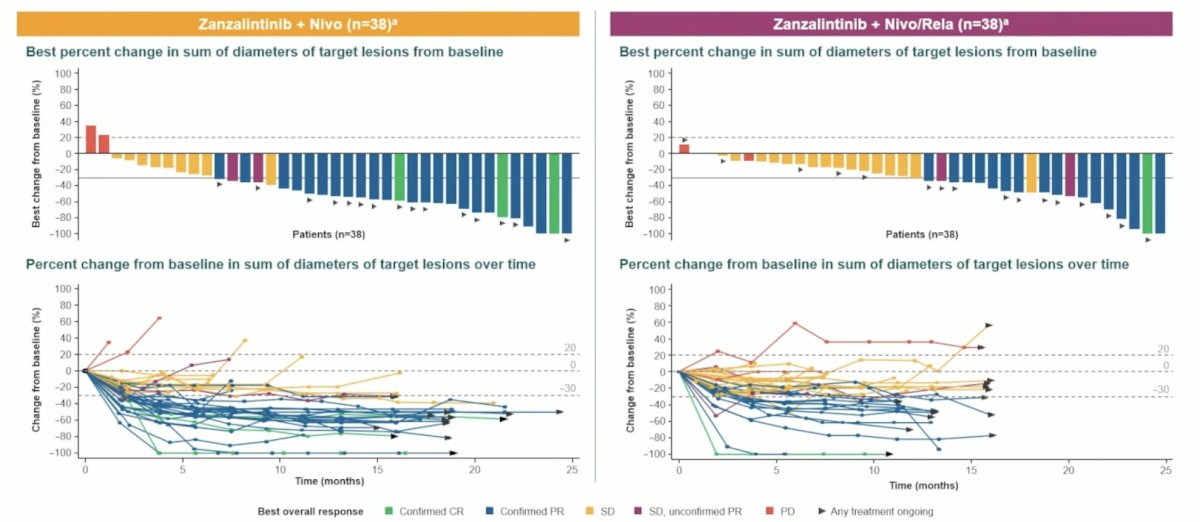
After median follow-up of 16.1 months for zanzalintinib + nivolumab, the objective response rate was 63% (3 complete responses, 22 partial responses), and disease control rate (defined as: complete response + partial response + stable disease) was 90%. The 6- and 12-month progression free survival rates were 83.4% and 64.4%, respectively. After a median follow-up of 11.9 months for zanzalintinib + nivolumab/relatlimab, the objective response rate was 40% (1 complete responses, 15 partial responses) and disease control rate was 90%. The 6- and 12-month progression free survival rates were 80.4% and 58.4%, respectively:
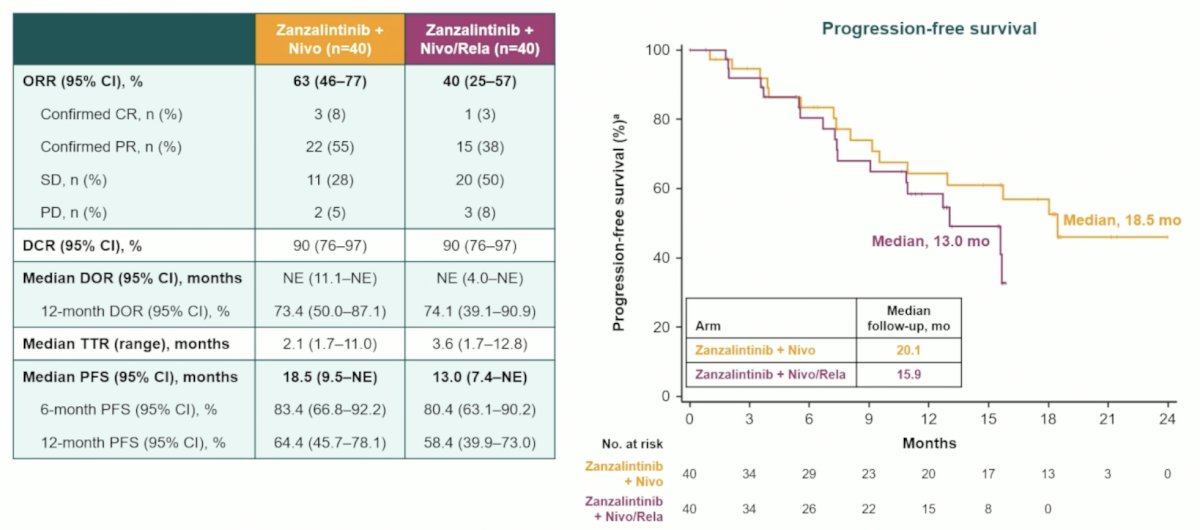
Further antitumor activity is highlighted as follows:
For zanzalintinib + nivolumab, the most common any grade treatment-emergent adverse events were diarrhea (78%), hypertension (58%), and nausea (58%). The most common grade 3/4 adverse events related to zanzalintinib were hypertension (30%) and diarrhea (15%). Treatment-related palmar-plantar erythrodysesthesia was reported in 28% (8% grade 3, 0% grade 4). Two (5%) patients discontinued both study treatments due to treatment-related adverse events, and the median average daily zanzalintinib dose was 49.5 mg (range: 26-100). For zanzalintinib + nivolumab/relatlimab, the most common any grade treatment-emergent adverse events were diarrhea (60%) and nausea (50%), and the most common grade 3/4 adverse events related to zanzalintinib was hypertension (13%). Treatment-related palmar-plantar erythrodysesthesia occurred in 5% (0% grade 3/4). Seven (18%) patients discontinued all study treatment due to treatment-emergent adverse events, the median average daily zanzalintinib dose was 54.9 mg (range: 31-100), and no grade 5 treatment-emergent adverse events occurred in either arm.
Dr. Chahoud concluded his presentation discussing results from an expansion cohort of the phase 1b STELLAR-002 study with the following take home points:
- Zanzalintinib + nivolumab showed promising preliminary activity in patients with previously untreated advanced or metastatic clear cell RCC, with an objective response rate of 63% and median progression free survival of 18.5 months
- Zanzalintinib demonstrated acceptable tolerability in combination with nivolumab +/- relatlimab in the first line treatment of RCC
- The encouraging preliminary clinical activity and acceptable tolerability with zanzalintinib support the ongoing investigation of zanzalintinib + immune checkpoint inhibitors in solid tumors
- A phase 3 study of zanzalintinib + nivolumab versus sunitinib in patients with untreated locally advanced or metastatic non-clear cell RCC (STELLAR-304) is ongoing
Presented by: Jad Chahoud, MD, Moffitt Cancer Center, Tampa, FL
Written by: Zachary Klaassen, MD, MSc – Urologic Oncologist, Associate Professor of Urology, Georgia Cancer Center, Wellstar MCG Health, @zklaassen_md on Twitter during the American Society of Clinical Oncology (ASCO) 2025 Annual Meeting, Chicago, IL, Fri, May 30 – Tues, Jun 3, 2025.
Related content: STELLAR-002 Trial: Zanzalintinib Combo Shows Promise in Clear Cell RCC - Jad Chahoud