

(UroToday.com) The 2025 ASCO annual meeting featured a kidney cancer rapid oral abstract session and a presentation by Dr. Tian Zhang discussing step 1 results of the phase 3 PDIGREE trial assessing ipilimumab and nivolumab in patients with metastatic clear cell RCC. Ipilimumab + nivolumab is a standard of care first-line treatment for patients with metastatic clear cell RCC based on the CheckMate 214 trial.1 However, the ideal timing of subsequent immunotherapy treatments is not well defined. At the 2025 ASCO annual meeting, Dr. Zhang and colleagues performed an analysis of patients initially treated with ipilimumab + nivolumab and subsequent cohort assignments on PDIGREE (A031704).
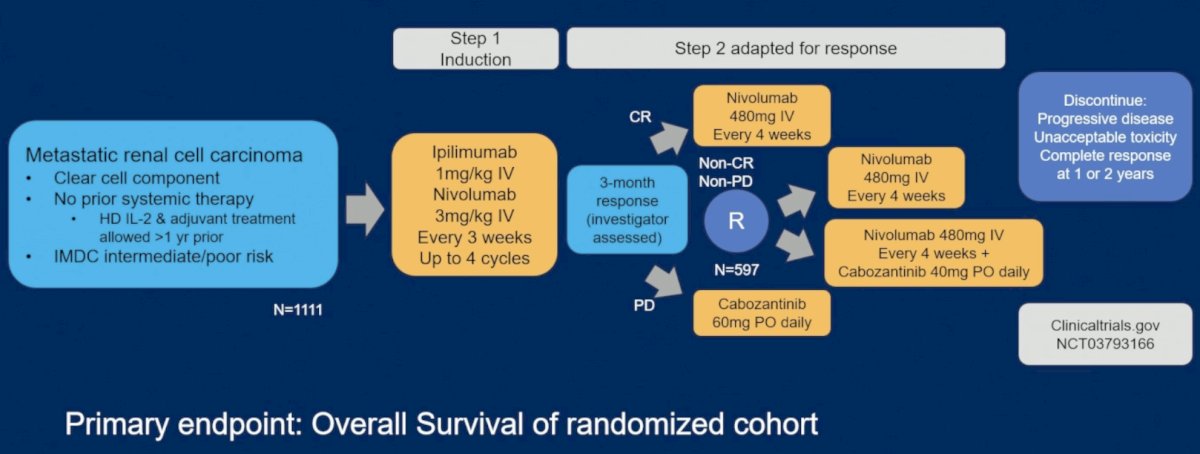
The PDIGREE trial treated patients with IMDC intermediate/poor risk metastatic clear cell RCC with first-line ipilimumab + nivolumab (Step 1) at NCTN sites (categorized as academic, academic regional, and community). Subsequent management was based on iRECIST responses at 12 weeks:
- Patients with complete response received 1-year nivolumab maintenance
- Patients with progressive disease received cabozantinib monotherapy
- Patients with non-complete response/non-progressive disease were randomized to nivolumab with or without cabozantinib (for primary endpoint of overall survival, target sample size was 1,175)
The trial design for PDIGREE is as follows:
Enrollment was held when the randomized sample target was reached. Patients with unresolved toxicity at week 22 were managed off protocol. Step 1 patient demographics, assignments into Step 2, and adverse event data are presented. These data were released with DSMB approval and do not inform the primary overall survival endpoint.
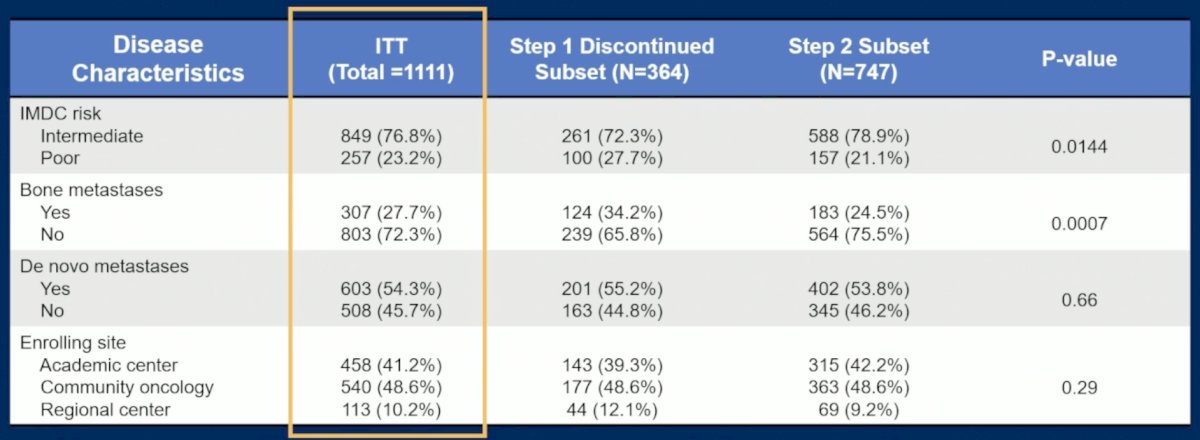
From May 2019 to May 2024, 1,111 patients were enrolled and treated with ipilimumab + nivolumab. Patient characteristics included a median age of 64.0 years (range 29.0-86.0), 819 (73.7%) males, White (85.1%), Hispanic (10.4%), Black (4.2%), and American Indian/Native Hawaiian (1.3%), 849 (76.8%) intermediate risk/257 (23.2%) poor risk, 458 (41.2%) at academic institutions, 113 (10.2%) at regional institutions, and 540 (48.6%) at community centers. There were 603 (54.3%) patients with de novo metastases:
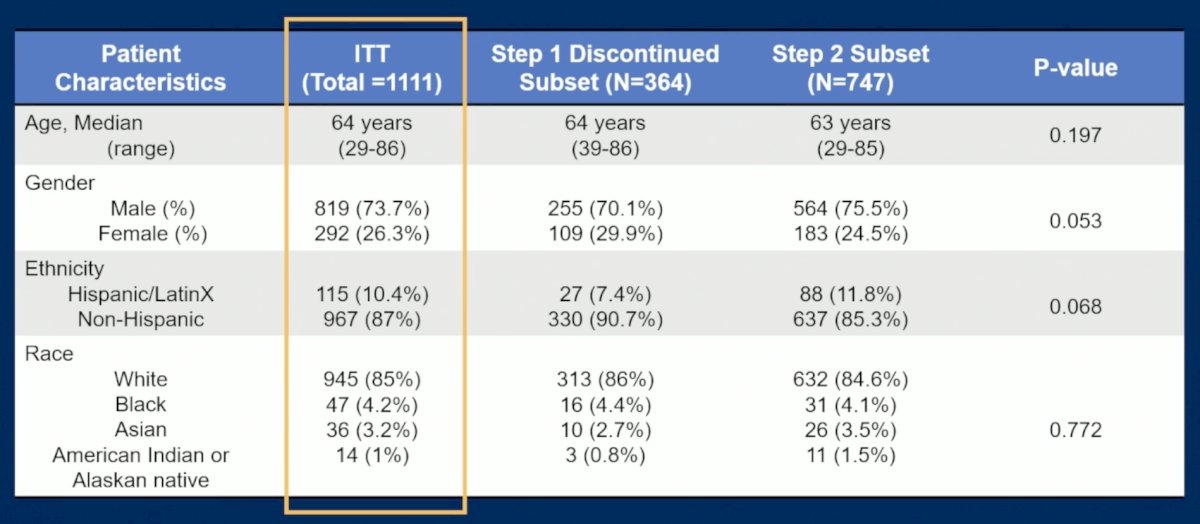
Overall, 364 patients (33%) stopped treatment in Step 1: 160 (44%) for adverse events, 46 (13%) for progressive disease/clinical progressive disease/suspected progressive disease, 42 (12%) withdrawals, 39 (11%) alternative treatments, 37 (10%) deaths on the study, 12 (3%) other complicating disease, 8 (2%) MD decision, and 19 (5%) other reasons. Of the 37 deaths, 15 (1.4%) grade 5 symptomatic adverse events were reported, 6 of which were due to progressive disease.
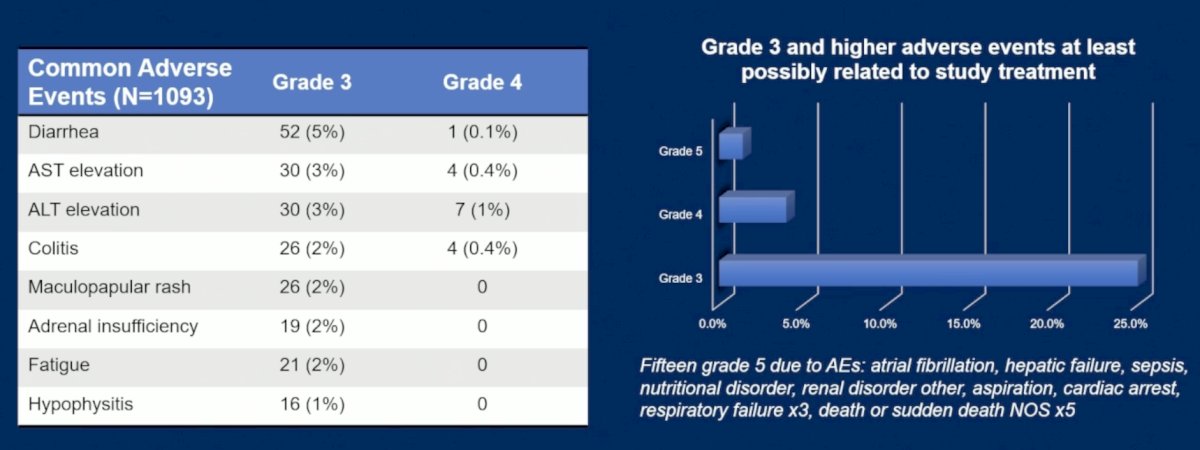
Of 747 (67%) patients registered to Step 2 at 3 months, 9 (1.2%) achieved complete response, and 141 (18.9%) patients were assigned to the progressive disease cohort. There were 597 patients (80%) randomized for the primary overall survival endpoint, notably with fewer patients with poor risk [(21 versus 27%, p = 0.01] and bone metastases [24.5% versus 34.2%, p = 0.0007] compared to Step 1 patients who discontinued treatment. Grade 3/4 treatment-related adverse event in 314/1093 (29%) evaluable patients included diarrhea/colitis (8%), transaminase elevation (3%), rash (2%), adrenal insufficiency (2%), fatigue (2%), and hypophysitis (1%):
Dr. Zhang concluded her presentation discussing results of the step 1 analysis of the phase 3 PDIGREE trial assessing ipilimumab and nivolumab in patients with metastatic clear cell RCC with the following take home points:
- Immunotherapy doublets remain standard of care treatments for patients with metastatic kidney cancer
- Fewer patients with IMDC poor risk and bone metastases were treated in Step 2 of PDIGREE
- PDIGREE may inform immunotherapy sequencing and adaptation before radiographic progression
Presented by: Tian Zhang, MD, MHS, Associate Professor in the Department of Internal Medicine, Associate Director of Clinical Research in the Simmons Comprehensive Cancer Center, Director of Clinical Research within the Division of Hematology and Oncology in the Department of Internal Medicine, UT Southwestern Medical Center, Dallas, TX
Written by: Zachary Klaassen, MD, MSc – Urologic Oncologist, Associate Professor of Urology, Georgia Cancer Center, Wellstar MCG Health, @zklaassen_md on Twitter during the American Society of Clinical Oncology (ASCO) 2025 Annual Meeting, Chicago, IL, Fri, May 30 – Tues, Jun 3, 2025.
Related content: PDIGREE Trial Tests Adaptive Immunotherapy Approach for Metastatic Kidney Cancer - Tian Zhang
References: