

(UroToday.com)The 2025 American Society of Clinical Oncology (ASCO) Annual Meeting held in Chicago, IL between May 30th and June 3rd, 2025, was host to a kidney and bladder cancers poster session. Dr. N Brigida Anna Maiorano presented the first survival outcomes and biomarker results of SURE-01, a phase II trial of neoadjuvant sacituzumab govitecan (SG) monotherapy, followed by radical cystectomy, in patients with muscle-invasive bladder cancer (MIBC).
A standard of care therapy for MIBC is neoadjuvant chemotherapy (NAC) followed by radical cystectomy. However, ~50% of patients are cisplatin-ineligible, and the 5-year survival for radical cystectomy alone is ≤50%.
SG is an antibody-drug conjugate (ADC) composed of an anti-trophoblast cell surface antigen 2 (Trop-2) antibody coupled to SN-38 (a topoisomerase-I inhibitor). SURE-01 (NCT05226117) is an ongoing study testing neoadjuvant SG prior to radical cystectomy. Preliminary results presented at ASCO 2024 demonstrated promising pathologic response rates (36.4%) suggesting efficacy in this setting.1 Herein, Dr. Maiorano presented the survival data and biomarker results.
The study design is illustrated below:

In SURE-01, patients with histologically confirmed urothelial carcinoma (≥50% component) with cT2-4N0M0 disease and either ineligible for or refused neoadjuvant cisplatin-based chemotherapy received four 3-weekly cycles of SG at a dose of 10 mg/Kg on days 1 and 8 and subsequently underwent a radical cystectomy. Prior to surgery, patients underwent a response assessment using a CT scan of the abdomen and chest, an 18FDG-PET/CT, and a bladder MRI. The primary endpoint was ypT0N0 rate. Secondary endpoints included:
- ypT≤1N0 rate
- Event-free survival (EFS)
- Overall survival
- Quality of life outcomes
- Safety
Decipher Bladder (Veracyte, San Diego, CA) was used on primary TURBT tissue for transcriptome-wide analyses. Signatera® was used for ctDNA assessment.
The baseline characteristics of the SURE-01 patient cohort are summarized below (n=42). The median patient age was 71 years. 55% were cisplatin-ineligible and 45% refused cisplatin chemotherapy. 57% of patients had cT3N0 or cT4aN0 disease. 60% had pure urothelial carcinoma, and 40% had urothelial carcinoma with variant histology.

From March 2022 to May 2025, 42 patients were enrolled, and 37 were evaluable for efficacy. The median follow-up was 14.6 months (IQR: 11.2–17.2 months). 24.3% of patients refused radical cystectomy and were assessed with a re-staging TURBT. The ypT0N0-x rate was 32.4%.
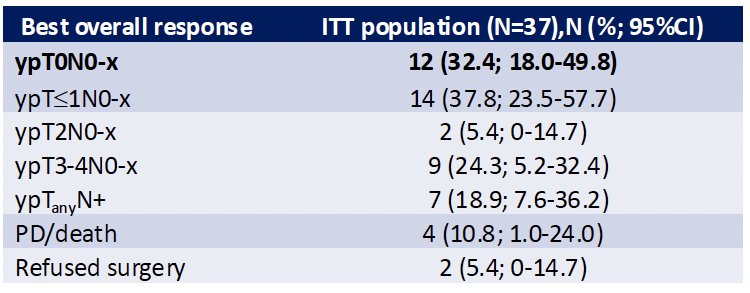
The 12- and 24-months EFS rates were 76% and 66%, respectively. None of the patients with ypT0N0-x disease experienced a qualifying event during follow-up:
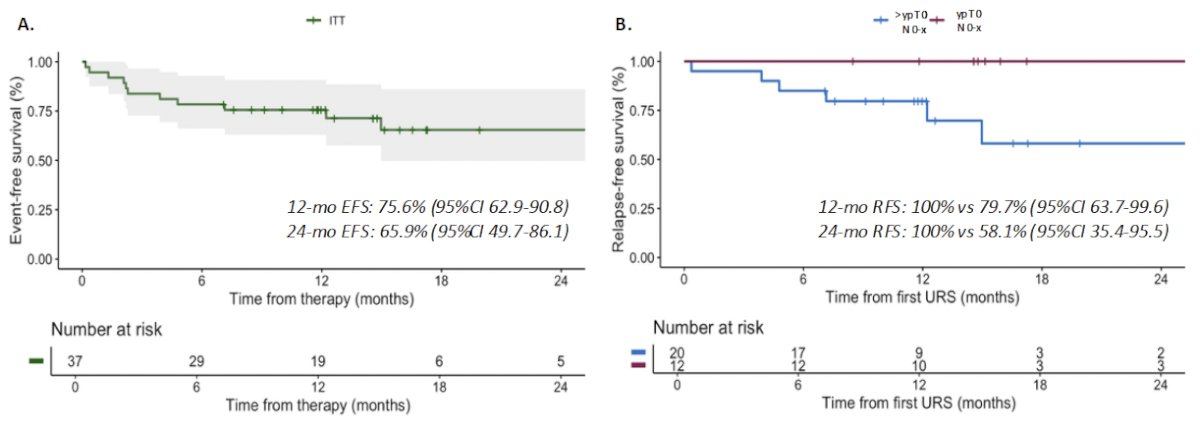
8/10 patients with high-risk disease at radical cystectomy had ctDNA-negative status post-operatively.
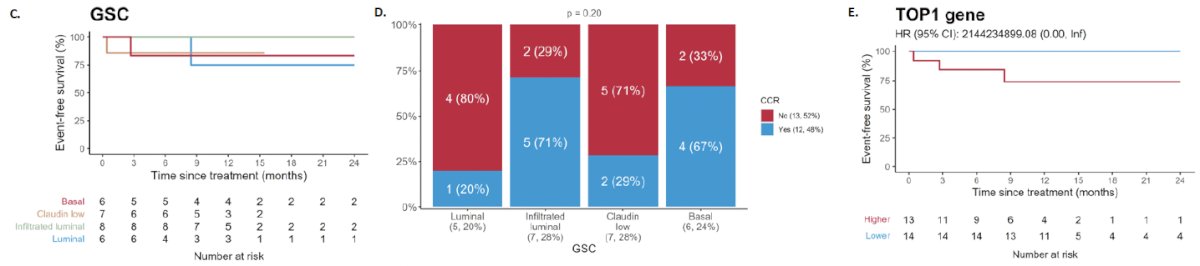
Transcriptome-wide data for 27 patients revealed 12-month recurrence-free survival (RFS) rates of 100% for 8 patients with Infiltrated-Luminal (IL), 86% in 7 patients with Claudin Low, 83% in 6 patients with Basal, and 75% in 6 Luminal cases (log-rank, p=0.24), with consistent associations found for ypT0 response (IL: 71% ypT0 rate).
Lower (< median) TOP1 gene expression (N = 14) was associated with a 100% 12-month RFS rate (log-rank, p=0.05). Trop-2 gene expression was not associated with either the pathologic response rate (p=0.69) or RFS.
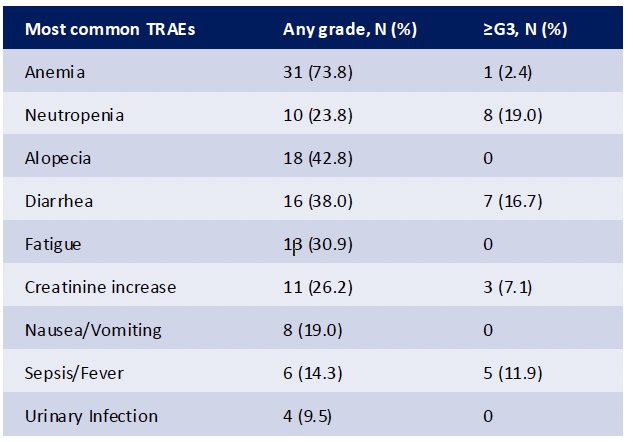
The most common treatment-related adverse events (TRAEs) were anemia (74%), alopecia (43%), and diarrhea (38%). The most common grade ≥3 TRAEs were neutropenia (19%), diarrhea (17%), and sepsis/fever (12%).
Dr. Maiorano concluded that SURE-01 revealed ‘compelling’ survival outcomes. While neither survival estimates nor transcriptome results were overtly associated with pathological response (interim endpoint), molecular subtypes and TOP1 gene expression may be putative biomarkers of SG efficacy.
Presented by: Brigida Anna Maiorano, MD, Consultant, Medical Oncology, IRCCS San Raffaele Hospital, Milan, Italy
Written by: Rashid K. Sayyid, MD, MSc – Robotic Urologic Oncology Fellow at The University of Southern California, @rksayyid on Twitter during the American Society of Clinical Oncology (ASCO) 2025 Annual Meeting, Chicago, IL, Fri, May 30 – Tues, Jun 3, 2025.
References:- Cigliola A, Moschini M, Tateo V, et al. Perioperative sacituzumab govitecan alone or in combination with pembrolizumab for patients with muscle-invasive urothelial bladder cancer: SURE-01/02 interim results. J Clin Oncol. 2024; 42(17_suppl):LBA4517.