

(UroToday.com) The 2025 American Society of Clinical Oncology (ASCO) Annual Meeting held in Chicago, IL between May 30th and June 3rd, 2025, was host to a kidney and bladder cancers poster session. Dr. Elena Sevillano presented the ongoing SASAN-SPARING trial, a phase II study of sasanlimab as bladder-sparing maintenance treatment after neoadjuvant chemotherapy in patients with muscle invasive bladder cancer (MIBC).
MIBC represents a significant clinical challenge due to its aggressive nature and high risk of progression.1 Neoadjuvant cisplatin-based chemotherapy followed by radical cystectomy remains a standard of care therapy for MIBC patients. Bladder preservation strategies are being increasingly explored, aiming to improve quality-of-life outcomes, without compromising oncologic outcomes.2 This study aims to evaluate a bladder-sparing approach using sasanlimab, a PD-1 inhibitor, as maintenance therapy following neoadjuvant chemotherapy in select patients.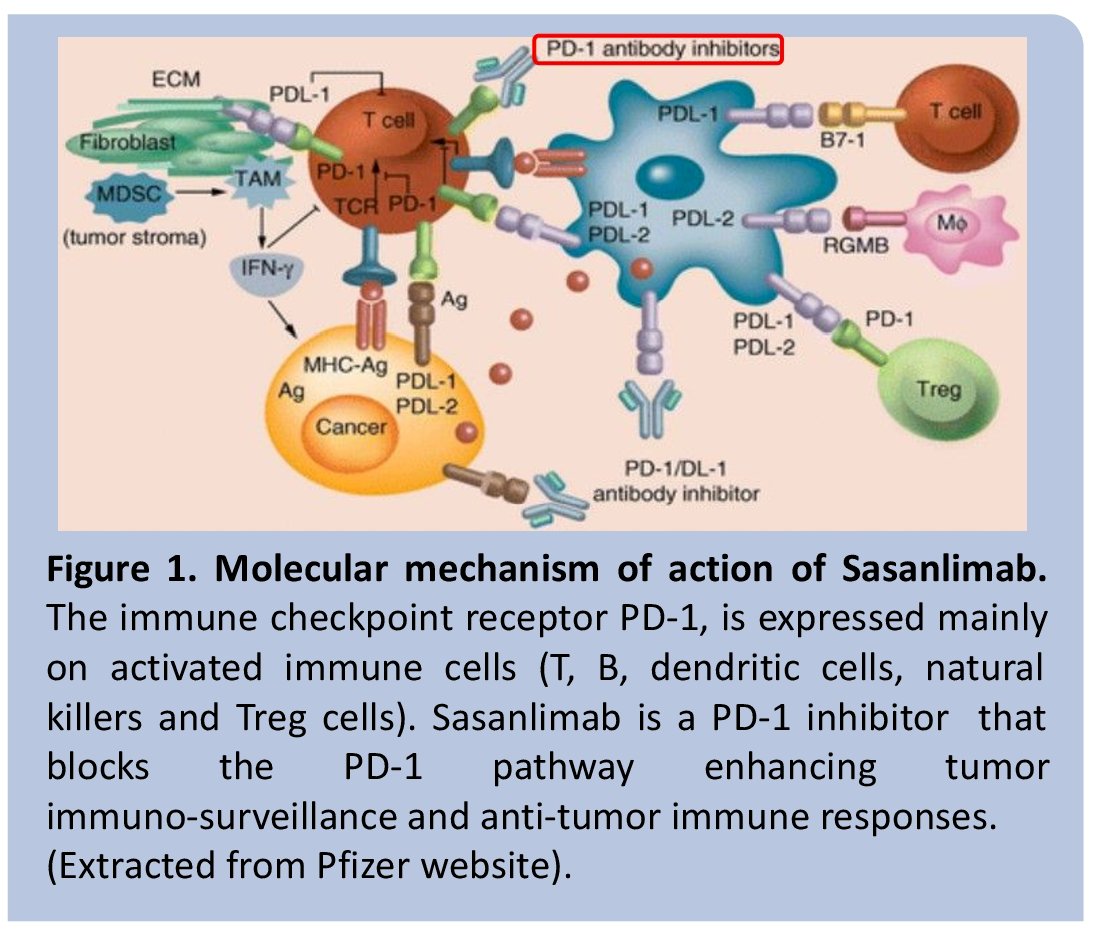
The SASAN-SPARING trial (NCT06623162) is a phase Il, single-arm, multicenter study evaluating the efficacy and safety of maintenance treatment with sasanlimab in MIBC patients planned for a bladder-sparing strategy with neoadjuvant cisplatin-based chemotherapy. Seventy patients with MIBC will receive four cycles of cisplatin at a dose of 70 mg/m2 on day 1 every 3 weeks and gemcitabine at 1000 mg/m2 on days 1 and 8 every 3 weeks, followed by clinical re-staging.
Patients with evidence of a clinical response (cT0/Ta/T1/Tis, negative cytology, and negative imaging [MRI or CT A/P]) will be eligible for bladder preservation with maintenance immunotherapy with sasanlimab 300 mg subcutaneous every 4 weeks for up to 12 cycles. Non-responders (≥cT2) will be recommended for a radical cystectomy.
Dr. Sevillano highlighted that this study introduces an innovative approach to bladder cancer management by integrating urinary tumor DNA (utDNA) and blood-based circulating tumor DNA (ctDNA) monitoring as an additional tool to confirm the presence of a clinical complete response.
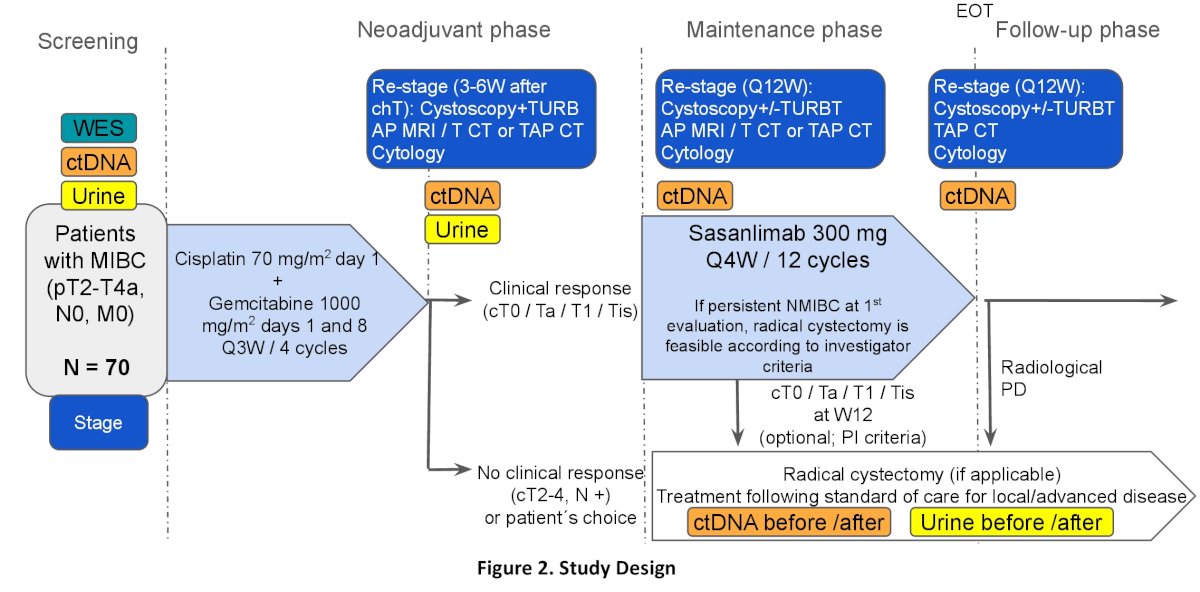
The primary study objective is to evaluate the bladder-intact overall survival (OS) at 12 months after the first dose of sasanlimab, defined as the time from initiation of sasanlimab treatment until death or cystectomy. The secondary objectives are as follows:
- Efficacy
- To evaluate the disease-free survival (DFS), metastasis-free survival (MFS), OS, and the clinical response rate (cT0, cTa, or cT1/Tis) at 12 months
- Safety of sasanlimab maintenance
- Quality of life outcomes
The exploratory objectives are as follows:
- To explore the associations between efficacy endpoints such as bladder-intact OS or DFS in subgroups by baseline ctDNA levels.
- To evaluate the associations between genomic biomarkers from the TURBT samples and benefit from treatment in patients achieving a clinical complete response.
- To evaluate blood ctDNA dynamics during treatment
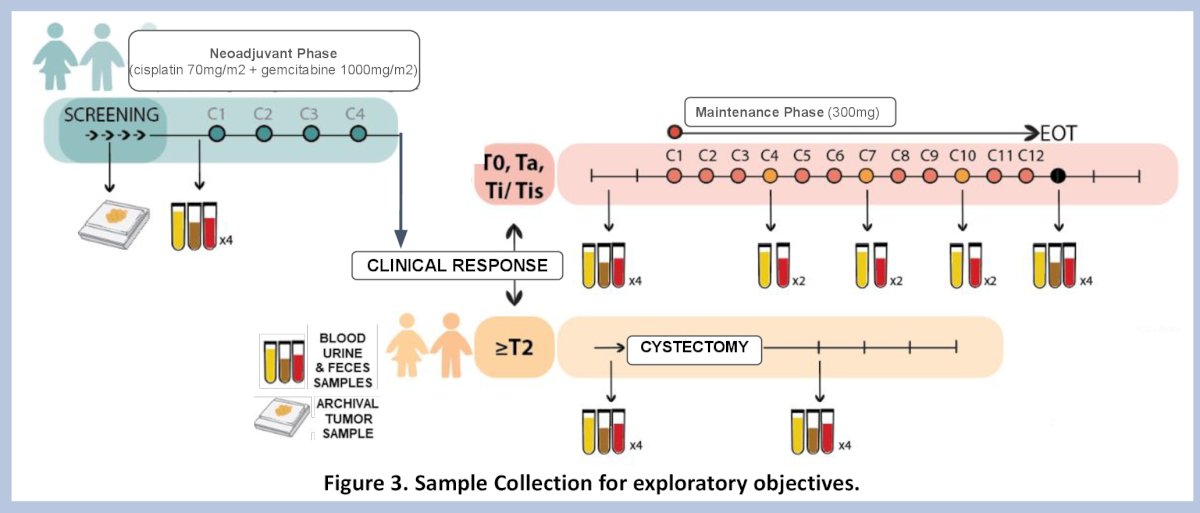
The SASAN-SPARING trial will implement a rigorous, timepoint-specific collection of tumor tissue, blood, urine, and stool to enable an integrative biomarker strategy. The analyses will include whole-exome sequencing, personalized ctDNA tracking in plasma and urine, and gut microbiome profiling. This comprehensive approach aims to monitor molecular response, uncover resistance mechanisms, and correlate biomarkers with clinical outcomes.
Whole-exome sequencing (WES) will be performed on TURBT tumor samples and matched
blood to identify relevant molecular alterations. Personalized ctDNA tracking in plasma and urine will be conducted at multiple timepoints to enable real-time monitoring. Changes in ctDNA levels will be retrospectively correlated with clinical outcomes to assess their prognostic value and treatment efficacy. Stool samples will be analyzed for gut microbiome profiling
This integrative approach aims to validate molecular response as a surrogate for clinical complete response, guide personalized bladder-sparing strategies, and uncover mechanisms of resistance.
The study accrual started in December 2024 and is expected to be completed by December 2025.
Presented by: Elena Sevillano, MD, PhD, Medical Oncologist, Centro Integral Oncológico Clara Campal ( CIOCC) - Hospital Universitario Sanchinarro, Madrid, Spain
Written by: Rashid K. Sayyid, MD, MSc – Robotic Urologic Oncology Fellow at The University of Southern California, @rksayyid on Twitter during the American Society of Clinical Oncology (ASCO) 2025 Annual Meeting, Chicago, IL, Fri, May 30 – Tues, Jun 3, 2025.
Related content: SASAN-SPARING Trial: Bladder-Sparing Approach for Muscle-Invasive Bladder Cancer - Elena Sevillano
- Sung H, Ferlay J, Siegel RL, et al. Global cancer statistics 2020: GLOBOCAN estimates of incidence and mortality worldwide for 36 cancers in 185 countries. CA Cancer J Clin. 2021 May;71(3):209-249.
- Galsky MD, Necchi A, Wang L, et al. Gemcitabine and cisplatin plus nivolumab as organ-sparing treatment for muscle-invasive bladder cancer: a phase 2 trial. Nat Med. 2023 Nov;29(11):3043–3054.