

(UroToday.com) The 2025 ASCO annual meeting featured a care delivery and models of care session and a presentation by Dr. Andrea Necchi discussing MRI radiomics as a predictor of clinical outcomes to neoadjuvant immunotherapy in patients with muscle invasive bladder cancer undergoing radical cystectomy. Muscle invasive bladder cancer is a deadly disease, for which Dr. Necchi and colleagues pioneered the use of neoadjuvant immune checkpoint inhibitors in a clinical trial (PURE-011) testing 3 cycles of neoadjuvant pembrolizumab before radical cystectomy. Currently, there are uncertainties related to the accuracy of cross-sectional imaging (CT or MRI scans) with regard to clinical staging and response assessment of bladder tumors. The objective of this study was to assess the ability of radiomic features extracted from a robust MRI processing pipeline to predict the pathological response to neoadjuvant pembrolizumab.
Patients enrolled had matched pre- and post- immune checkpoint inhibitors MRIs, and tumors were segmented on both T2w images by GU radiologists. The MRI signal intensities were standardized by N4-bias field correction and robust z-scores. IBSI-compatible pyCERR software was used to extract radiomics features:
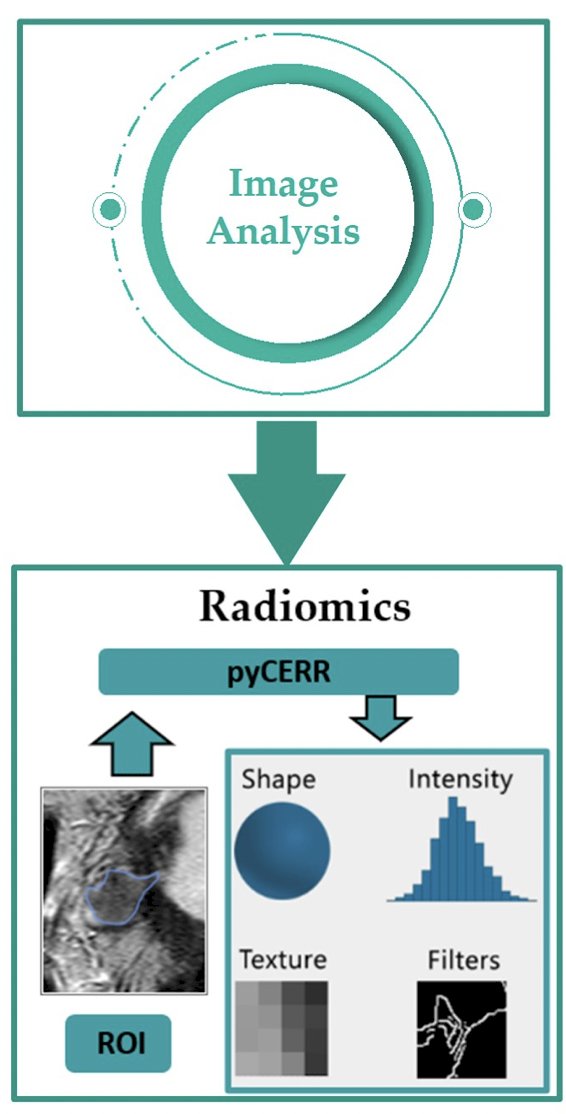
A total of 289 radiomic features, including shape, first-order statistics, and higher-order textures, were analyzed for associations with pathological complete response (pathological complete response at radical cystectomy). An additional association was also investigated for major response groups, i.e., complete response and partial response (partial response, i.e. downstaging to ypT≤1N0) versus no response. The investigators employed Elastic Net, a machine learning technique that blends the strengths of Lasso and Ridge regression and is particularly effective for datasets with many correlated features such as in this study. The endpoint was modeled by training Elastic Net logistic regression models separately for pre- and post-immune checkpoint inhibitor MRI features, as well as clinical T-stage. Models were evaluated on a 30% held-out test set using ROC curves (AUC).
A total of 112 patients with muscle invasive bladder cancer (96 males and 16 females), with median age of 68 years, a clinical stage T2N0 (n = 51; 46%) or T3-4N0 (n = 61; 54%), who were enrolled in the PURE-01 study, were analyzed:

For both pathological complete response and pathologic major response endpoints, the best performing models included two post-immune checkpoint inhibitor MRI features: shape (flatness) and a texture feature from Gray Level Co-occurrence Matrix (GLCM sum average). For pathological complete response, final models fit with selected features resulting in a test AUC of 0.86 (95% CI 0.72 - 1.00). For pathological major response, final models fit with selected features resulting in a test AUC of 0.92 (95% CI 0.81 - 1.00):

Models including pre-immune checkpoint inhibitor and delta (post-pre/pre) MRI features performed worse than post-immune checkpoint inhibitor alone. The limitations of this study include the lack of both external validation and accuracy for the prediction of pathologic complete response.
Dr. Necchi concluded his presentation discussing MRI radiomics as a predictor of clinical outcomes to neoadjuvant immunotherapy in patients with muscle invasive bladder cancer undergoing radical cystectomy with the following take home points:
- These results could be instrumental for improving the way we can predict the pathological response in patients with muscle invasive bladder cancer
- This is one of the first machine learning models using MRI radiomics to predict the pathological response to neoadjuvant immunotherapy in muscle invasive bladder cancer
Presented by: Andrea Necchi, MD, IRCCS San Raffaele Hospital, Vita-Salute San Raffaele University, Milan, Italy
Written by: Zachary Klaassen, MD, MSc – Urologic Oncologist, Associate Professor of Urology, Georgia Cancer Center, Wellstar MCG Health, @zklaassen_md on Twitter during the American Society of Clinical Oncology (ASCO) 2025 Annual Meeting, Chicago, IL, Fri, May 30 – Tues, Jun 3, 2025.
Related content: MRI Radiomics Predicts Bladder Cancer Response to Pembrolizumab in PURE-01 Study - Andrea Necchi
References:
- Necchi A, Anichini A, Raggi D, et al. Pembrolizumab as Neoadjuvant Therapy Before Radical Cystectomy in Patients with Muscle-Invasive Urothelial Bladder Carcinoma (PURE-01): An Open-Label, Single-Arm, Phase II Study. J Clin Oncol 2018 Dec 1;36(34):3353-3360.