

(UroToday.com) The 2025 American Society of Clinical Oncology (ASCO) Annual Meeting held in Chicago, IL, was host to a kidney and bladder cancers poster session. Dr. Simon Crabb presented AURORA, a single arm, multicentre, phase II trial of atezolizumab immunotherapy for advanced squamous cell carcinoma of the bladder and urinary tract.
Urinary tract squamous cell carcinoma (SCC) is a rare disease, accounting for 2.1 to 6.7% of urinary tract cancers. These patients typically have more advanced disease stage at diagnosis, compared to patients with urothelial carcinoma, and appear to have worse prognoses. To date, there are limited systemic treatment options for patients with advanced urinary tract SCC, and such patients have been commonly excluded from clinical trials of urothelial carcinoma.
Preliminary data from urinary tract SCC patient tumour samples suggest high PD-L1 expression and tumour infiltrating lymphocytes in a proportion of cases. Atezolizumab is an anti-PD-L1 immune checkpoint inhibitor approved for select advanced urothelial carcinoma patients.1,2 AURORA is a single arm, multicenter, phase II clinical trial evaluating whether atezolizumab is active, tolerable, and safe in patients with advanced urinary tract SCCs. Herein, Dr. Crabb presented the stage 1 results from AURORA.

This trial included patients meeting the following eligibility criteria:
- Progressive, measurable, histologically confirmed urinary tract SCC
- Mixed histology permitted if SCC predominant and there was no urothelial carcinoma component
- ≤1 prior line of systemic chemotherapy in the advanced disease setting
- No prior immunotherapy
- Not planned for treatment with curative intent
Eligible participants received atezolizumab 1,680 mg intravenously every 28 days for up to 1 year (13 doses). Patients were treated until evidence of disease progression, unacceptable adverse events, or patient/physician choice. Patients underwent 12 weekly assessments, including response assessment, until disease progression. The primary endpoint was best objective response rate (ORR). Key secondary endpoints included:
- Progression-free survival (PFS)
- Overall survival (OS)
- Duration of response
- Safety profile
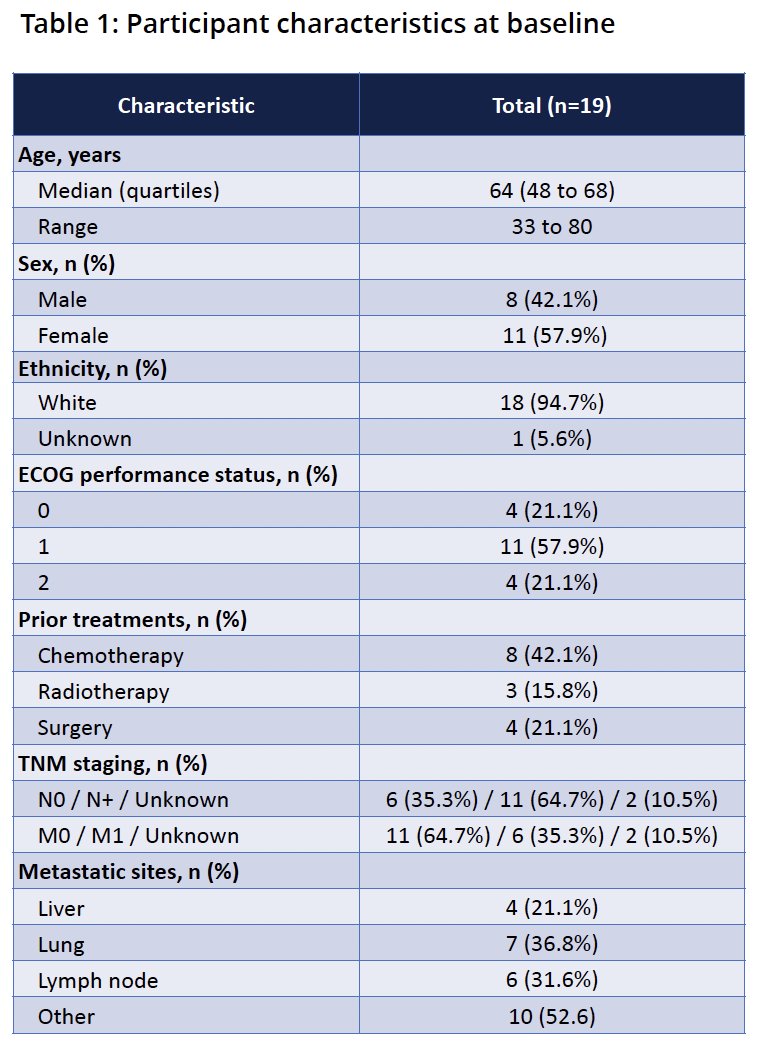
The patient characteristics are summarized below. The median patient age was 64 years. Of the 19 patients, 11 (65%) had N+ disease, and 6 (35%) had M1 disease. The most common sites of metastases were the lungs (37%), lymph nodes (32%), and liver (21%).
The ORR was 16%, with 3 partial responses observed (no complete responses). Three further patients (16%) achieved a best response of stable disease. These results led the Independent Data Monitoring Committee to recommend suspension of further enrolment.
At a median follow-up of 10.1 months, the median PFS was 3 months, and the median OS was 5.2 months. The duration of response was 8.4 months in one patient and ongoing in the other two with a partial response.

A median of 3 atezolizumab cycles was administered. One patient remained on study treatment at the time of data cut-off. The reasons for treatment discontinuation are as follows:
- Cancer progression: 12 (63%)
- Clinical withdrawal: 3 (16%)
- Unacceptable toxicity: 1 (5%)
- Patient withdrawal: 1 (5%)
- Other reasons: 1 (5%)
Overall, atezolizumab was well tolerated with no new safety signals observed.
Dr. Crabb concluded as follows:
- The objective response rate and other efficacy endpoints did not meet the protocol defined thresholds for activity
- Further evaluation of atezolizumab immunotherapy, as monotherapy, for unselected patients with urinary tract SCC, is not supported by the results of this trial
- Translational endpoints are under investigation in an attempt to further elucidate future options for therapeutic development in this ‘orphan’ disease with a substantial unmet clinical need
Presented by: Simon J. Crabb, PhD, MBBS, BSc, Southampton Clinical Trials Unit, University of Southampton and University Hospital Southampton NHS Foundation Trust, Southampton, UK
Written by: Rashid K. Sayyid, MD, MSc – Robotic Urologic Oncology Fellow at The University of Southern California, @rksayyid on Twitter during the American Society of Clinical Oncology (ASCO) 2025 Annual Meeting, Chicago, IL, Fri, May 30 – Tues, Jun 3, 2025.
References:
- Rosenberg JE, Hoffman-Censits J, Powles T, et al. Atezolizumab in patients with locally advanced and metastatic urothelial carcinoma who have progressed following treatment with platinum-based chemotherapy: A single-arm, multicentre, phase 2 trial. Lancet 2016;387(10031):1909-1920.
- Balar AV, Galsky MD, Rosenberg JE, et al. Atezolizumab as first-line treatment in cisplatin-ineligible patients with locally advanced and metastatic urothelial carcinoma: A single-arm, multicentre, phase 2 trial. Lancet 2017;389(10064):67-76.