

(UroToday.com) The 2025 American Society of Clinical Oncology (ASCO) Annual Meeting held in Chicago, IL between May 30th and June 3rd, 2025, was host to a kidney and bladder cancers poster session. Dr. Joaquim Bellmunt presented SSANTROP (APRO07-2022), a phase II prospective, open-label, multi-center, single-arm study of sasanlimab plus sacituzumab govitecan (SG) in BCG-unresponsive non-muscle invasive bladder cancer (NMIBC) patients.
Radical cystectomy (RC) is considered the standard of care treatment for high-risk, BCG unresponsive NMIBC. Pembrolizumab was approved by the FDA in this setting based on the results of the KEYNOTE-057 trial (3 months complete response rate of 41%)1 and offers a non-surgical option for patients who decline or are ineligible for RC. Nadofaregene firadenovec and Nogapendekin alfa inbakicept have been recently approved in this setting.2,3
Sacituzumab govitecan demonstrated encouraging efficacy and safety in metastatic urothelial cancer (mUC) in the TROPHY-U-01 trial.4 Combining antibody-drug conjugates (ADCs) with immunotherapy has shown promising results in mUC. The study investigators hypothesized that the combination of sasanlimab, a subcutaneous anti-PD1 agent, and sacituzumab govitecan would improve the complete response rate compared to pembrolizumab in BCG-unresponsive NMIBC patients who refuse or are ineligible for RC.
SSANTROP (APRO07-2022) is a phase II, open-label, multicenter trial of BCG-unresponsive NMIBC patients (HG Ta, T1, and/or CIS) who refused or are ineligible for RC. Eligible patients received sasanlimab (5 cycles subcutaneously every 28 days) + sacituzumab govitecan (7 cycles intravenously every 21 days), followed by maintenance sasanlimab for 84 weeks. The primary endpoint was the 3-months complete response rate of high-risk disease, with secondary endpoints of 6-, 12-, 18-, and 24-months complete response rates, duration of response, progression-free and overall survivals, and safety.

The planned sample size of 116 patients was calculated to demonstrate a 53% complete response rate for the combination, based on pembrolizumab’s historical control of 41% (one-sided alpha 0.05, power 82%). The study design was modified to include a total of 40 patients.
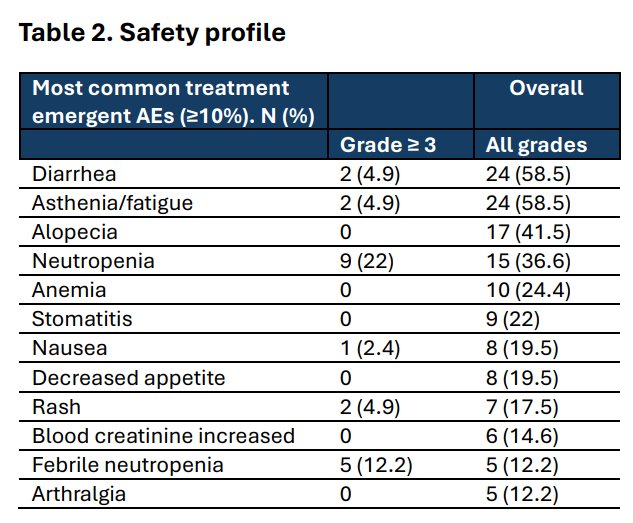
As of January 21, 2025, 59 patients were screened of whom 41 initiated treatment and were included in the safety analysis.
From a safety standpoint, the regimen was well-tolerated. Twenty-four patients (58.5%) experienced adverse events (AEs), but grade ≥ 3 AEs were uncommon. The most common grade ≥ 3 AEs were neutropenia (22%) and febrile neutropenia (12.2%), which were mainly related to sacituzumab govitecan. G-CSF prophylaxis was implemented on 9/2024, and three patients received it as primary prophylaxis.
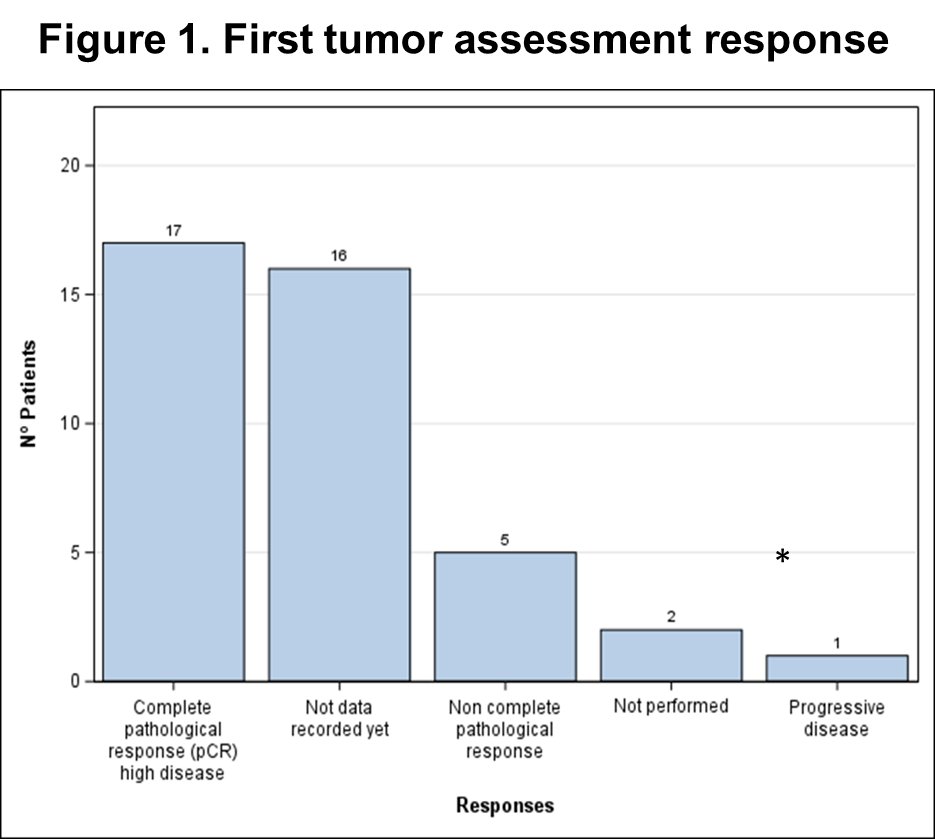
As of December 2024, 3-month assessments were available for 23 patients. Two patients progressed prior to evaluation, resulting in a total of 25 evaluable patients. A 3-months complete response was observed in 17/25 (68%) evaluable patients. One patient experienced disease progression by 3 months follow-up.
Dr. Bellmunt concluded as follows:
- This trial is the first to evaluate the combination of sasanlimab plus sacituzumab govitecan in high-risk, BCG-unresponsive NMIBC patients with a preliminary 3-months complete response rate of 68%
- The safety analysis identified no unexpected concerns, with grade ≥ 3 AEs mainly including neutropenia (9 patients, 22%) and febrile neutropenia (5 patients, 12.2%). No grade 5 adverse events were observed. The recommendation for use of G-CSF was added 4 months prior to closing study accrual.
Presented by: Joaquim Bellmunt, MD, PhD, Associate Professor, Director of the Bladder Cancer Center, Dana Farber Cancer Institute, Harvard Medical School, Boston, MA
Written by: Rashid K. Sayyid, MD, MSc – Robotic Urologic Oncology Fellow at The University of Southern California, @rksayyid on Twitter during the American Society of Clinical Oncology (ASCO) 2025 Annual Meeting, Chicago, IL, Fri, May 30 – Tues, Jun 3, 2025.
Related content: SSANTROP Trial: Evaluating Sasanlimab Plus Sacituzumab Govitecan in BCG-Unresponsive Non-Muscle Invasive Bladder Cancer - Joaquim Bellmunt
- Balar AV, Kamat AM, Kulkarni GS, et al. Pembrolizumab monotherapy for the treatment of high-risk non-muscle-invasive bladder cancer unresponsive to BCG (KEYNOTE-057): An open-label, single-arm, multicenter, phase 2 study. Lancet Oncol. 2021; 22(7): 919-930.
- Chamie K, Chang SS, Kramolowsky E, et al. IL-15 Superagonist NAI in BCG-Unresponsive Non-Muscle-Invasive Bladder Cancer. NEJM Evid. 2022; 2(1)
- Boorjian SA, Alemozaffar M, Konety BR, et al. Intravesical nadofaragene firadenovec gene therapy for BCG-unresponsive non-muscle-invasive bladder cancer: A single-arm, open-label, repeat-dose clinical trial. Lancet Oncol. 2020: S1470-2045(20)30540-4.
- Tagawa ST, Balar AV, Petrylak DP, et al. Metastatic urothelial carcinoma progressing after platinum-based chemotherapy and checkpoint inhibitors. J Clin Oncol. 2021; 39(22): 2474-2485.