

(UroToday.com) The 2023 American Society of Clinical Oncology (ASCO) annual meeting held in Chicago, IL between June 2nd and June 6th was host to a prostate, testicular, and penile cancers poster session. Dr. Rahul Aggarwal presented the results of an exploratory analysis of PRESTO evaluating the “depth” of PSA nadir and its association with subsequent PSA progression-free survival in patients with high-risk, biochemically relapsed prostate cancer.
PRESTO is a randomized phase III, open-label trial in patients with biochemically relapsed prostate cancer and PSA doubling time ≤ 9 months, without distant metastases on conventional imaging (NCT03009981). Patients were randomized 1:1:1 to receive a finite 52-week treatment course with ADT, ADT + apalutamide, or ADT + apalutamide + abiraterone acetate plus prednisone, stratified by PSA doubling time (< 3 vs 3–9 months).
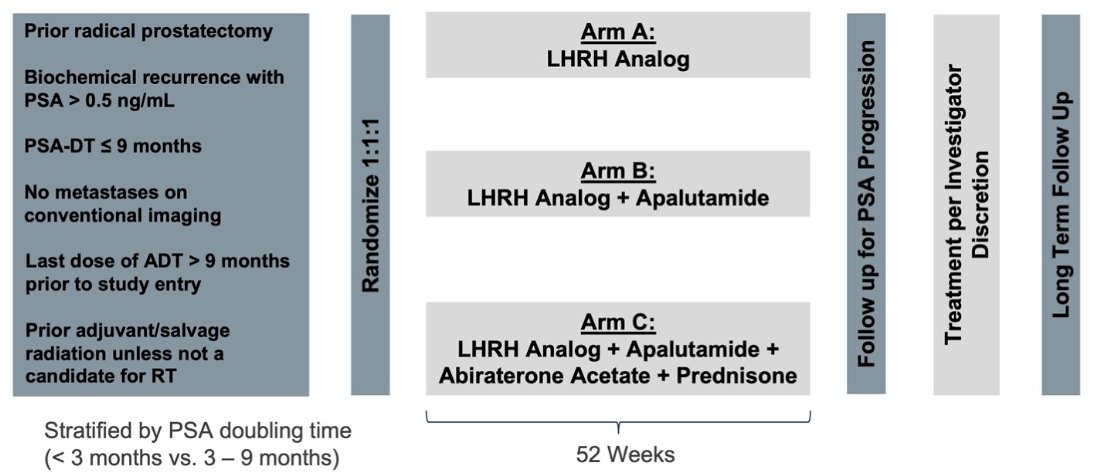
At the first planned interim analysis presented at ESMO 2022 (median follow-up 21.5 months), both experimental arms significantly prolonged biochemical progression-free survival compared to the control arm: median 24.9 months for ADT + apalutamide versus 20.3 months for ADT (HR: 0.52, 95% CI: 0.35–0.77) and a median of 26 months for ADT + apalutamide + abiraterone acetate plus prednisone versus 20 months for ADT (HR: 0.48, 95% CI: 0.32 – 0.71).
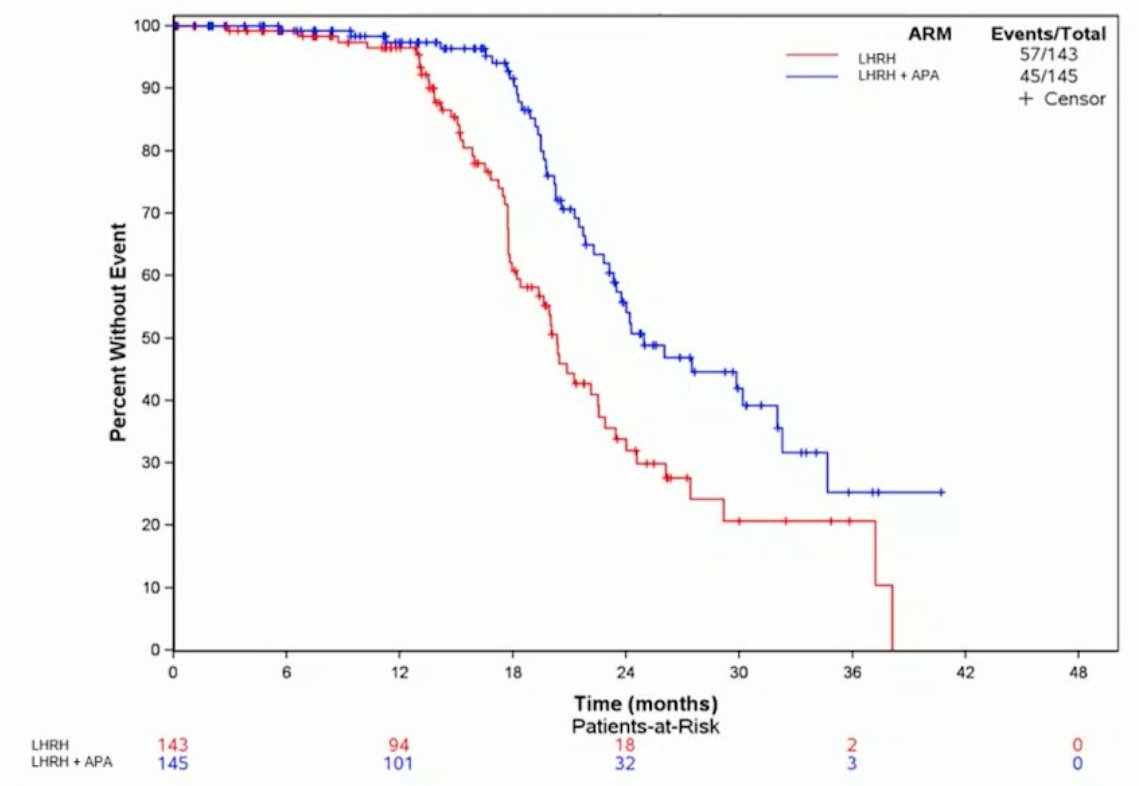
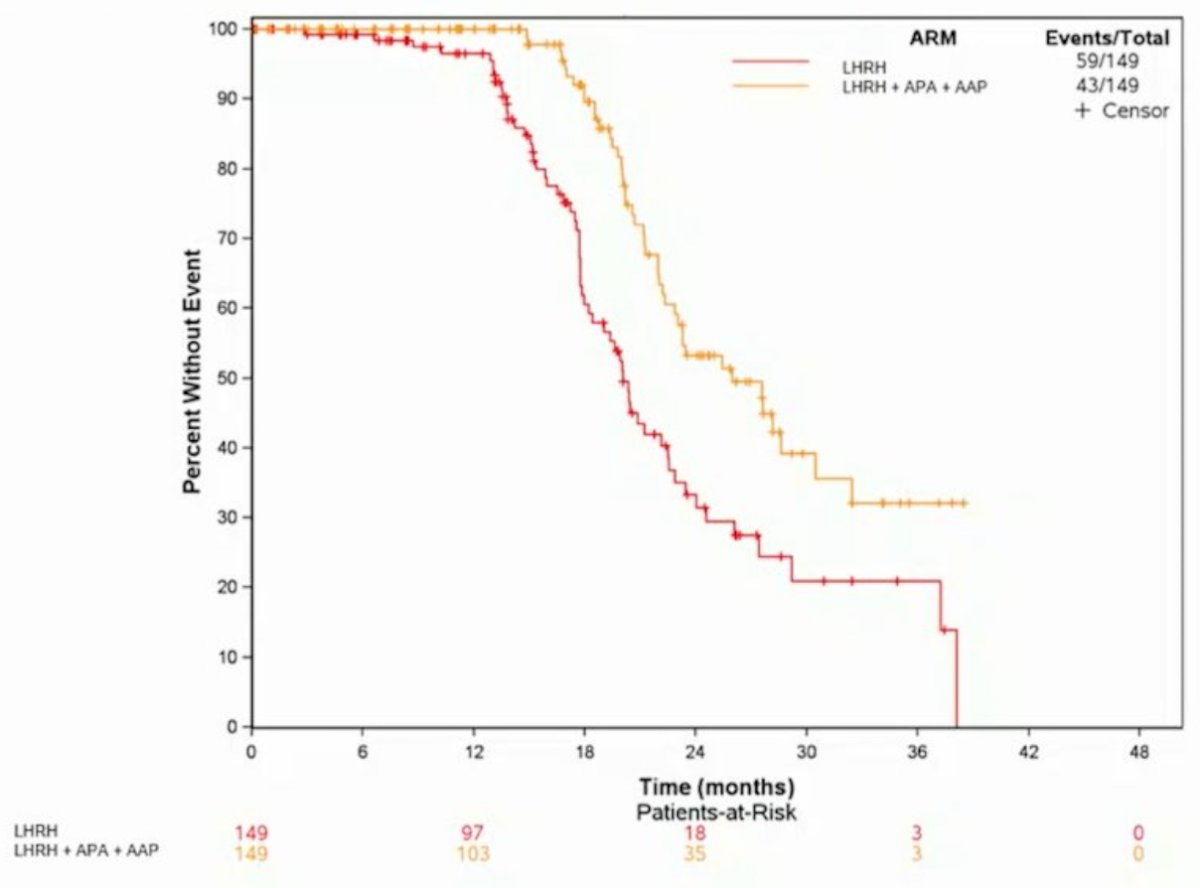
In this exploratory analysis of the PRESTO trial, the investigators evaluated the association of PSA nadir within 3 months of treatment initiation with subsequent PSA PFS. This analysis included 504 patients randomized to ADT alone (n=167), ADT + apalutamide (n=168), or ADT + apalutamide + abiraterone (n=169). 463/504 patients were evaluable for PSA nadir at 3 months. Across the three treatment arms, PSA nadirs were attained as follows:
- <0.1 ng/mL: 86.3%
- 0.1 – 0.2 ng/mL: 4.4%
- ≥ 0.2 ng/mL: 9.3%
A PSA nadir of <0.2 ng/ml within 3 months of treatment initiation was observed in:
- ADT: 80%
- ADT + apalutamide: 97%
- ADT + apalutamide + abiraterone: 95%
The median time to PSA nadir was 2 months (IQR: 1.1 – 4.8 months). The association between time to PSA nadir and subsequent PSA PFS was -0.30 (standard error = 0.03, Kendall’s tau modified for bivariate censoring). Failure to reach a PSA nadir < 0.2 ng/mL within the first three months of treatment was associated with a significantly shorter PSA PFS compared to patients with a PSA nadir ≤ 0.1 ng/mL (median PSA PFS of 13.9 vs. 22.8 months from 3 months post-treatment initiation; HR: 5.60, 95% CI: 3.58 – 8.75, p < 0.0001). There was also a significant difference in PSA PFS for those with a three-month PSA nadir between 0.1 – 0.2 versus ≤ 0.1 ng/mL (median PSA PFS 17.4 versus 22.8 months, HR: 2.63, 95:CI: 1.49 – 4.63, p=0.0008).
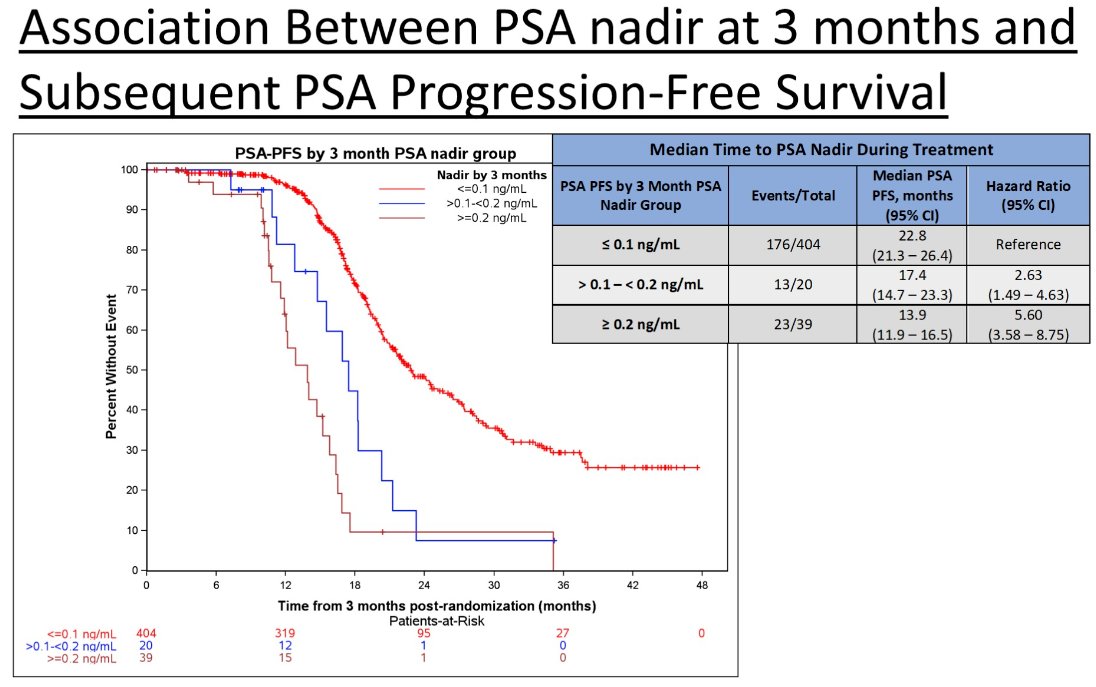
Dr. Aggarwal concluded that failure to reach a PSA nadir less than 0.1 ng/mL within three months of ADT initiation in biochemically recurrent prostate cancer is associated with shorter time to subsequent progression following treatment discontinuation. Follow-up is ongoing to integrate genomic profiling of primary prostate cancer tissues and whole blood RNA in patients with suboptimal PSA nadir to identify potential markers of relative androgen pathway inhibitor resistance.
Presented by: Rahul Raj Aggarwal, MD, Associate Professor, Department of Medicine, University of California, San Francisco, CA
Written by: Rashid Sayyid, MD, MSc – Society of Urologic Oncology (SUO) Clinical Fellow at The University of Toronto, @rksayyid on Twitter during the 2023 American Society of Clinical Oncology (ASCO) Annual Meeting, Chicago, IL, Fri, June 2 – Tues, June 6, 2023.