

(UroToday.com) The 2025 APCCC Diagnostics annual meeting featured a session on how to monitor metastatic prostate cancer and a presentation by Dr. Nina Tunariu discussing monitoring with whole body MRI. Dr. Tunariu started her presentation by highlighting that whole body MRI allows assessment of lesion cellularity, fat content, and whole body anatomy (including the spine and brain) – all in 45 minutes:

Diffusion weighted MRI is sensitive to random water diffusion that is impeded by cellular architecture and thus provides a measure of tissue cellularity. Work from Dr. Tunariu’s group assessed 43 patients with DWI and rFF images, calculated from 2-point T1w Dixon MRI: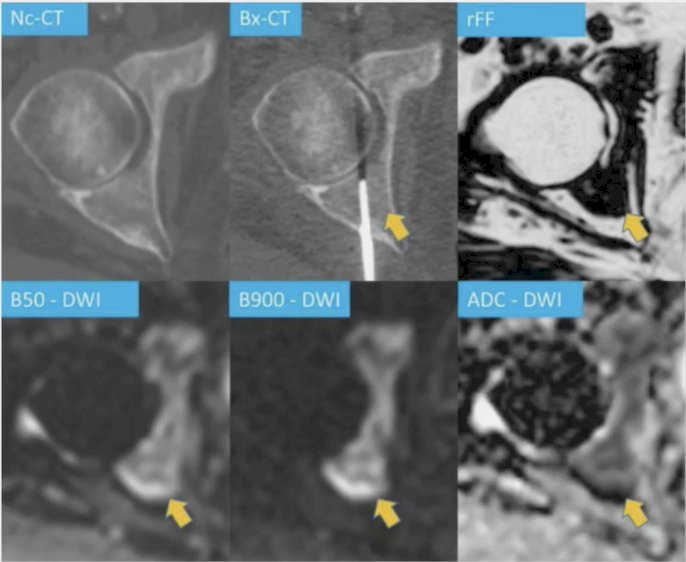
They found that the mpBMRI combination of high DWI signal, mean ADC < 1100 um2/s and mean rFF < 20% identified tumor positive biopsies with 82% sensitivity, 80% specificity, and a positive predictive value of 93% (p = 0.001). Additionally, NGS feasibility had a sensitivity of 91%, specificity of 78%, and a positive predictive value of 91% (p < 0.001). Additional work from Dr. Tunariu’s group assessing bone only MET-RADS-P and PCWG3 showed reader agreement in 44.9% with 55.6% of patients progressing on whole body MRI:
According to Dr. Tunariu, there are several outstanding scenarios and questions that remain to be answered for monitoring treatment with whole body MRI:
- An increase in number of previously occult osteoblastic bone metastases versus improvement in the SUV and DWI parameters
- What is the meaning of PSMA PET and whole body MRI heterogeneous response?

Dr. Tunariu provided the following example of an increase in ADC, but clear inter-tumoral response heterogeneity:
Dr. Tunariu concluded her presentation discussing monitoring with whole body MRI with the following take-home points:
- Monitoring and assessing imaging response with whole body MRI:
- No confounding of a flare
- No real risk of biomarker negative disease
- Reduced specificity for sub-centimeter nodes
- Reduced sensitivity for sub-centimeter lung metastases
- Detecting complications: early, before renal failure and skeletal related events
- Treatment choice and drug development:
Presented by: Nina Tunariu, FRCR, MRCP, MDRes, MBBS, Division of Radiotherapy and Imaging, The Institute of Cancer Research, Sutton, United Kingdom
Written by: Zachary Klaassen, MD, MSc – Urologic Oncologist, Associate Professor of Urology, Georgia Cancer Center, Wellstar MCG Health, @zklaassen_md on Twitter during the Advanced Prostate Cancer Consensus Conference (APCCC) Diagnostics 2025 Annual Meeting, Virtual and Lugano, Switzerland, Thurs, Feb 27 – Fri, Feb 28, 2025.