

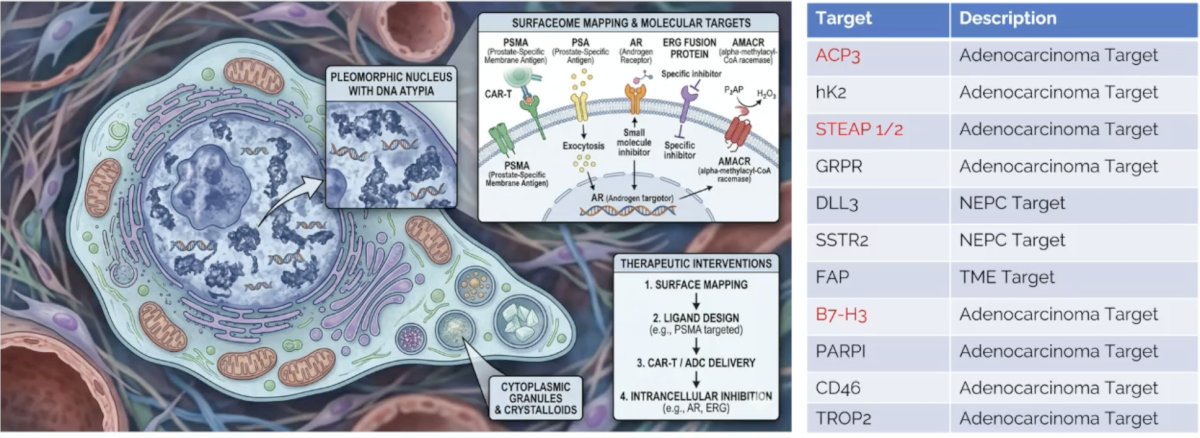
(UroToday.com) The 2026 Advanced Prostate Cancer Consensus Conference (APCCC) meeting featured a radioligand and radionuclide therapy in advanced prostate cancer session and a presentation by Dr. Ken Herrmann discussing new theranostic targets approaching near-term clinical implementation. Based on the mapping of the prostate cancer cell, there are many new targets for imaging and therapeutics beyond PSMA:
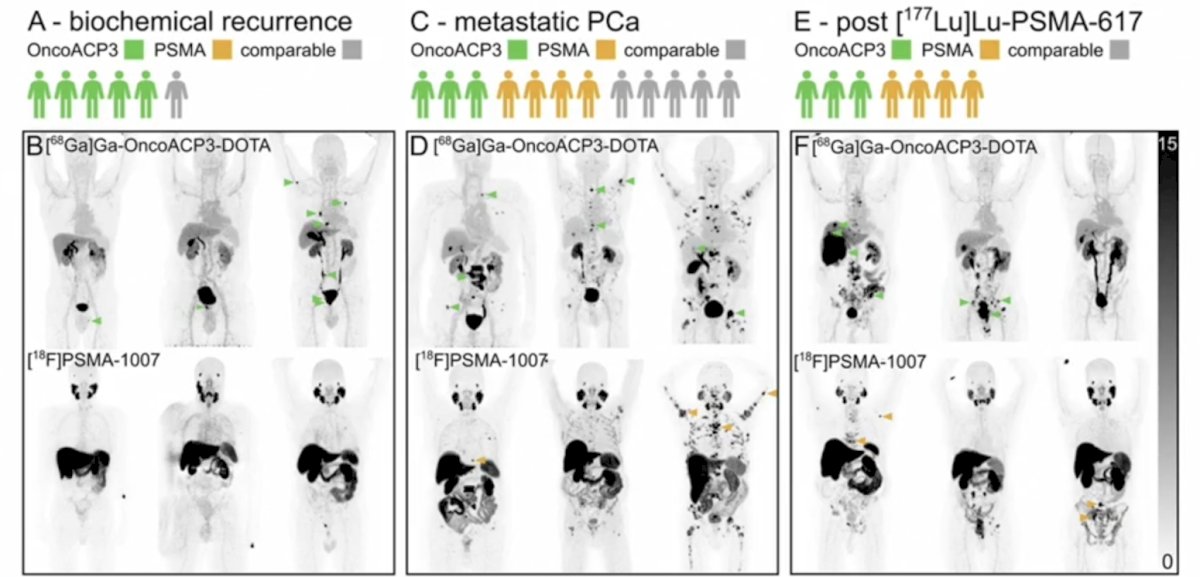
The first new target discussed by Dr. Herrmann was ACP, also known as acid phosphatase 3 or prostatic acid phosphatase. This is an enzyme produced by the prostate, but also a membrane-bound variant known as transmembrane PAP. Importantly, there is near universal expression (>95%) among prostate tumors. In late 2025, Backhaus et al.1 reported the first translational and first in human PET targeting prostatic acid phosphatase using 68Ga-OncoACP3-DOTA. This study analyzed and matched 68Ga-OncoACP3-DOTA and 18F-PSMA-1007 PET scans in a cohort of 25 patients with prostate cancer, comparing the biodistribution and tumor uptake of the two tracers. 68Ga-OncoACP3-DOTA showed low background uptake, including in the salivary glands and kidneys, with a significant difference from the high 18F-PSMA-1007 PET uptake in these organs (p < 0.002). Overall, SUVmax in localized or metastatic prostate cancer did not significantly differ between the two tracers. Better 68Ga-OncoACP3-DOTA performance was observed in 11 of 25 matched scan pairs, and better 18F-PSMA-1007 PET performance was noted in 8 of 25 matched pairs:
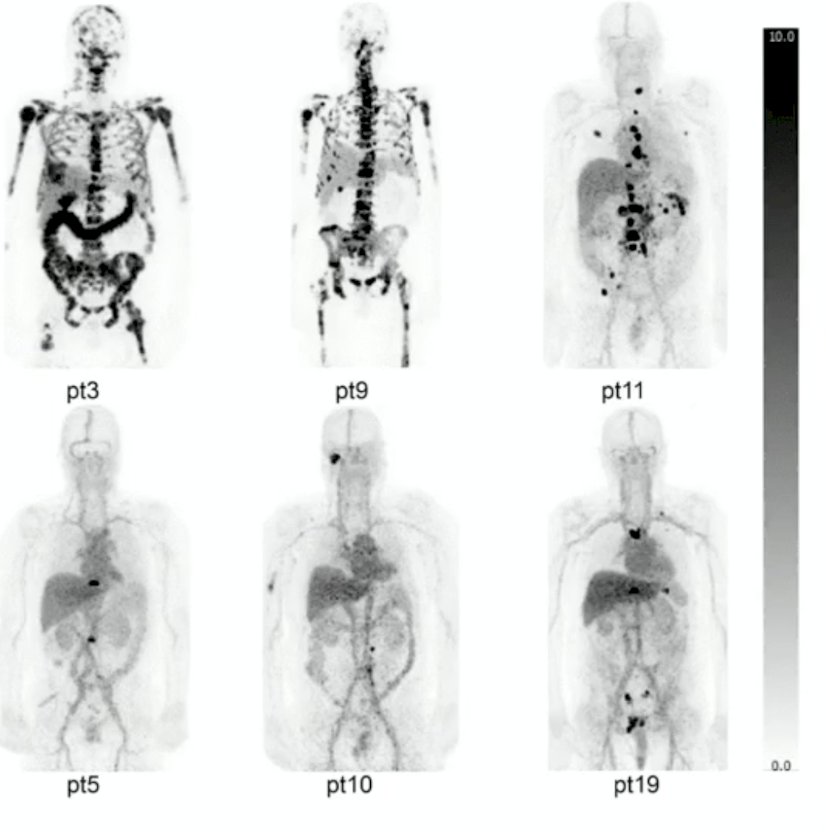
The second target discussed by Dr. Herrmann was STEAP1, a six transmembrane antigen of prostate 1, a membrane bound target sitting on the cell surface. STEAP1 is believed to act as an ion channel or transporter helping cell to cell communication, and is currently being explored for BiTEs (xaluritamig), antibody drug conjugate (ABBV-969, ADRX-0405), and radioligand therapies. STEAP1 has near universal expression in prostate cancer and is virtually absent in healthy tissue, especially salivary glands and kidneys:
The third target is STEAP2, a six transmembrane antigen of prostate 2, a metalloreductase enzyme (like STEAP1) located on the plasma membrane. STEAP 2 promotes iron and copper uptake in order to facilitate tumor growth, and knocking it down results in increased apoptosis. Currently, STEAP2 is being explored for CAR-T, antibody drug conjugate, T-cell engager, and radioligand therapy. STEAP2 is also currently being evaluated in a phase I study of [225Ac]-AZD2284 in patients with mCRPC.
The fourth target is B7-H3, also known as CD276, which is an immune checkpoint protein (a direct cousin of PD-L1) that drives tumor aggressiveness. There are two isoforms that exist (2lg and 4lg), with the long isoform predominant and highly expressed on the tumor surface. B7-H3 is currently being explored for antibody drug conjugates (MGC018, DC-1311/BNT324), radioligand therapy, and CAR-T. There is near universal, stable expression of B7-H3 in prostate cancer (>90% being mCRPC), with minimal healthy tissue present. There are at least 3 radioligand therapy programs currently studying B7-H3.
Dr. Herrmann concluded his presentation discussing new theranostic targets approaching near term clinical implementation with the following take-home points:
- There are no new “beyond PSMA radioligand therapy” targets ready for near time implementation
- There is a long list of exciting new targets
- Dr. Herrmann’s personal favorites are ACP3, STEAP1/2, and B7-H3
- By APCCC 2028, there will be new exciting data to discuss
Presented by: Ken Herrmann, MD, University Hospital Essen, Essen, Germany
Written by: Zachary Klaassen, MD, MSc – Urologic Oncologist, Associate Professor of Urology, Georgia Cancer Center, Wellstar MCG Health, @zklaassen_md on Twitter during the 2026 Advanced Prostate Cancer Consensus Conference (APCCC), Lugano, Switzerland, Thurs, April 30 – Sat, May 2, 2026.
Related content: Three Priority Targets Beyond PSMA for Prostate Cancer Radioligand Therapy - Ken Herrmann
References:
- Backhaus P, Cazzamalli S, Oehler O, et al. Translational and first-in-human positron emission tomography targeting prostatic acid phosphatase in prostate cancer using the ligand [68Ga]Ga-OncoACP3-DOTA. Eur Urol. 2026 Apr;89(4):305-310.