

(UroToday.com) The 2026 Advanced Prostate Cancer Consensus Conference (APCCC) meeting featured a management of metastatic CRCP (mCRPC) session and a presentation by Dr. Susan Halabi discussing the statistical view of the three trials assessing an androgen receptor pathway inhibitor + PARP inhibitor. There are three key phase III androgen receptor pathway inhibitor + PARP inhibitor trials in the first line mCRPC setting: MAGNITUDE,1 TALAPRO-2,2 and PROpel.3
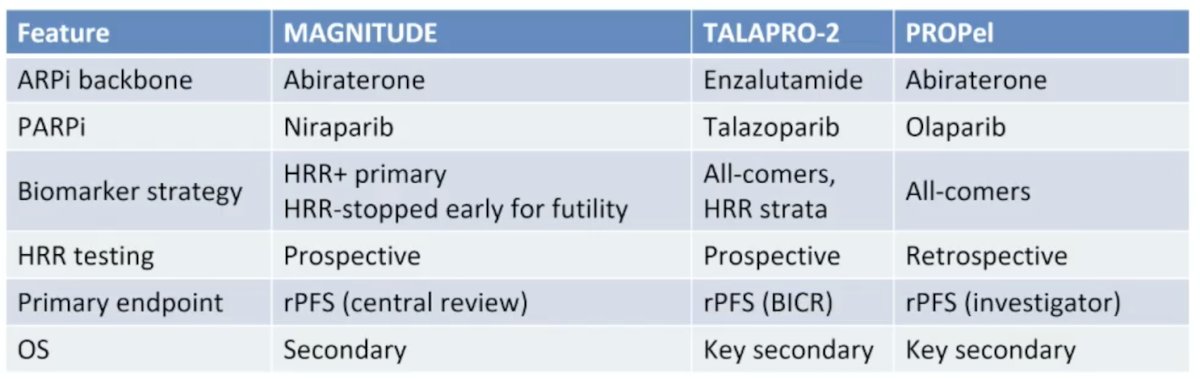
PARP inhibitors have a strong biological rationale in HRR-mutated prostate cancer. MAGNITUDE was designed as a biomarker selected trial, with enrolment in HRR negative patients stopped for futility. PROpel and TALAPRO-2 were designed for all comers, and because these are different trials, we cannot interpret them as replicable trials. Dr. Halabi notes that MAGNITUDE, TALAPRO-2, and PROpel had different biomarker strategies:
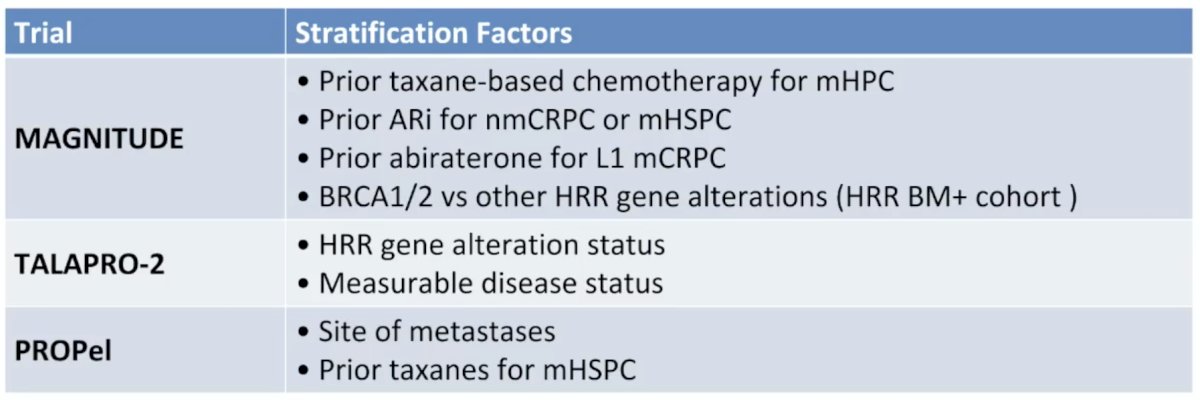
Additionally, there were different stratification factors among the three trials:
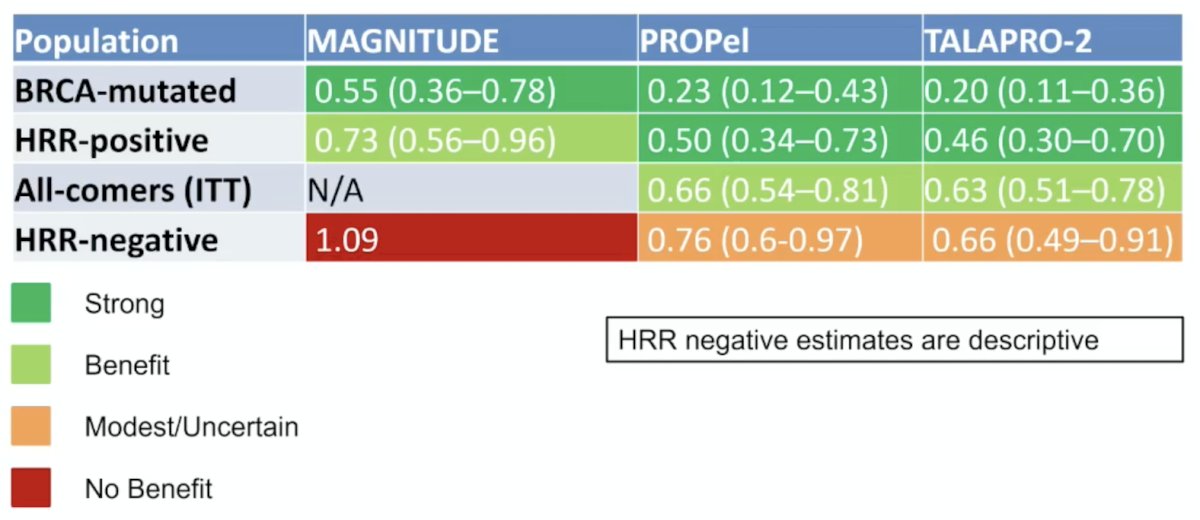
With regard to radiographic progression free survival, where is the benefit? Based on the table below, all three trials demonstrated a benefit in BRCA mutated patients in addition to HRR positive patients:
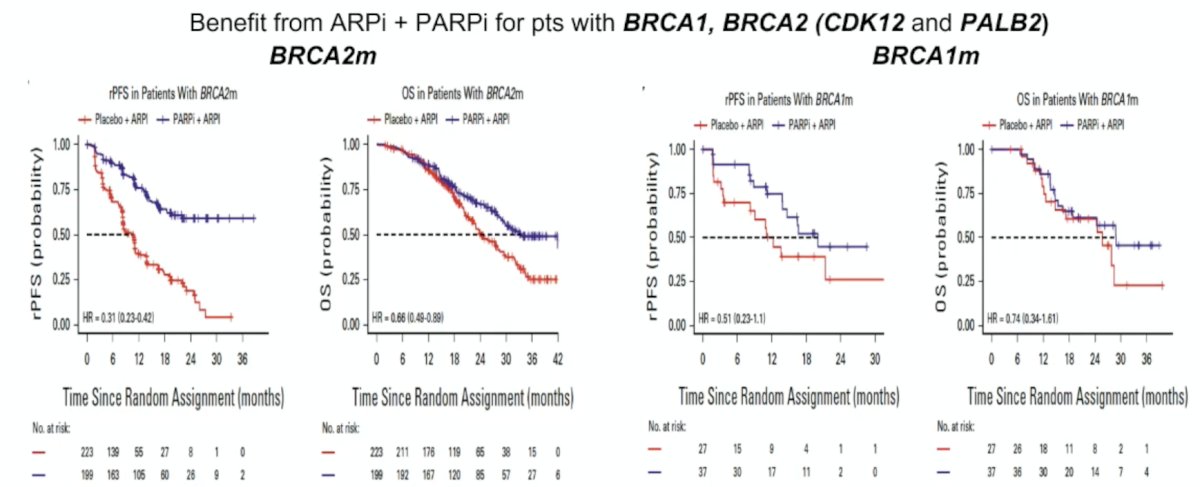
Dr. Halabi also discussed a 2024 FDA pooled analysis that assessed the impact of PARP inhibitors on patients with non-BRCA HRR alterations,4 noting that the benefit from PARP inhibitors appeared greatest for patients with BRCA1, BRCA2, CDK12, and PALB2 mutations:
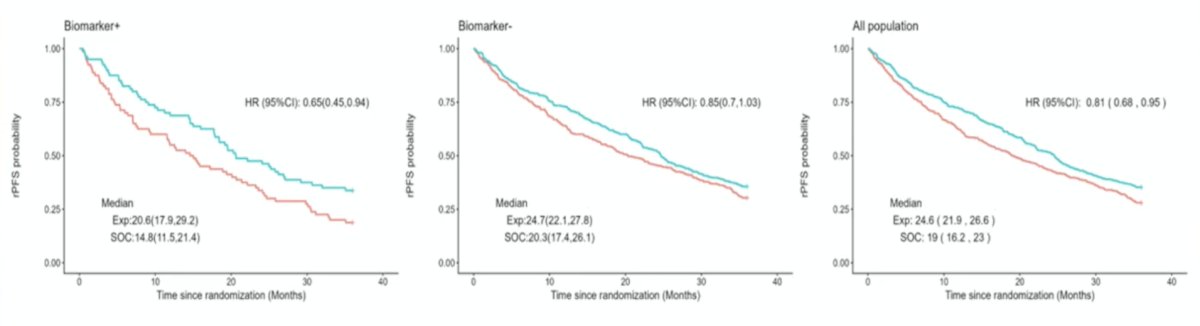
All comer trials can be misleading because mCRPC patients are HRR positive in ~20-30% of cases, with a large effect in HRR positive patients driving the intention to treat analyses. In HRR negative patients, the effect is small and uncertain. Moreover, unknown HRR status is not the same as negative, since this cohort may be contaminated with undetected HRR mutations. Using simulated data, Dr. Halabi illustrated that an overall hazard ratio can be driven by a subgroup, and when a subgroup has a very large treatment effect, it can make the whole trial look positive:
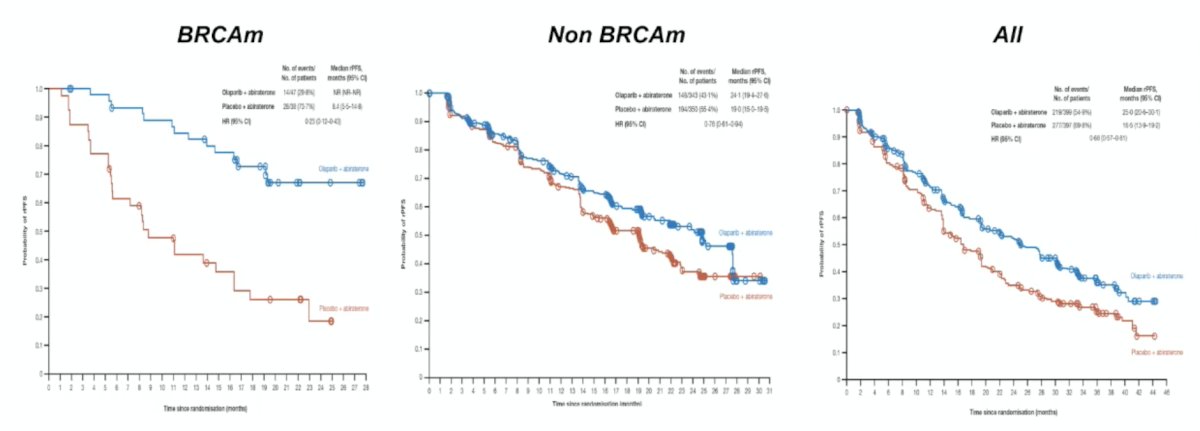
This is further illustrated in the PROpel radiographic progression free survival analyses by BRCA mutation, non BRCA mutated, and all comer Kaplan-Meier curves:
Dr. Halabi notes that none of the three trials included a pre-specified test of treatment by biomarker interaction. In the absence of a formal interaction test, differences in hazard ratios across biomarker strata do not establish statistical evidence of differential treatment effect. Thus, subgroup comparisons should be interpreted with caution: the absence of proof is not proof of absence and also not proof of presence.
According to Dr. Halabi, a stratified biomarker design would have the following trial schema:

Is there evidence that genetic testing is not needed?
- There is strong, consistent evidence for a benefit for HRR positive and BRCA mutated patients
- There is unstable and inconsistent evidence for HRR negative patients
- Unknown biomarker status represents missing data, not a biological subgroup
- Thus, there is no strong evidence to skip genetic testing
Dr. Halabi concluded her presentation discussing the statistical view of the three trials assessing an androgen receptor pathway inhibitor + PARP inhibitor with the following take-home points:
- All-comer trial results tell us drugs work overall, not that testing is unnecessary
- The benefit gradient tracks HRR biology
- The most consistent, reproducible benefit is in HRR mutated disease — especially BRCA
- Toxicity, cost, and alternative androgen receptor pathway inhibitors make empiric use hard to justify
- Biomarker testing remains essential
Presented by: Susan Halabi, PhD, FSCT, FASA, FASCO, Duke University, Durham, NC
Written by: Zachary Klaassen, MD, MSc – Urologic Oncologist, Associate Professor of Urology, Georgia Cancer Center, Wellstar MCG Health, @zklaassen_md on Twitter during the 2026 Advanced Prostate Cancer Consensus Conference (APCCC), Lugano, Switzerland, Thurs, April 30 – Sat, May 2, 2026.
References:
- Chi KN, Rathkopf D, Smith MR, et al. Niraparib and abiraterone acetate for metastatic castration-resistant prostate cancer. J Clin Oncol. 2023 Jun 20;41(18):3339-3351.
- Agarwal N, Azad AA, Carles J, et al. Talazoparib plus enzalutamide in men with first-line metastatic castration-resistant prostate cancer (TALAPRO-2): A randomized, placebo-controlled, phase 3 trial. Lancet. 2023 Jul 22;402(10398):291-303.
- Saad F, Clarke NW, Oya M, et al. Olaparib plus abiraterone versus placebo plus abiraterone in metastatic castration-resistant prostate cancer (PROpel): final prespecified overall survival results of a randomized, double-blind, phase 3 trial. Lancet Oncol. 2023 Oct;24(10):1094-1108.
- Fallah J, Xu J, Weinstock C, et al. Efficacy of Poly(ADP-ribose) Polymerase Inhibitors by Individual Genes in Homologous Recombination Repair Gene-Mutated Metastatic Castration-Resistant Prostate Cancer: A US Food and Drug Administration Pooled Analysis. J Clin Oncol. 2024 May 10;42(14):1687-1698.