

(UroToday.com) The 2026 PSMA & Beyond conference featured a clinical development session and presentation by Dr. William Maguire discussing regulatory considerations related to PSMA PET imaging in clinical trials. Dr. Maguire notes that for PSMA PET the regulatory context and challenge is that the horse is already out of the barn. Most drug approvals so far in prostate cancer have been based on overall survival or conventional imaging-based endpoints, namely radiographic progression free survival, metastasis free survival, or objective response rate. However, PSMA PET is increasingly used in clinical practice. There are several issues with designing a pivotal trial in prostate cancer with only conventional imaging:
- Baseline PSMA PET results may inform patient selection and willingness to enter trials
- Use of off-study PSMA PET during a trial may lead to treatment changes or study withdrawal
- Non-uniform use of PSMA PET leads to increased heterogeneity
However, Dr. Maguire states that it is difficult or impossible to completely ignore PSMA PET.
Another regulatory challenge is that conventional imaging based endpoints remain important. However, there are a few issues with designing a pivotal trial in prostate cancer with only PSMA PET (no conventional imaging):
- Differing potential definitions of PSMA PET-based endpoints, and all are relatively less validated versus conventional imaging
- There is uncertain clinical meaningfulness of PSMA PET-based endpoints
- Is there a potential for modulation of PSMA expression with certain therapy classes?
As such, it is difficult or impossible to completely exclude conventional imaging endpoints. What should the primary endpoint be? According to Dr. Maguire, both conventional imaging-based and PSMA PET-based primary endpoints have challenges in 2026.
There are several considerations for any radiographic primary endpoints. A common feedback from the FDA is “Use of a time to event radiographic endpoint as a primary endpoint in a marketing application will depend on the totality of evidence of a favorable benefit-risk assessment, including, but not limited to, the magnitude of the observed effect size, consistent study results in subgroup analyses, sensitivity analyses, and clinically meaningful secondary endpoints, no apparent overall survival detriment, and the safety and tolerability profile.” Ultimately, whether any radiographic primary endpoint can support an approval is a review issue at the time an application is reviewed. Still, careful planning and discussion with regulatory agencies at the design stage can increase the chances of success.
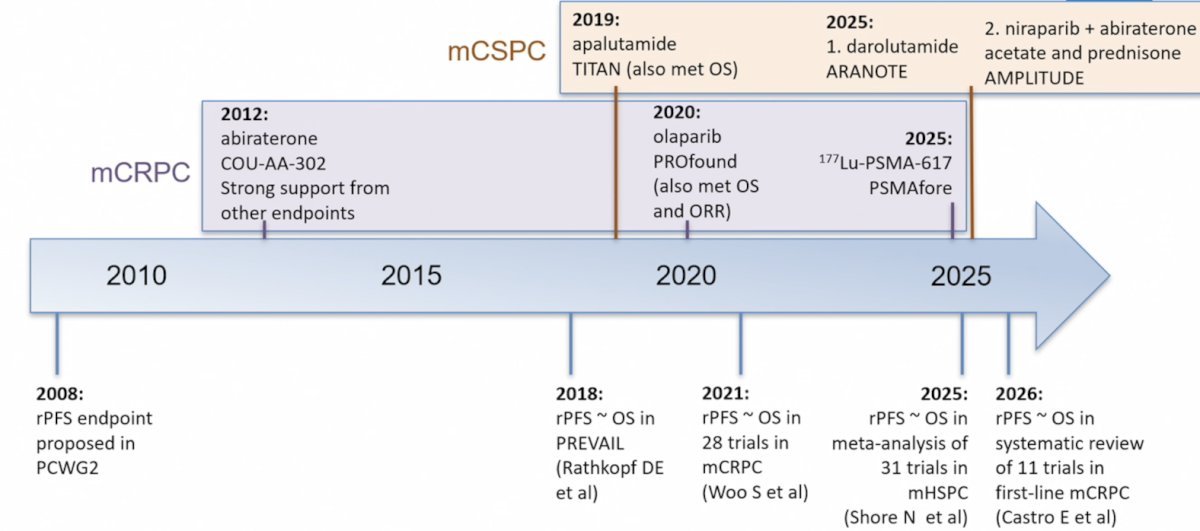
The following figure highlights selected approvals supported by conventional imaging radiographic progression free survival in prostate cancer:
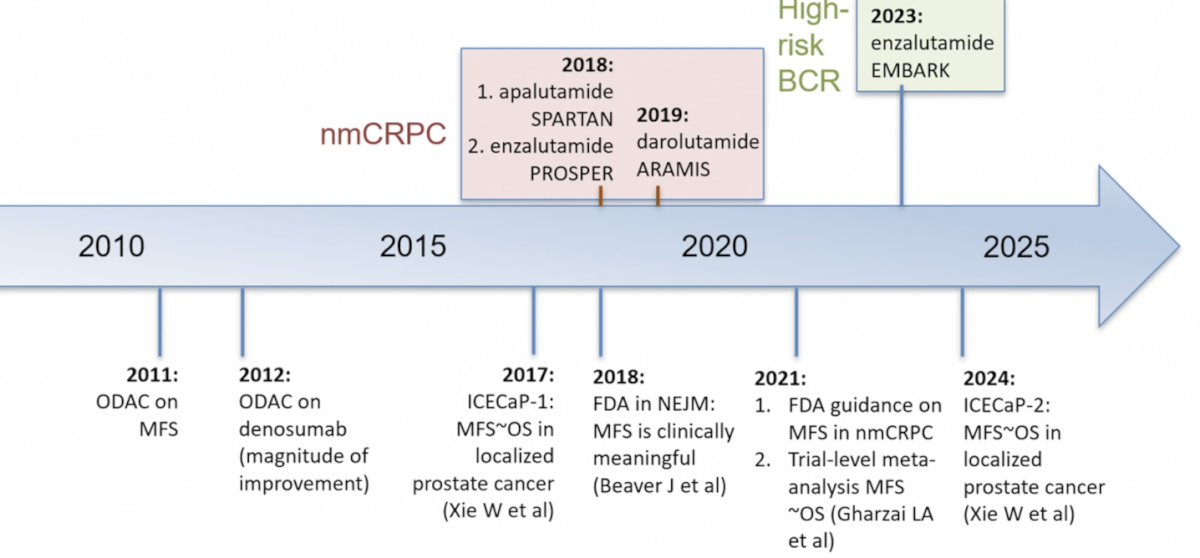
Moreover, the figure below shows approvals supported by conventional imaging metastasis free survival:
Finally, the use of conventional imaging based objective response endpoints has led to the approval of rucaparib, which received accelerated approval on May 15, 2020 for mCRPC (post androgen receptor pathway inhibitor and taxane) based on objective response rate and duration of response.
For the remainder of his talk, Dr. Maguire discussed trial design considering potential impacts of PSMA PET on a hypothetical clinical trial, organized based on the 5 elements of estimands framework:

#1: Treatment(s) of Interest
PSMA PET images physiologic PSMA expression rather than anatomy. Can PSMA expression be altered by certain anti-cancer therapies, and might this complicate determination of response/progression? Of note, a treatment-induced flare phenomenon has been documented. What about the emergence of PSMA-negative disease? This may potentially be relevant after treatment with PSMA-targeted drugs. Conventional cross-sectional imaging reflects anatomy and interpretation may be relatively unaffected by treatment type.
#2: Population
The clinical context of a patient population affects the benefit/risk evaluation, and new patient populations have been defined by PSMA PET. What is the natural history of PSMA PET-only lesions? Could single PSMA PET-positive bone metastases or lymph nodes have more indolent biology than conventional imaging-positive lesions, and do they need to be treated in the same way?
#3: Endpoint
Multiple potential definitions of PSMA PET-based endpoints exist, but none are fully validated. Thus, we should consider including conventional imaging progression as an event even in a PSMA PET-based endpoint. Any proposals for the use of specific quantitative metrics (such as particular SUV thresholds, new lesion numbers, or change in total tumor volume) should be justified. If PSMA PET imaging is incorporated in a primary endpoint, PSMA PET imaging should be obtained at baseline and at set intervals (not solely at the time of PSA rise). Furthermore, the asymmetric timing of imaging between arms will complicate statistical interpretation, and radiographic progression without PSA rise is not uncommon (PREVAIL, ARCHES, etc). Criteria for objective response via PSMA PET are relatively less validated and benchmark data are limited. PSMA PET-based endpoints are not well-suited to support accelerated approval at this time. For conventional imaging-based endpoints (primary or secondary) we should consider blinding readers to PSMA PET results.
#4: Intercurrent events
Examples of potentially important intercurrent events related to PSMA PET use include:
- When does “worsening” of a PSMA PET image necessitate a change in systemic treatment?
- How to handle receipt of metastasis directed therapy on-study, ie. for oligoprogression
- How to handle “PSA anxiety” that might impact imaging schedule?
Sponsors should: (i) pre-specify objective criteria for how to define and deal with intercurrent events, (ii) limit asymmetry between arms due to intercurrent events and/or missing data, and (iii) pre-specify supplementary analyses to explore the robustness of the primary endpoint and the impact of anticipated intercurrent events.
#5: Summary measure
For time to event endpoints in a randomized trial, summary measure of interest is frequently a hazard ratio comparing 2 or more treatments. Key questions remain:
1) What is the clinical meaningfulness of a PSMA PET-based summary measure?
2) What magnitude of improvement is “sufficient” to conclude benefit?
These questions may be addressed by multi-stakeholder discussion, including public workshops and potentially one or more advisory committee meetings.
3) Is the PSMA PET-based endpoint associated with established endpoints such as conventional imaging-based endpoints and overall survival?
This question may be addressed by emerging data and analyses of patient-level and trial-level association with established endpoints. Dr. Maguire cautions that interpretation of a PSMA PET-based summary measure may be influenced by clinical context and the “totality of data,” including conventional imaging-based endpoints.
Dr. Maguire concluded his presentation discussing regulatory considerations related to PSMA PET imaging in clinical trials with the following take-home points:
- Regardless of choice of primary endpoint, sponsors should carefully consider how availability of PSMA PET might affect all aspects of trial design and interpretation. Sponsors should meet with the FDA and other regulatory agencies to discuss trial designs intended to support future marketing applications
- Inclusion of conventional imaging-based endpoints remains important in trials intended to support product registration in prostate cancer
- Ideally, emerging data and ongoing multi-stakeholder discussions will clarify appropriate definitions and clinical meaningfulness of PSMA PET-based endpoints
Presented by: William Maguire, MD, U.S. Food and Drug Administration, Silver Spring, MD
Written by: Zachary Klaassen, MD, MSc – Urologic Oncologist, Associate Professor of Urology, Georgia Cancer Center, Wellstar MCG Health, @zklaassen_md on Twitter during the 2026 PSMA & Beyond Conference, Los Angeles, CA, Thurs, Mar 26 – Fri, Mar 27, 2026.
Related content: PSMA PET in Prostate Cancer Drug Development: Regulatory Challenges and Considerations "Presentation" - William Maguire