

(UroToday.com) The 2026 PSMA & Beyond conference featured a clinical trial updates session and presentation by Dr. Francois Benard discussing the CCTG PR21 trial assessing chemotherapy versus PSMA radioligand therapy. 177Lu-PSMA-617 prolongs radiographic progression free survival in taxane-naïve patients with metastatic castration resistant prostate cancer (mCRPC), when compared to an androgen receptor pathway inhibitor switch.1 In the PSMAfore trial, for 177Lu-PSMA-617, the median radiographic progression free survival was 11.6 months, and the median overall survival was 24.5 months. Docetaxel is also a standard of care option in patients with mCRPC progressing after an androgen receptor pathway inhibitor. Outcomes with docetaxel after an androgen receptor pathway inhibitor in a recent phase III trial demonstrated a median radiographic progression free survival of 8.3 months and an overall survival of 19 months.2 In the CCTG PR21 trial, the investigators aimed to compare these two treatment options for chemotherapy-naïve mCRPC patients progressing after androgen receptor pathway inhibitor therapy.
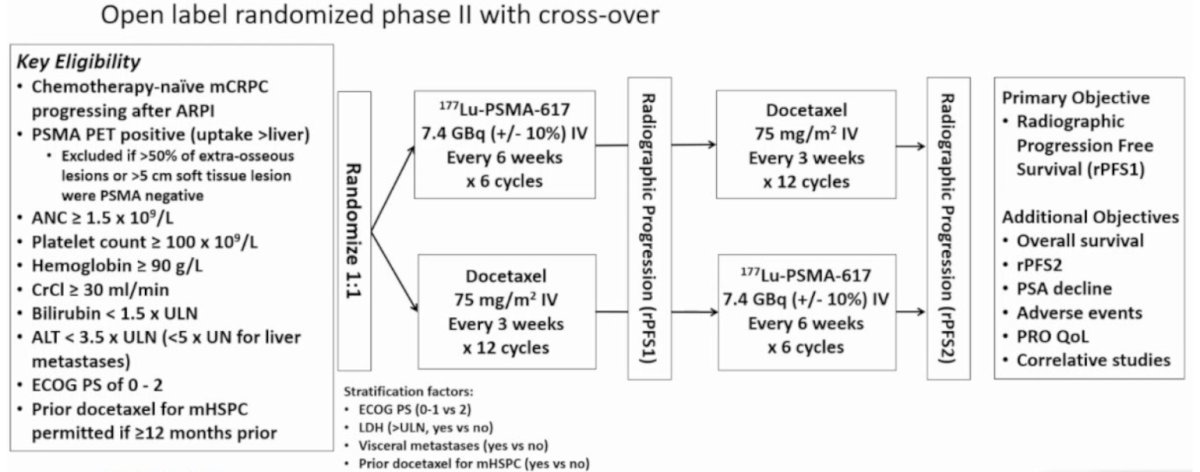
This was an open label, randomized, phase II trial that allowed for crossover between the two study arms. The key eligibility criteria were as follows:
- Chemotherapy-naïve mCRPC progressing after an androgen receptor pathway inhibitor
- PSMA PET positive disease (ie. uptake > liver)
- Excluded if >50% of extra-osseous lesions or >5 cm soft tissue lesion was PSMA negative
- Adequate end organ function
- Prior docetaxel for mHSPC permitted if ≥12 months prior
Eligible patients were randomized 1:1 to 177Lu-PSMA-617 7.4 GBq IV every 6 weeks x 6 cycles versus docetaxel 75 mg/m2 every 3 weeks x 12 cycles. The primary endpoint was radiographic progression free survival, with key secondary endpoints including:
- Overall survival
- Radiographic progression free survival 2
- PSA decline
- Adverse events
- Patient-reported outcomes/quality-of-life
- Correlative studies
The CONSORT diagram is illustrated below. There were 199 patients randomized to 177Lu-PSMA-617 (n = 100) or docetaxel (n = 99). The median numbers of 177Lu-PSMA-617 and docetaxel doses were 5 and 8, respectively. Fifteen patients discontinued docetaxel due to treatment related adverse events, compared to only one in the 177Lu-PSMA-617 arm. Thirty-eight patients crossed over from 177Lu-PSMA-617 to docetaxel versus 56 from docetaxel to 177Lu-PSMA-617.
There was no difference in radiographic progression free survival between the two arms. The median radiographic progression free survival values were 8.6 and 10.7 months for the 177Lu-PSMA-617 and docetaxel arms, respectively (HR 1.01, 95% CI 0.77–1.31; p = 0.51).
Disease response rates favored 177Lu-PSMA-617:
- PSA50 response: 36% versus 16% (p = 0.0015)
- Complete or partial response: 16% versus 8% (p = 0.23)
Grade 3-4 treatment related adverse events were more common in the docetaxel arm (34% versus 13%). Two treatment related deaths were observed (sepsis, not otherwise specified), both of which were in the docetaxel arm. The most common adverse events in either arm were as expected for both treatments.
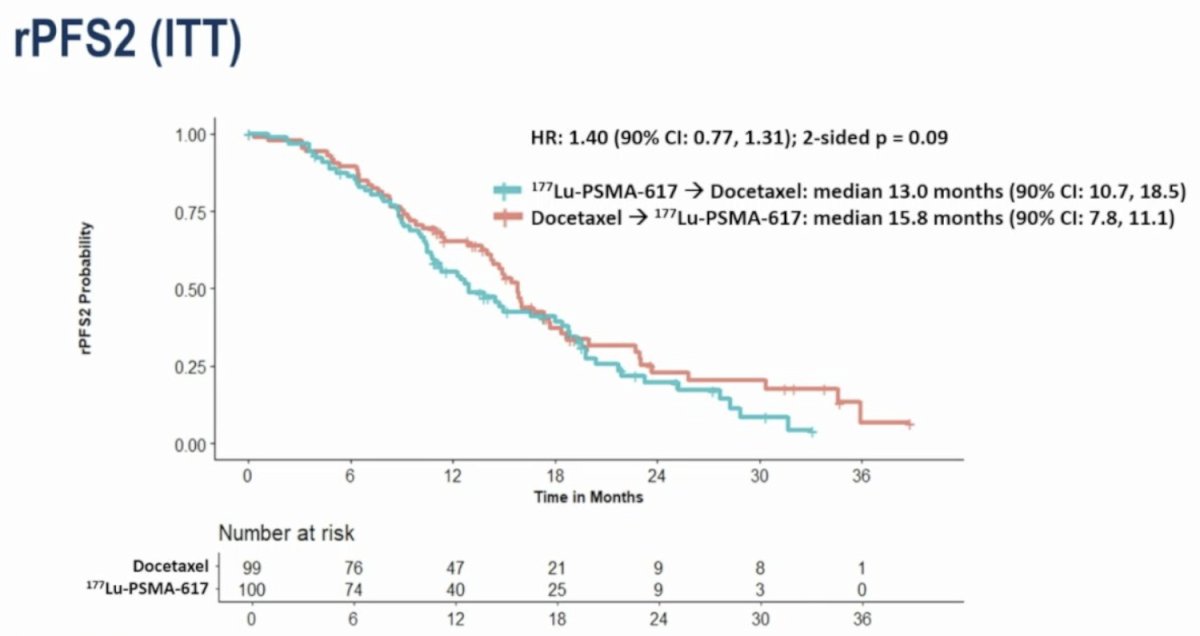
Radiographic progression free survival 2 favored patients initially randomized to the docetaxel arm (HR 1.40, 90% CI 0.77–1.31; p = 0.09).
Overall survival also favored patients initially randomized to the docetaxel arm (HR 1.64, 95% CI 1.14–2.35; p = 0.02). The median overall survival was 14.3 and 18.2 months, respectively, in favor of initial randomization to docetaxel.
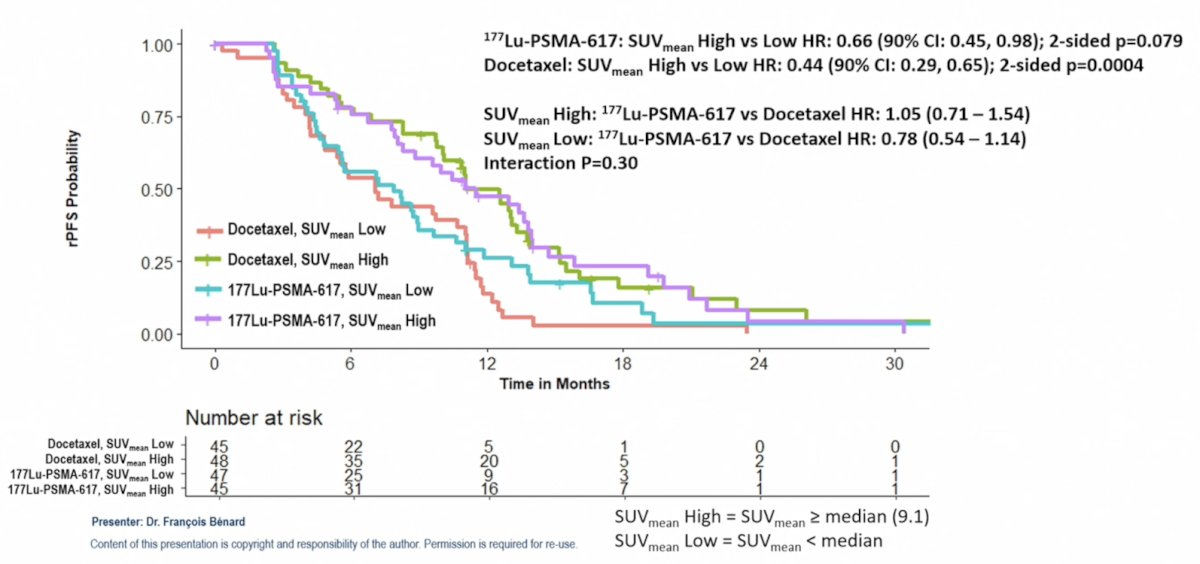
The median SUVmean was prognostic, but not predictive for radiographic progression free survival. As seen below, patients with SUVmean high disease had worse radiographic progression free survival outcomes, compared to SUVmean low disease, in both treatment arms. Furthermore, patients with SUVmean high disease did not derive a preferential benefit from 177Lu-PSMA-617 therapy, confirming that SUVmean was not predictive in this setting.
Dr. Benard concluded his presentation discussing the CCTG PR21 trial assessing chemotherapy versus PSMA radioligand therapy with the following take-home points:
- There was no difference in the primary endpoint of radiographic progression free survival between 177Lu-PSMA-617 and docetaxel in patients with chemotherapy-naïve mCRPC progressing after an androgen receptor pathway inhibitor
- Other endpoints favored 177 Lu-PSMA-617:
- There was a higher proportion of patients with a PSA decline and measurable disease response
- Fewer grade ≥3 adverse events and treatment discontinuations due to adverse events were seen with initial 177Lu-PSMA-617 randomization
- PSMA PET median SUVmean was prognostic, but not predictive, of radiographic progression free survival for 177Lu-PSMA-617 and docetaxel
- Overall survival was longer in patients initially randomized to docetaxel - this is possibly due to a higher treatment cross-over rate from docetaxel to 177Lu-PSMA-617
- Additional analyses with longer follow-up, patient reported outcomes, PSMA PET parameters, and serial ctDNA samples are planned
Written by: Zachary Klaassen, MD, MSc – Urologic Oncologist, Associate Professor of Urology, Georgia Cancer Center, Wellstar MCG Health, @zklaassen_md on Twitter during the 2026 PSMA & Beyond Conference, Los Angeles, CA, Thurs, Mar 26 – Fri, Mar 27, 2026.
Related content: Chemo versus PSMA RLT "Presentation" - François Bérnard
References:
- Morris MJ, Castellano D, Herrmann K, et al. 177Lu-PSMA-617 versus a change of androgen receptor pathway inhibitor therapy for taxane-naïve patients with progressive metastatic castration-resistant prostate cancer (PSMAfore): A phase 3, randomized, controlled trial. Lancet 2024 Sep 28;404(10459):1227-1239.
- Petrylak DP, Ratta R, Matsubara N, et al. Pembrolizumab plus docetaxel versus docetaxel for previously treated metastatic castration-resistant prostate cancer: the randomized, double-blind, phase III KEYNOTE-921 trial. J Clin Oncol. 2025;43(14):1638–1649.