

(UroToday.com) The 2026 PSMA & Beyond conference featured a clinical trial updates session and presentation by Dr. Désirée Deandreis discussing the PEACE-6 PR trial. Recently, prostate cancer is moving from imaging to therapy, including radioligand therapy treatment in the neoadjuvant setting, to treatment in the metastatic hormone sensitive prostate cancer (mHSPC) setting, to treatment in the metastatic castration resistant prostate cancer (mCRPC) setting:

What we learned from PEACE-1 in de novo mHSPC is that 3 drugs are better than only 2 drugs.1,2
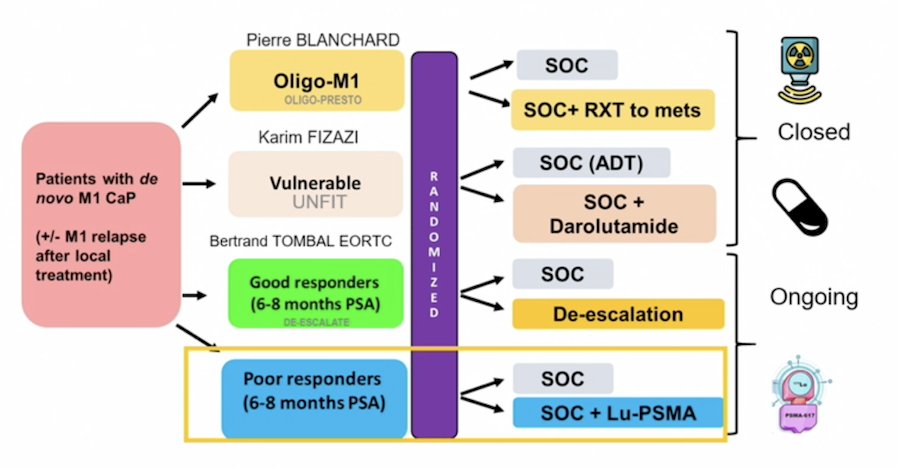
The purpose of PEACE 6 in de novo mHSPC is to search for the best treatment strategy for these patients. Patients with oligometastatic disease will be randomized to standard of care versus standard of care + radiotherapy to the metastatic lesions. Unfit, vulnerable patients will be randomized to standard of care (ADT) versus standard of care + darolutamide. Good responders (after 6-8 months of PSA response) will be randomized to standard of care versus de-escalation approaches. Finally, poor responders (after 6-8 months of poor PSA response) will be randomized to standard of care versus standard of care + Lu-PSMA therapy:
Specific to the poor responders, 500 patients at 100 European centers (7 countries) with a PSA >= 0.2 ng/mL after 6-8 months treatment will be randomized to standard of care versus standard of care + 177Lu-PSMA-617. The detailed treatment schedule is as follows:
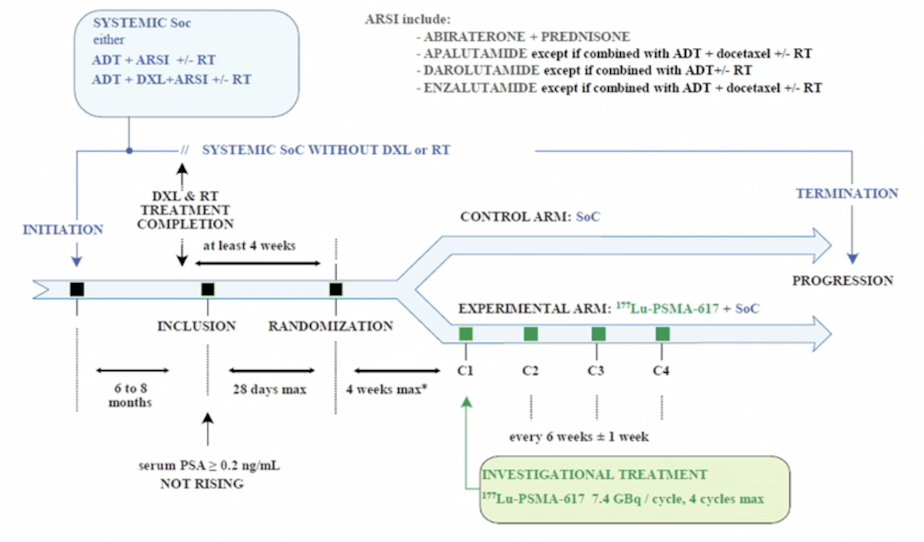
Overall survival is defined as the time from the date of randomization to the date of death due to any cause, and radiographic progression free survival will be defined as the time from randomization to radiographic progression per PCWG3 criteria or death, whichever occurs first. Inclusion criteria include:
- Age > 18 years
- Life expectancy > 6 months per the investigator’s estimation
- ECOG performance status <= 2
- Histologic confirmation of prostate adenocarcinoma
- De novo metastatic disease
- Measurable disease
- 68Ga-PSMA-11 PET/CT within 4 weeks pre-randomization (FDG-PET is not required). PSMA-positive or negative (based on PROMISE 2.0) patients are eligible
- 6-8 months of previous and ongoing standard treatment: ADT + androgen receptor pathway inhibitor + radiotherapy, or ADT + docetaxel
- Stable or declining PSA
- PSA >= 0.2 at 6-8 months after systemic treatment initiation
- Testosterone < 50 ng/mL
PEACE-6 PR started in France in 2025, with 99 of 500 patients currently randomized, and plans to open in 2026 in the following European countries: Germany, Ireland, Italy, Spain, and the Netherlands. Dr. Deandreis also highlighted a PEACE-6 PR ancillary study that will assess the prognostic role of PSMA imaging and the predictive value for toxicity of personalized dosimetry in patients with hormone sensitive de novo metastatic prostate cancer treated among PEACE-6 poor responders:
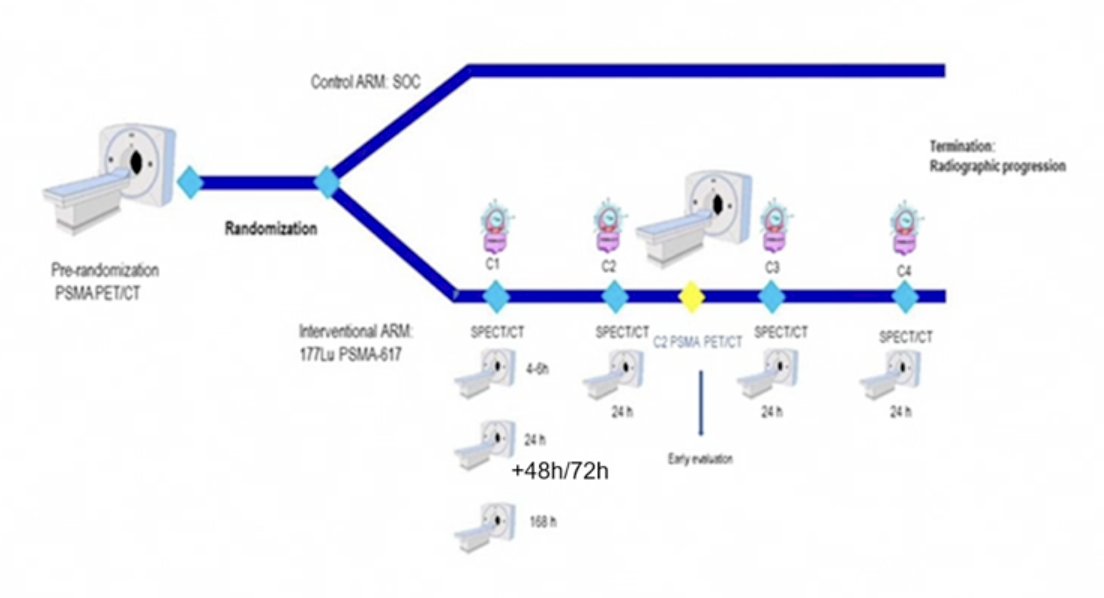
The primary endpoint is the prognostic value of whole body PSMA tumor volume derived from PSMA PET/CT in terms of overall survival and radiographic progression free survival, defined as the time from randomization into the PEACE-6 trial to death from any cause or radiographic progression.
Finally, Dr. Deandreis discussed the following two preliminary cases. The first was that of a 65 year old treated with ADT + abiraterone + docetaxel for high volume disease, and whose PSA went from 2 ng/mL to 0.38 ng/mL:
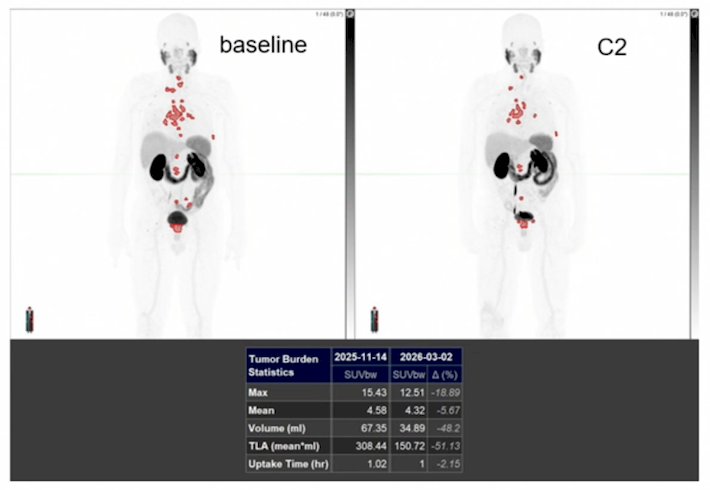
The second case was that of a 71 year old treated with ADT + abiraterone for low volume disease whose PSA went from 0.4 ng/mL to 0.02 ng/mL:
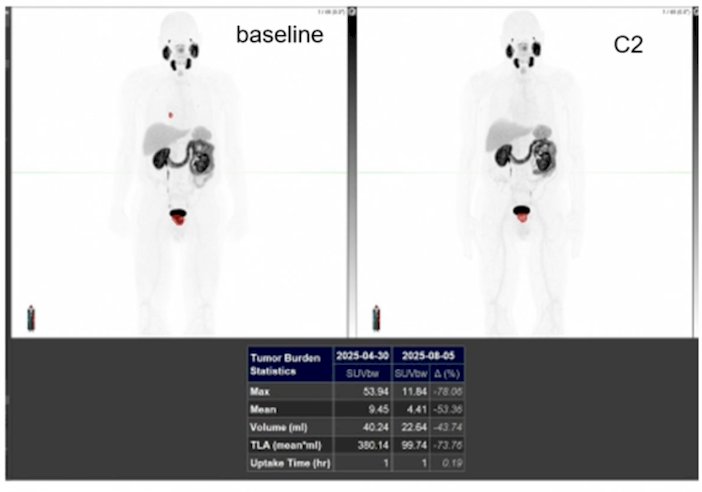
Dr. Deandreis concluded her presentation discussing the PEACE-6 PR trial with the following take-home points:
- The PEACE-6 PR is a phase III trial in de novo mHSPC poor responders to standard treatment and not progressive
- It is designed to change clinical practice and to validate radionuclide therapy (+ standard of care) as a means of reinforcing treatment response in this setting.
- The ImDOSE ancillary study includes image analysis and dosimetry, representing a significant challenge in incorporating these aspects into a multicenter phase III clinical trial
Presented by: Désirée Deandreis, Gustave Roussy, Villejuif, France
Written by: Zachary Klaassen, MD, MSc – Urologic Oncologist, Associate Professor of Urology, Georgia Cancer Center, Wellstar MCG Health, @zklaassen_md on Twitter during the 2026 PSMA & Beyond Conference, Los Angeles, CA, Thurs, Mar 26 – Fri, Mar 27, 2026.
Related content: The PEACE-6-PR Trial "Presentation" - Désirée Deandreis
References:
- Fizazi K, Foulon S, Carles J, Roubaud G, et al. Abiraterone plus prednisone added to androgen deprivation therapy and docetaxel in de novo metastatic castration-sensitive prostate cancer (PEACE-1): A multicentre, open-label, randomized, phase 3 study with a 2 x 2 factorial design. Lancet. 2022 Apr 30;399(10336):1695-1707.
- Bossi A, Foulon S, Maldonado X, et al. Efficacy and safety of prostate radiotherapy in de novo metastatic castration-sensitive prostate cancer (PEACE-1): A multicenter, open-label, randomized, phase 3 study with a 2 x 2 factorial design. Lancet. 2024 Nov 23;404(10467):2065-2076.