

(UroToday.com) The 2025 GU Oncology Early Career Thought Leaders Conference featured a clinical trials and research session and a presentation by Dr. Andrea Apolo discussing how to develop your clinical trials. Dr. Apolo started her presentation by highlighting that there are many types of clinical trials, but generally, these can be distilled down to pharmaceutical sponsored trials and investigator-initiated trials.
For the purpose of her talk, Dr. Apolo focused on the investigator initiated clinical trials. When thinking about these types of trials, it is important to come up with an innovative idea, which may occur from (i) attending conferences – look through the posters, (ii) speaking with your mentors and other investigators – what are the unanswered questions? (iii) meeting with pharma colleagues – ask to see their pipeline, (iv) attending protocol presentations (ie, at your department/institution, CRO meetings, cooperative group meetings, etc) – what are the objectives and statistical design? and (v) being heavily involved in research – review PubMed, clinicaltrials.gov, and press releases.
The first steps to developing your trial include identifying/understanding the sponsor, the contract research organization, and the investigators. The sponsor is in charge of safety, compliance, quality assurance, monitoring, reporting, and investigator selection. Sponsors may be companies, the government (CTEP via ETCTN/NCTN), academic institutions, or individuals/private organizations. The contract research organization is responsible for protocol development, site selection, patient recruitment, clinical monitoring, data collection, regulatory compliance, statistical analysis, reporting, and quality assurance. The contract research organization may be the government (CTEP via ETCTN, NCTN), academic institutions, not for profit organizations, or clinical consortiums. Dr. Apolo highlighted that the Experimental Therapeutics Clinical Trials Network (ETCTN) is a network of clinical trial sites and infrastructure that is solely devoted to the conduct of the earliest clinical studies of investigational new drugs sponsored by the NCI. Additionally, it ensures efficient and timely activation of early phase experimental therapeutics clinical trials using a coordinated, collaborative, and inclusive team-based approach:
With regards to the National Clinical Trials Network (NCTN), this is a collection of organizations and clinicians that coordinates and supports cancer clinical trials at more than 2,200 sites across the United States, Canada, and internationally. NCTN also provides the infrastructure for NCI-funded treatment and primary advanced imaging trials to improve the lives of people with cancer. Of the 2,200 sites, 32 have been awarded a Lead Academic Participating Site (LAPS) grant, a source of funding for NCTN sites that can demonstrate their ability to enroll high numbers patients onto NCTN trials, as well as scientific leadership in the design and conduct of clinical trials. NCTN clinical trials also help to establish new standards of care, set the stage for approval of new therapies by the FDA, test new treatment approaches, and validate new biomarkers. The NCTN’s organizational structure, funding, and long-term strategic direction are under the purview of the Clinical Trials and Translational Research Advisory Committee (CTAC). This federal advisory committee is composed of clinical trials experts, industry representatives, and patient advocates from across the nation and provides recommendations to the NCI director. NCTN consists of four adult groups and one large group focused solely on childhood cancers, as well as including a Canadian Collaborating Clinical Trials Network. The five US Network Groups are:
- Alliance for Clinical Trials in Oncology
- ECOG-ACRIN Cancer Research Group
- NRG Oncology
- SWOG
- Children’s Oncology Group (COG)
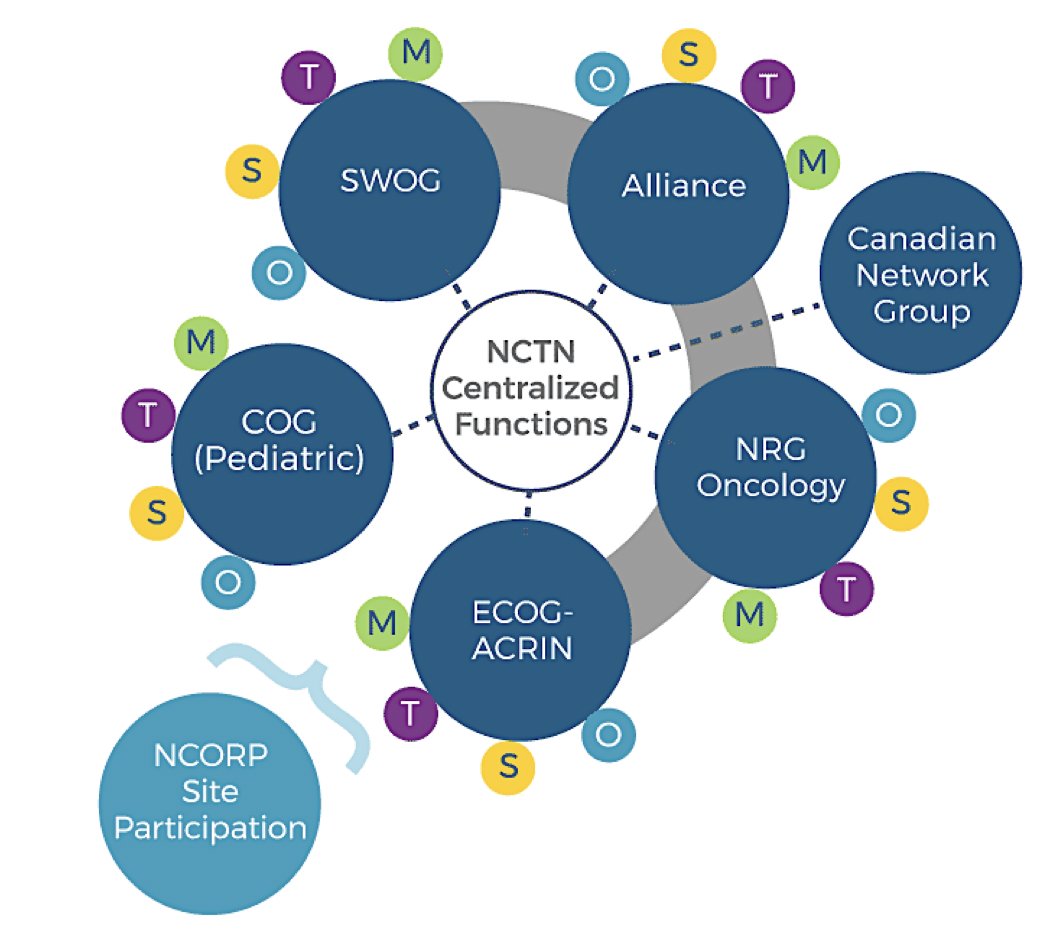
Dr. Apolo also discussed the NCI Community Oncology Research Program (NCORP), which is a national network that brings cancer clinical trials and care delivery studies to people in their communities. The NCORP network designs and conducts clinical trials in the following focus areas:
- Cancer prevention
- Screening
- Supportive care and symptom management
- Surveillance
- Health-related quality of life
- Cancer care delivery
Of note, the NCI has supported cancer clinical research within community settings for over four decades. Additionally, the participation of community oncologists, non-oncology specialists, and primary care physicians in cancer clinical trials has facilitated the introduction of research advances into practices throughout the country. Although academic medical centers play a crucial role in cancer clinical research, the majority of cancer care takes place in the community setting. NCORP is comprised of 7 Research Bases and 46 Community Sites, 14 of which are designated as Minority/Underserved Community Sites:
Dr. Apolo concluded her presentation discussing how to develop your clinical trials with the following take home messages:
- There are many mechanisms in place that can support you in your goal of developing your clinical trial
- It takes a long time to develop a trial from concept to enrollment
- Once you start, stay on top of all the steps
- Ask for help,
- The key is perseverance
Presented by: Andrea Apolo, MD, National Cancer Institute, Bethesda, MD
Written by: Zachary Klaassen, MD, MSc – Urologic Oncologist, Associate Professor of Urology, Georgia Cancer Center, Wellstar MCG Health, @zklaassen_md on Twitter during the 2025 GU Oncology Early Career Thought Leaders Conference, Philadelphia, PA, Thurs, Mar 6 – Sat, Mar 8, 2025.
