

(UroToday.com) The 2026 SESAUA annual meeting featured a bladder cancer session and a presentation by Dr. William Huang discussing the response to treatment with UGN-102 in patients with early or late recurrent low-grade intermediate risk non-muscle invasive bladder cancer. Low-grade intermediate risk non-muscle invasive bladder cancer is a highly persistent and recurrent disease, where patients typically undergo treatment with repeated TURBTs under general anesthesia.
UGN-102 has been recently approved for the treatment of adults with recurrent low-grade intermediate-risk non-muscle invasive bladder cancer, and the objective of this analysis was to investigate if early (within one year) or late recurrence impacted the durability of response to UGN-102 in the ongoing pivotal ENVISION prospective, phase 3, multinational, single-arm trial.1
Patients received6 once-weekly intravesical instillations of UGN-102 (75mg mitomycin in a reverse thermal gel). Approximately 3 months after the first instillation, patients underwent cystoscopy, urine cytology testing, and for-cause biopsy to evaluate for bladder cancer presence:
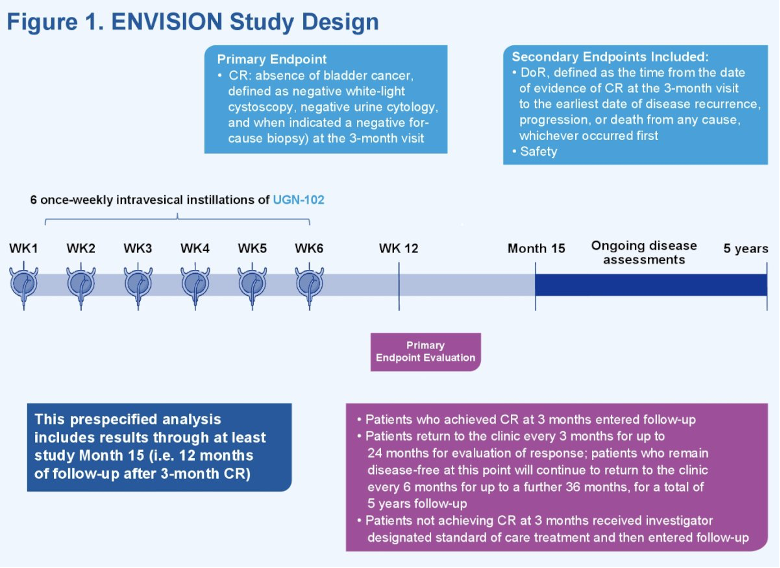
Duration of response (time from complete response at 3 months to the earliest date of disease recurrence, progression, or death from any cause, whichever occurred first) was calculated using Kaplan–Meier estimate with Brookmeyer–Crowley confidence intervals for subgroups of patients with early recurrence or recurrence.
There were 240 patients with recurrent low-grade intermediate risk non-muscle invasive bladder cancer enrolled and received ≥1 dose of UGN-102, of which 95% (n = 228) received all 6 doses:
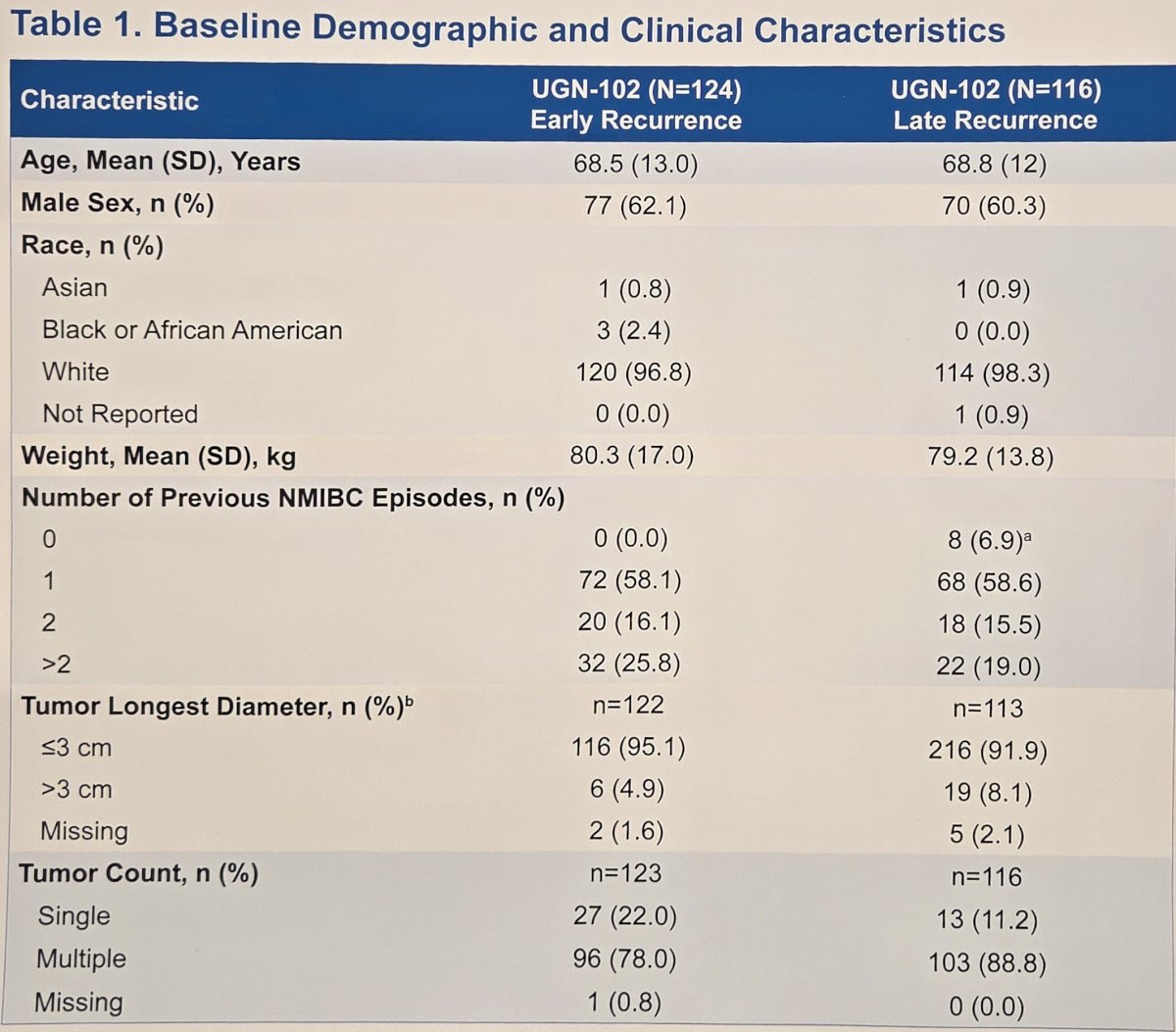
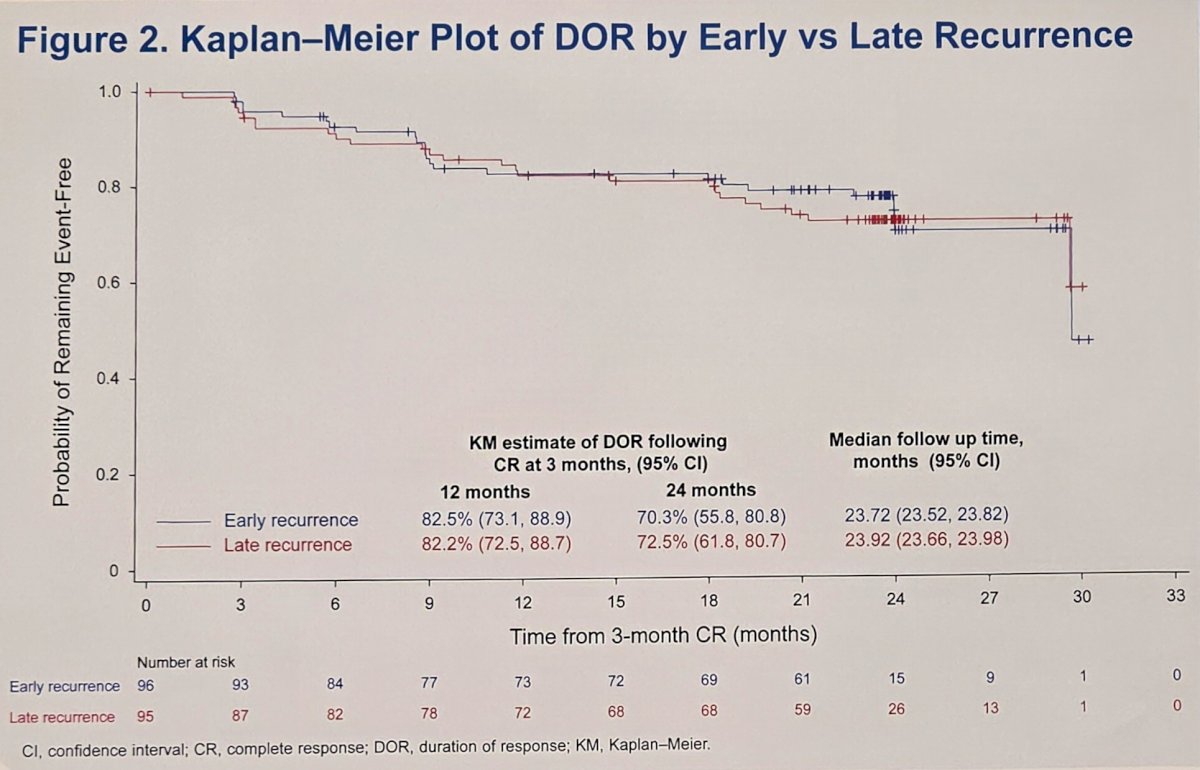
Complete response at 3 months was achieved by 96/124 patients (77.4%, 95% CI 69.0, 84.4) in the early group and 95/116 patients in the late group (81.9%, 95% CI 73.7, 88.4). The probability of remaining in response 12 and 24 months after complete response was similar for both groups (12 months - early: 82.5% versus late: 82.2%; 24 months - 70.3% early versus late: 72.5%):
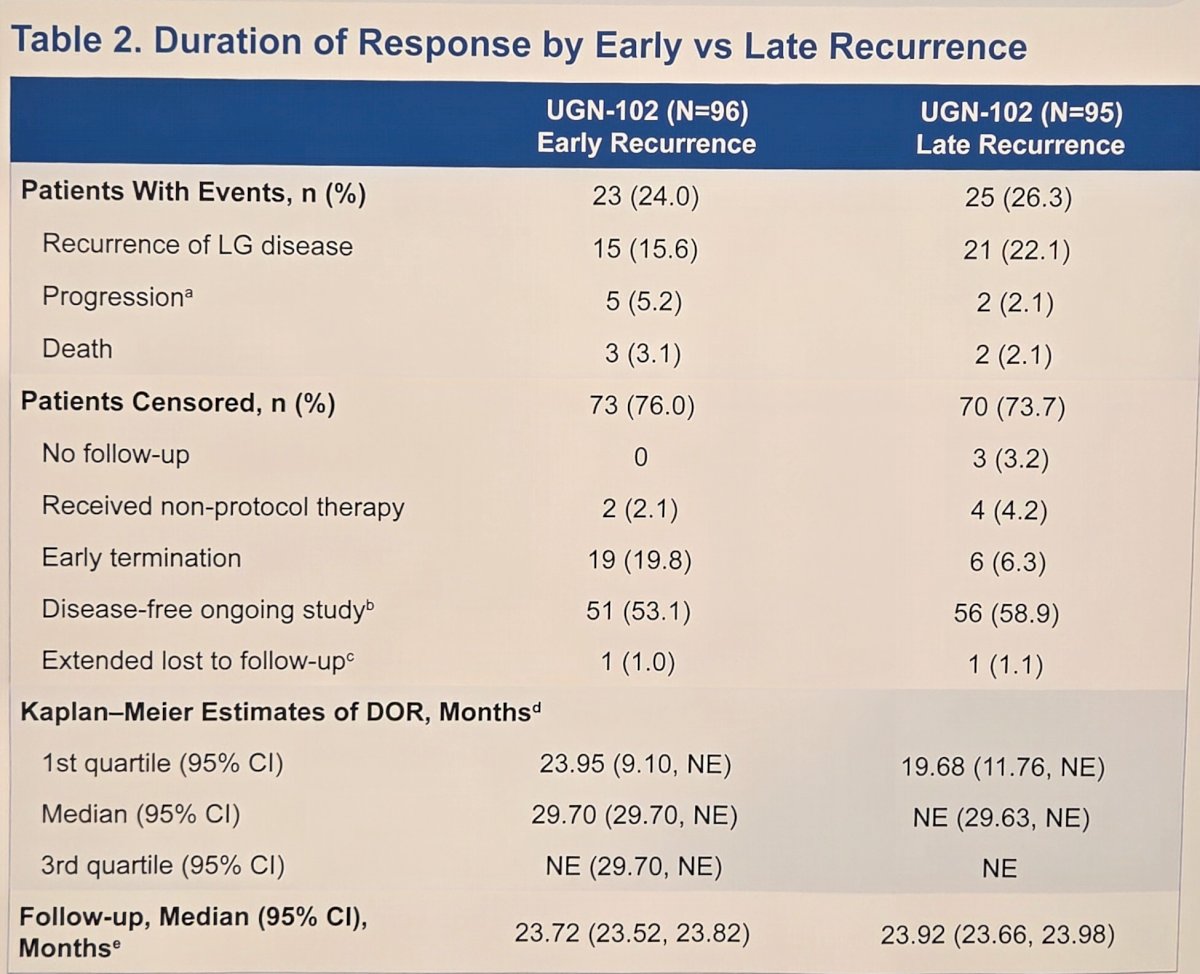
There were 23 patients (24%) in the early and 25 (26.3%) in the late recurrence group that experienced an event (disease recurrence, progression, or death) post complete response, with most patients (early: n = 15; late: n = 21) experiencing low-grade disease recurrence:
Dr. Huang concluded his presentation discussing response to treatment with UGN-102 in patients with early or late recurrent low-grade intermediate risk non-muscle invasive bladder cancer with the following take-home points:
- UGN-102 treatment in patients with recurrent low-grade intermediate risk non-muscle invasive bladder cancer resulted in a clinically meaningful complete response rate and had a high probability of remaining in response 12 and 24 months later, irrespective of whether the previous non-muscle invasive bladder cancer event was within the preceding year or earlier
- These data indicate that UGN-102 provides a durable recurrence-free interval for patients with both early and late recurrent low-grade intermediate-risk non-muscle invasive bladder cancer
Presented by: William Huang, MD, Professor, Departments of Urology and Radiology, Vice Chair, Clinical Affairs, Co-Director, Robotics Program, NYU Langone, New York, NY
Written by: Zachary Klaassen, MD, MSc – Urologic Oncologist, Associate Professor of Urology, Georgia Cancer Center, Wellstar MCG Health, @zklaassen_md on Twitter during the 2026 Southeastern Section of the American Urological Association (SESAUA) Annual Meeting, San Juan, PR, Wed, Mar 18 – Sat, Mar 21, 2026.Reference:
Related Content:
SES AUA 2026: Patient Reported Outcomes Before and After Treatment with UGN-102 in Adults with Recurrent Low-Grade Intermediate-Risk Non Muscle Invasive Bladder Cancer
SES AUA 2026: UGN-102 for Low-Grade Intermediate Risk Non Muscle Invasive Bladder Cancer: 5-Year Long-Term Extension Study Results from the Single-Arm, Phase 2B OPTIMA II Study
OPTIMA II Five-Year Data: Mitomycin Chemoablation Provides Durable Response in LG-IR-NMIBC - Neal Shore