

(UroToday.com) The 2026 SESAUA annual meeting featured a bladder cancer session and presentation by Dr. Trushar Patel discussing patient-reported outcomes before and after treatment with UGN-102 in adults with recurrent low-grade intermediate-risk non-muscle invasive bladder cancer. Low-grade intermediate risk non-muscle invasive bladder cancer is typically managed with TURBT conducted under general anesthesia; disease recurrence is common.
UGN-102 (a reverse thermal hydrogel containing 75 mg of mitomycin) is an FDA-approved non-surgical ablative treatment for patients with recurrent low-grade intermediate-risk non-muscle invasive bladder cancer. UGN-102 has been evaluated in 3 clinical trials: OPTIMA II,1 ATLAS,2 and ENVISION.3 At the SESAUA 2026 annual meeting, Dr. Patel and colleagues reported the patient-reported outcomes of patients with recurrent low-grade intermediate risk non-muscle invasive bladder cancer treated with UGN-102.
Patients with ≥1 previous non-muscle invasive bladder cancer episode who received UGN-102 for the treatment of low-grade intermediate risk non-muscle invasive bladder cancer across OPTIMA II, ATLAS, and ENVISION are reported: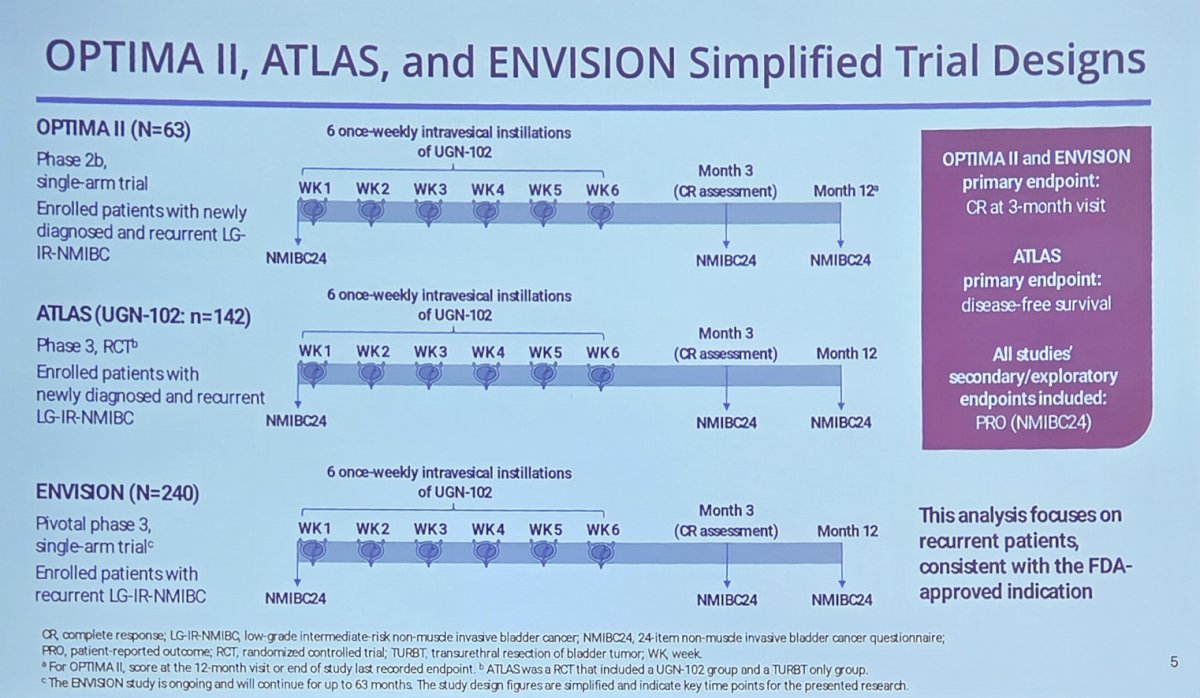
Trials included 6 once-weekly intravesical instillations of UGN-102, an assessment of complete response at 3 months, and a follow-up between 9–60 months after complete response. Patient-reported outcomes were evaluated using the EORTC-QLQ-NMIBC24 at baseline, 3, and 12 months post-treatment initiation. The following graphic highlights the patient-reported outcome assessment schedule:
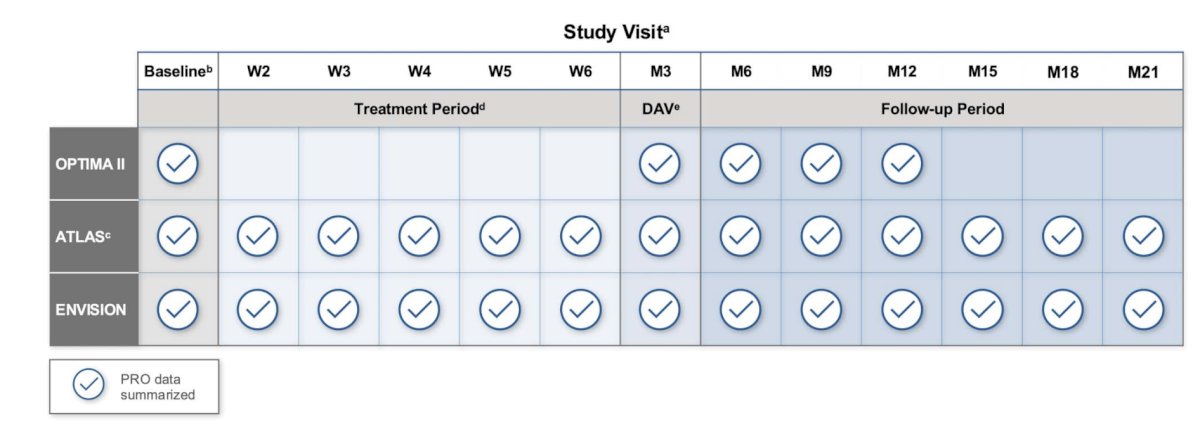
Overall, there were 49, 57, and 232 patients with ≥1 previous non-muscle invasive bladder cancer episode at baseline who were enrolled into the OPTIMA II, ATLAS, and ENVISION trials: 91.8%, 91.2%, and 94.8% received all 6 doses of UGN-102, respectively. At baseline, patients in OPTIMA II, ATLAS, and ENVISION had a median age of 68, 69, and 70 years, respectively, and the majority of patients in all three trials were male (55.1%, 75.4%, 62.1%).
At baseline, NMIBC24 domain scores mainly indicated no/low symptom burden. The mean change from baseline, 3, and 12 months post-treatment initiation, of malaise, intravesical treatment issues, risk of contaminating partner, female sexual problems, male sexual problems, and sexual function, did not reach minimal clinically important difference thresholds. Post-treatment initiation, mean change from baseline in sexual intimacy at 3 months (n = 8) in OPTIMA II, and sexual enjoyment at 3 (n = 23) and 12 months (n = 17) in ATLAS, reached the worsening minimal clinically important difference threshold. Mean change from baseline for future worries at 12 months (n = 17) in OPTIMA II, bloating and flatulence at 3 months (n = 49), and urinary symptoms at 3 (n = 49) and 12 months (n = 32) in ATLAS, reached the improved minimal clinically important difference threshold. A summary of these findings is highlighted below:

Dr. Patel concluded this presentation discussing patient-reported outcomes before and after treatment with UGN-102 in adults with recurrent low-grade intermediate-risk non-muscle invasive bladder cancer, with the following take-home points:
- UGN-102 did not have a clinically meaningful impact on the majority of domains across studies
- UGN-102 is an FDA-approved non-surgical treatment that does not appear to decrease quality of life for patients with recurrent low-grade intermediate-risk non-muscle invasive bladder cancer
Presented by: Trushar Patel, MD, Associate Professor, Vice Chairman in the Department of Urology, University of South Florida, Tampa, FL
Written by: Zachary Klaassen, MD, MSc – Urologic Oncologist, Associate Professor of Urology, Georgia Cancer Center, Wellstar MCG Health, @zklaassen_md on Twitter during the 2026 Southeastern Section of the American Urological Association (SESAUA) Annual Meeting, San Juan, PR, Wed, Mar 18 – Sat, Mar 21, 2026.
References:
- Chevli KK, Shore ND, Trainer A, et al. Primary chemoablation of low-grade intermediate-risk nonmuscle-invasive bladder cancer using UGN-102, a mitomycin-containing reverse thermal gel (Optima II): A phase 2b, open-label, single-arm trial. J Urol. 2022 Jan;207(1):61-69.
- Prasad SM, Huang WC, Shore ND, et al. Treatment of low-grade intermediate-risk nonmuscle-invasive bladder cancer with UGN-102 +/- transurethral resection of bladder tumor compared to transurethral resection of bladder tumor monotherapy: A randomized, controlled, phase 3 trial (ATLAS). J Urol. 2023 Oct;210(4):619-629.
- Prasad SM, Shishkov D, Vladimirov Mihaylov N, et al. Primary Chemoablation of Recurrent Low-Grade Intermediate-Risk Nonmuscle-Invasive Bladder Cancer with UGN-102: A Single-Arm, Open-Label, Phase 3 Trial (ENVISION). J Urol. 2025 Feb;213(2):205-216.
SES AUA 2026: UGN-102 for Low-Grade Intermediate Risk Non Muscle Invasive Bladder Cancer: 5-Year Long-Term Extension Study Results from the Single-Arm, Phase 2B OPTIMA II Study
ENVISION Trial Analysis: Reverse Thermal Gel with Mitomycin Outcomes by EORTC Risk Group – William Huang
ASCO GU 2026: Patient Experiences with UGN-102 for Recurrence LG-IR-NMIBC: Insights for Shared Decision Making