

(UroToday.com) The 2025 Western Section AUA annual meeting featured a urothelial carcinoma session and a presentation by Dr. Karim Chamie discussing long-term outcomes of primary chemoablation of new-onset or recurrent low-grade upper tract urothelial carcinoma with UGN-101. Endoscopically guided ablation is commonly used to treat low-grade upper tract urothelial carcinoma. Surgical ablation is effective, but not typically durable, requiring long-term endoscopic surveillance associated with potential complications.
Topical adjuvant aqueous chemotherapy has a modest effect on disease recurrence following local ablation, likely due to drug dilution and rapid evacuation secondary to physiologic urine flow. Topical gel therapy has, therefore, been developed, with the intention of sustained drug delivery. In the phase 3 OLYMPUS trial [1], UGN-101, a reverse thermal gel containing mitomycin (4 mg/mL) used as primary treatment for low-grade upper tract urothelial carcinoma, resulted in clinically significant disease eradication. At the 2025 Western Section AUA annual meeting, Dr. Chamie and colleagues reported data from a non-interventional study following the long-term outcomes of patients who achieved complete response following treatment with UGN-101, a reverse thermal gel containing 4mg mitomycin per mL, in the phase 3 OLYMPUS trial.1,2
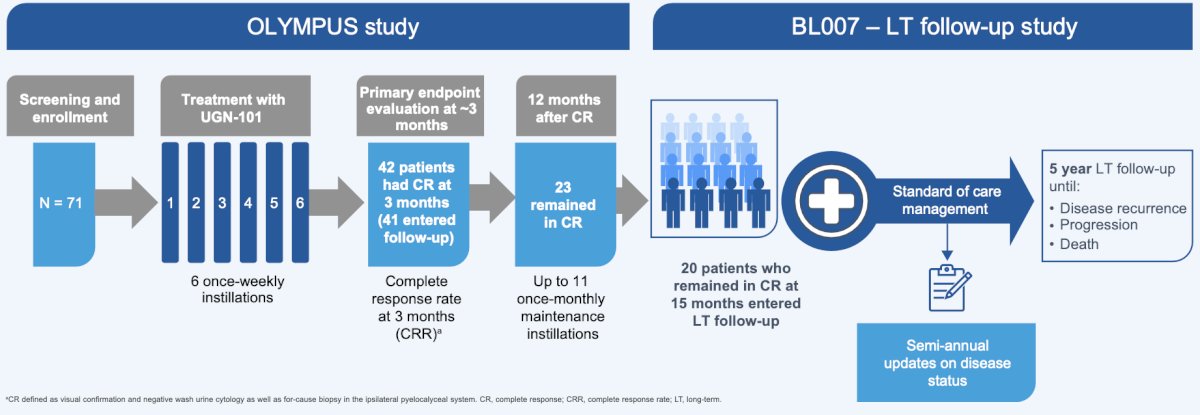
Patients who achieved a complete response after 6 once-weekly pyelocalyceal doses of UGN-101 in the OLYMPUS trial were followed for up to 12 months after initial complete response. Those with a complete response at study completion were eligible to enroll in a long-term follow-up study (BL007) through 5 years. The outcomes included duration of response and disease recurrence or progression. There were no protocol-specified interventions or treatments, or protocol-specified visits. Supervising physicians provided semiannual updates on a patient’s disease status:
Among the 41 patients followed after initial complete response in the OLYMPUS study, the median follow-up was 28.1 months (95% CI 13.1–60.1), and the median duration of response was 47.8 months (95% CI 13.0–not estimable). Of these patients, 21 had new-onset upper tract urothelial carcinoma, and 20 had recurrent upper tract urothelial carcinoma at baseline. Overall, 8 patients in each group experienced recurrence or death. Twenty patients (49%) had long-term follow-up (median 53.3 months, 95% CI 27.9–65.3), with a median duration of response of not estimable (95% CI 43.5–not estimable) due to a low event rate: 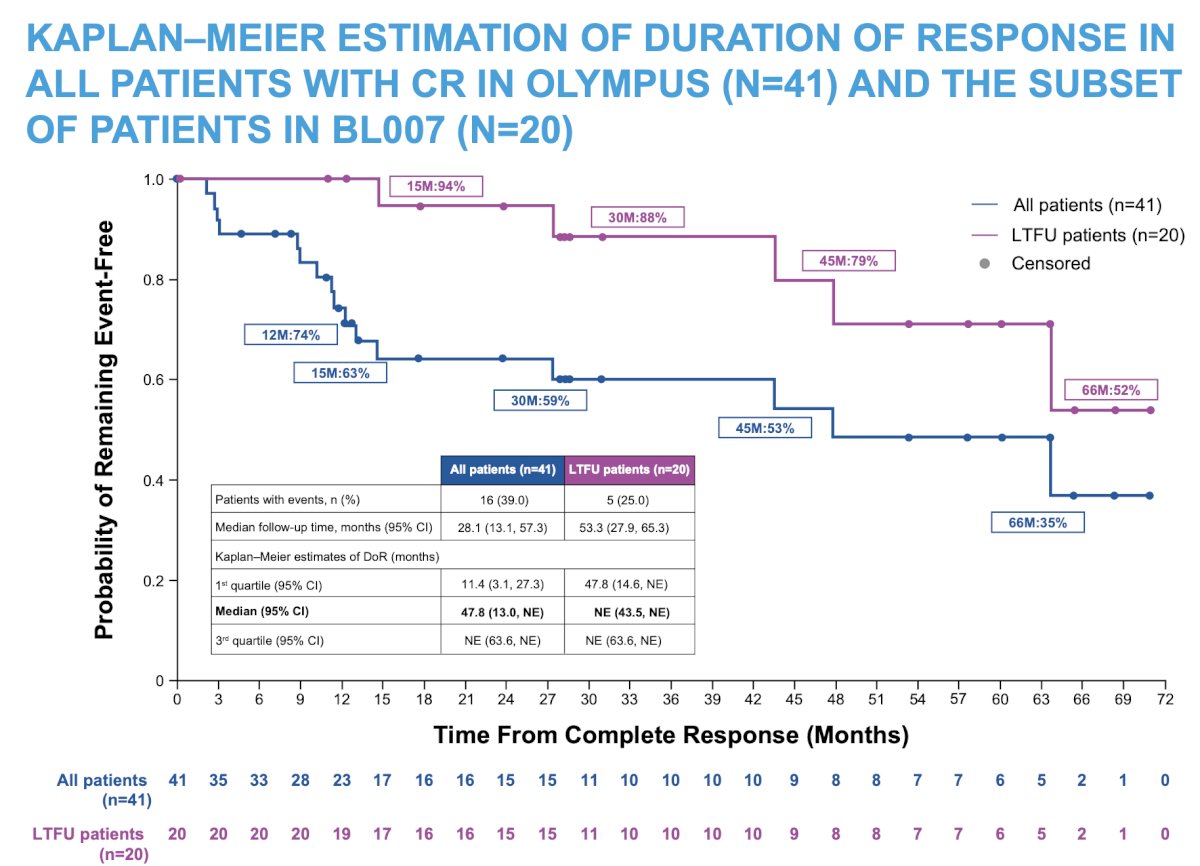
There were 5 patients in ongoing complete response at the end of the 5-year long-term follow-up study, with the longest reported duration of response of 82.6 months.
Dr. Chamie concluded his presentation discussing long-term outcomes of primary chemoablation of new-onset or recurrent low-grade upper tract urothelial carcinoma with UGN-101 with the following take-home points:
- Patients with low-grade upper tract urothelial carcinoma who achieved a complete response after receiving treatment with UGN-101 experienced a clinically meaningful long-term response, with a median duration of response of almost 4 years, irrespective of whether their cancer was new-onset or recurrent
- In the subset of patients entering the BL007 long-term follow-up study, the median duration of response was not estimable due to the low event rate
- The ongoing uTRACT registry (NCT05874921) provides an opportunity to evaluate real-world data in a larger sample, to further inform the use of UGN-101 in upper tract urothelial carcinoma patients
Presented by: Karim Chamie, MD, MSHS, Urologist, Associate Professor of Urology, University of California, Los Angeles, Los Angeles, CA
Written by: Zachary Klaassen, MD, MSc – Urologic Oncologist, Associate Professor of Urology, Georgia Cancer Center, Wellstar MCG Health, @zklaassen_md on Twitter during the 2025 Western Section American Urological Association (AUA) Annual Meeting, Napa Valley, CA, Sun, Nov 2 – Thurs, Nov 6, 2025.
References:
- Kleinmann N, Matin SF, Pierorazio PM, et al. Primary chemoablation of low-grade upper tract urothelial carcinoma using UGN-101, a mitomycin-containing reverse thermal gel (OLYMPUS): An open-label, single-arm, phase 3 trial. Lancet Oncol 2020 Jun;21(6):776-785.
- Pierorazio PM, Kleinmann N, Shabsigh A, et al. Long-term outcomes of primary chemoablation of low-grade upper tract urothelial carcinoma with UGN-101, a mitomycin reverse thermal gel. J Urol. 2025 Mar;213(3):313-322.