

(UroToday.com) The 2025 Western Section AUA annual meeting featured a urothelial carcinoma session and a presentation by Dr. Jay Raman discussing 5-year outcomes of the phase 2b Optima II study assessing the treatment of low-grade intermediate-risk non-muscle invasive bladder cancer with UGN-102.
The OPTIMA II phase 2b study treated patients with low-grade intermediate risk non-muscle invasive bladder cancer with UGN-102, a reverse thermal hydrogel containing mitomycin.1 Twelve-month primary efficacy and safety results were previously reported, and at the 2025 Western Section AUA annual meeting, Dr. Raman and colleagues reported the 5-year follow-up data.
Patients who participated in OPTIMA II and achieved a complete response at 3 months, after 6 once-weekly intravesical doses of UGN-102, were followed for up to 9 months after the initial complete response. Those with a complete response at study completion were eligible to enroll in an observational long-term follow-up study, which did not require protocol-specified interventions or visits. Supervising physicians provided semi-annual updates on a patient’s disease status. The outcomes included disease recurrence or progression and duration of response, which was calculated using the Kaplan–Meier method.
In total, 63 patients with a mean age of 70.5 (SD 11.7) years were enrolled and treated in OPTIMA II. Overall, 87.3% of patients were Caucasian and 60.3% were male. Most patients (77.8%) had recurrent disease at baseline with multiple prior TURBT procedures: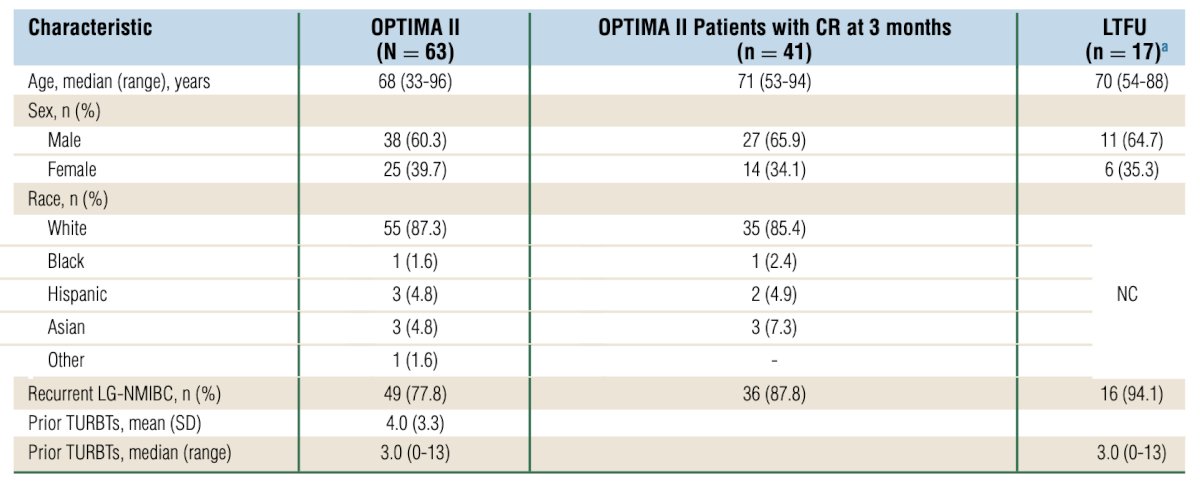
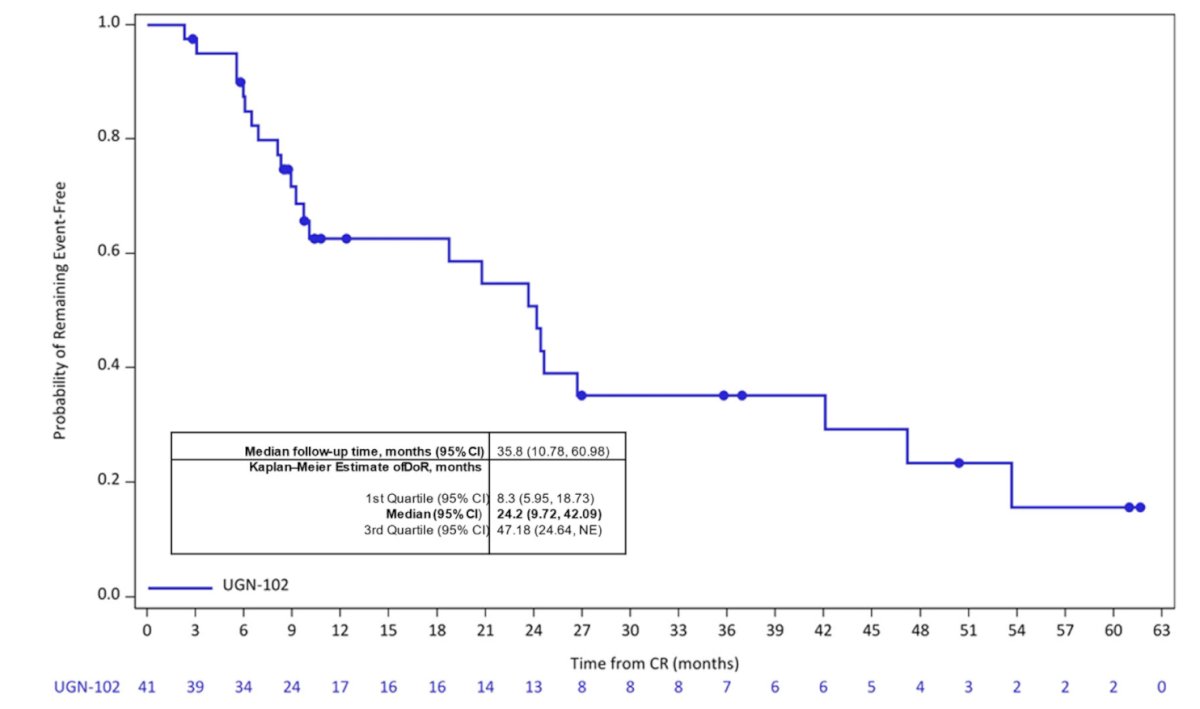
Of the 41 patients with complete response at 3 months, 25 remained disease-free at 12 months, and 17 entered long-term follow-up. For the 41 patients with complete response at 3 months, the median duration of response was 24.2 months (95% CI 9.7, 42.1), with a median follow-up time of 35.8 months (95% CI 10.8, 61.0):
For the 17 long-term follow-up patients, median duration of response was 42.1 months (95% CI 24.2, not estimable), with a median follow-up of 50.4 months (95% CI 27.0, not estimable):

Dr. Raman concluded his presentation discussing 5-year outcomes of the phase 2b Optima II study assessing the treatment of low-grade intermediate risk non-muscle invasive bladder cancer with UGN-102, with the following take-home points:
- UGN-102 results in clinically meaningful and highly durable complete responses in patients with low-grade intermediate-risk non-muscle invasive bladder cancer
- UGN-102 may represent an efficacious non-surgical alternative to TURBT for low-grade intermediate-risk non-muscle invasive bladder cancer patients
Presented by: Jay D. Raman, MD, Penn State Health Milton S. Hershey Medical Center, Hershey, PA
Written by: Zachary Klaassen, MD, MSc – Urologic Oncologist, Associate Professor of Urology, Georgia Cancer Center, Wellstar MCG Health, @zklaassen_md on Twitter during the 2025 Western Section American Urological Association (AUA) Annual Meeting, Napa Valley, CA, Sun, Nov 2 – Thurs, Nov 6, 2025.
Reference: