

(UroToday.com) The 2025 ASCO annual meeting featured a urothelial carcinoma session and a presentation by Dr. John Sfakianos discussing a substudy of the phase 3 ENVISION trial assessing the impact of tumor burden or focality in recurrent low-grade intermediate-risk non-muscle invasive bladder cancer on response to treatment with UGN-102. In the ENVISION pivotal phase 3 study, patients with low-grade intermediate-risk non-muscle invasive bladder cancer were treated with UGN-102, a reverse thermal hydrogel containing mitomycin. Primary efficacy and safety results were previously reported.1 Complete response rate at 3 months was 79.6%, with an 82.3% probability of remaining in response at 12 months by Kaplan–Meier estimate. At the 2025 ASCO annual meeting, Dr. Sfakianos and colleagues presented a post-hoc analysis evaluating whether multifocality and tumor size influenced response rate and durability.
In the single-arm ENVISION study, 240 patients with low-grade intermediate-risk non-muscle invasive bladder cancer received 6 weekly intravesical instillations of UGN-102:
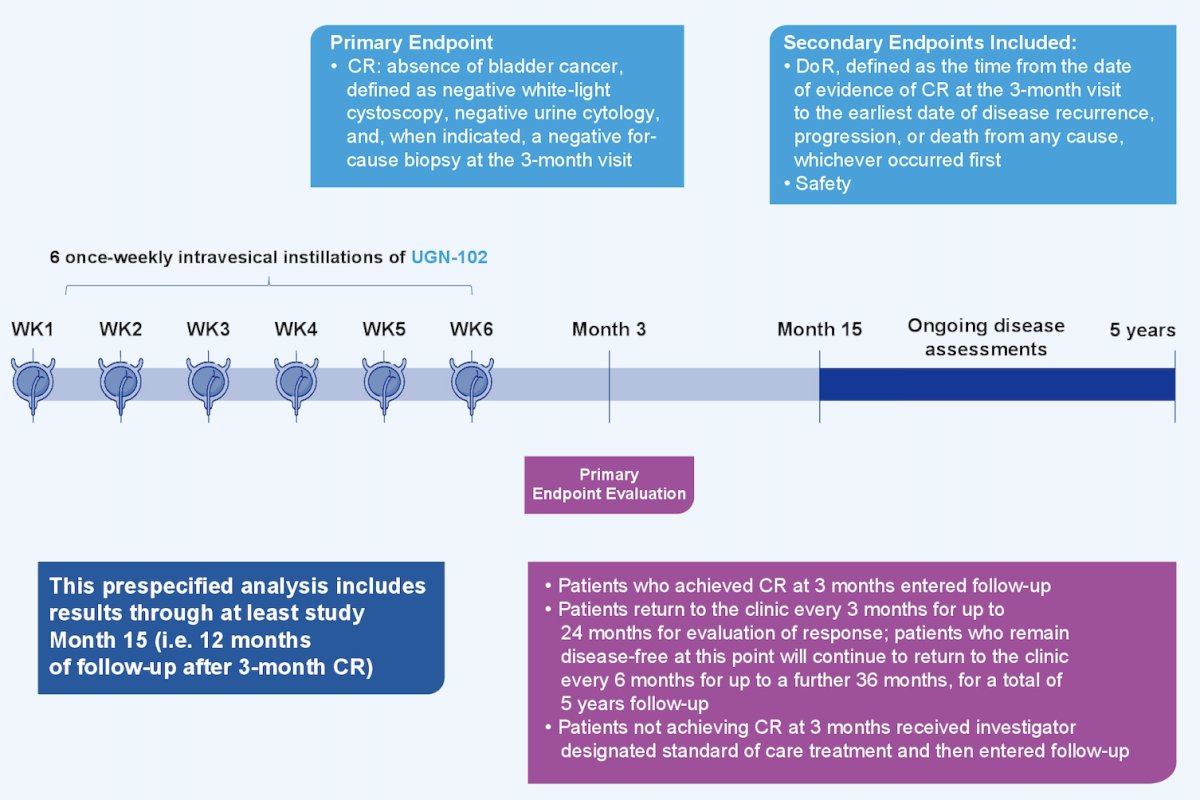
Three months after the first dose, patients were examined for the presence of bladder cancer using cystoscopy, urine cytology testing, and for-cause biopsy. Patients achieving complete response (no detectable disease) underwent follow-up with surveillance cystoscopy. In pre-specified subgroups, comparisons of patients with tumor burden (calculated as total length of all tumors) ≤3cm versus >3 cm and single versus multiple tumors were performed for complete response rate at 3 months and hazard ratios of duration of response at 12 months after achieving complete response. Hazard ratios of duration of response were calculated using a Cox proportional hazards model, and p values calculated using a log-rank test. Comparisons were not powered to identify a difference, and p values were unadjusted for multiple comparisons.
Complete response rate at 3 months was 82.8% versus 73.2% for patients with tumor burden ≤3 cm and >3 cm, respectively. Of patients with complete response at 3 months with tumor burden ≤3 cm and >3 cm, 15.4% versus 20%, respectively, experienced either recurrence of low grade disease, progression (either stage or grade), or death by 15 months. In patients with multiple versus single tumors, 3-month complete response was 79.3% versus 82.9%, and recurrence rates were 18.5% versus 11.8%:
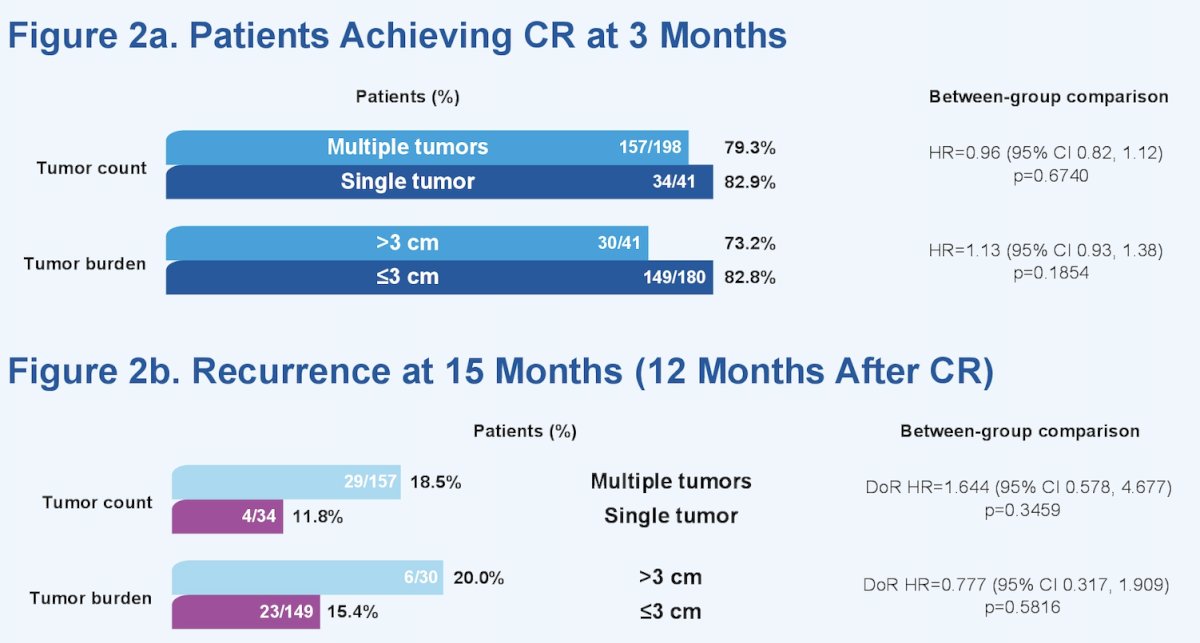
Duration of response hazard ratios were not statistically significant for any comparison made.
Dr. Sfakianos concluded his presentation discussing a substudy of the phase 3 ENVISION trial assessing the impact of tumor burden or focality in recurrent low-grade intermediate-risk non-muscle invasive bladder cancer on response to treatment with UGN-102, with the following take home points:
- Treatment with UGN-102 resulted in high, clinically meaningful complete response rate in patients with low grade intermediate risk non muscle invasive bladder cancer
- There was no significant difference in complete response rate or duration response at 12 months based on tumor burden or focality
- Study limitations were the small sample size of comparator groups, single arm design, and post-hoc nature of the analysis
- UGN-102 may represent a valuable treatment option for many patients with low-grade intermediate-risk non-muscle invasive bladder cancer
Presented by: John Sfakianos, MD, Icahn School of Medicine at Mount Sinai, New York, NY
Written by: Zachary Klaassen, MD, MSc – Urologic Oncologist, Associate Professor of Urology, Georgia Cancer Center, Wellstar MCG Health, @zklaassen_md on Twitter during the American Society of Clinical Oncology (ASCO) 2025 Annual Meeting, Chicago, IL, Fri, May 30 – Tues, Jun 3, 2025.
References: