

(UroToday.com) The 2025 SNMMI annual meeting featured a prostate cancer and dosimetry session and a presentation by Dr. Loic Djaileb discussing clinical protocols to monitor efficacy of 177Lu-PSMA radiopharmaceutical therapy in metastatic castration-resistant prostate cancer (mCRPC).
In 2021, the VISION trial established 177Lu-PSMA-617 radioligand therapy as a treatment option for men with PSMA positive mCRPC after androgen receptor pathway inhibitors and taxane-based chemotherapy.1 The objective this study was to assess the prognostic value of post-therapy 177Lu-PSMA-SPECT/CT by visual Response Evaluation Criteria In PSMA-imaging (RECIP) 1.0 during 177Lu-PSMA radioligand therapy and to develop an evidence-based clinical protocol to monitor efficacy of 177Lu-PSMA-617 treatment.
Patients with mCRPC who received 177Lu-PSMA-617 between April 2019 and November 2023 and underwent at least two 177Lu-PSMA-617 cycles were retrospectively included. Pairs of baseline and interim 177Lu-PSMA-SPECT/CT and PSMA-PET/CT after two therapy cycles were analyzed for visual RECIP 1.0. Changes in PSA levels at 12 weeks were categorized by PCWG3 and combined with RECIP 1.0 reads to determine progression using a composite classification method PSA + RECIP. The primary outcome was the prognostic value of post-therapeutic 177Lu-PSMA-SPECT/CT by RECIP 1.0 for overall survival. The clinical protocol was developed based on the prognostic accuracy (C-index) of 177Lu-PSMA-SPECT/CT versus PSMA-PET/CT and 177Lu-PSMA-SPECT/CT + PSA versus PSMA-PET/CT + PSA.
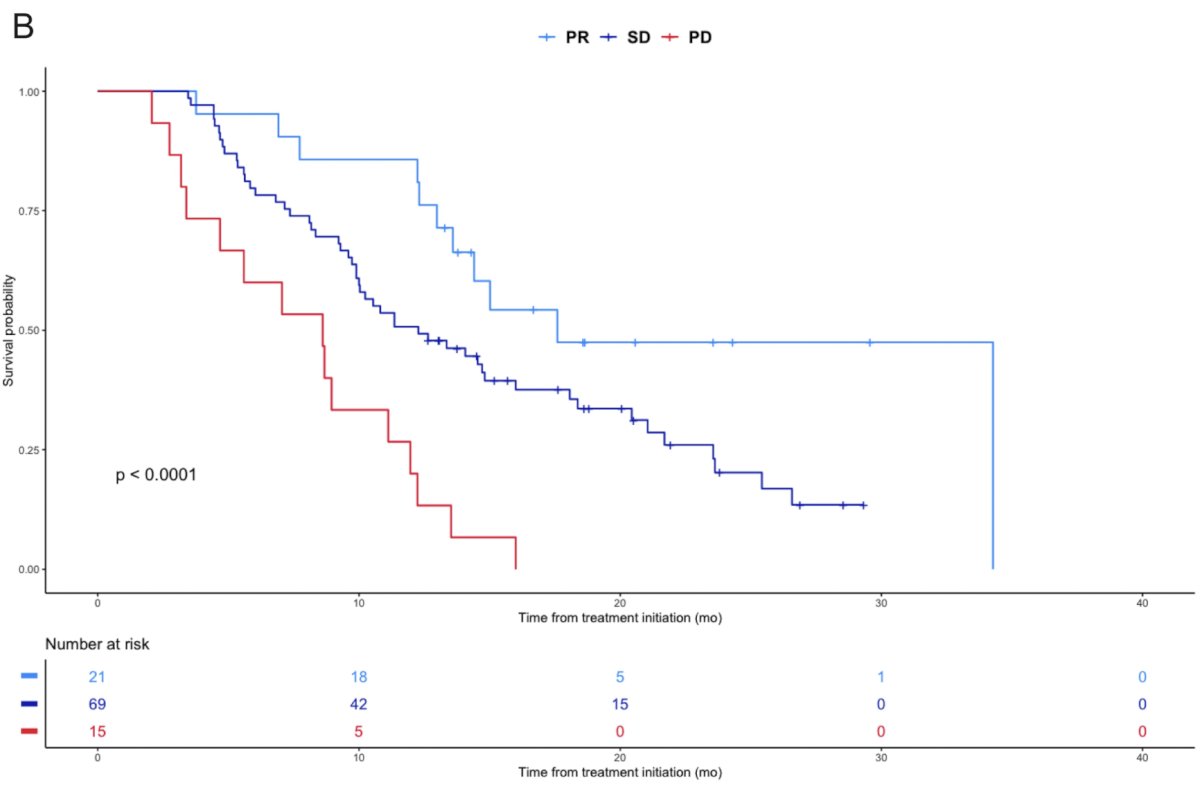
Overall, there were 105 patients eligible and included in the analysis. Progressive disease by 177Lu-PSMA-SPECT/CT was associated with shorter overall survival compared to stable disease (HR 2.5, 95% CI 1.2-5.3, p = 0.015) and to partial response (HR 6.5, 95% CI 2.7-15.7, p < 0.001):
There were 73 of 105 (70%) patients that received a PSMA-PET/CT after 2 cycles. Overall, 7 of 73 (10%), 30 of 73 (41%), 22 of 73 (30%), and 30 of 73 (41%) patients had tumor progression by 177Lu-PSMA-SPECT/CT, PSMA-PET/CT, 177Lu-PSMA-SPECT/CT + PSA, and PSMA-PET/CT + PSA, respectively. The C-index for 177Lu-PSMA-SPECT/CT was inferior compared to PSMA-PET/CT (0.54 versus 0.66; p < 0.001), while 177Lu-PSMA-SPECT/CT + PSA did not differ significantly from PSMA-PET/CT + PSA (0.62 versus 0.66; p = 0.07). The following Kaplan-Meier curves demonstrate overall survival for non-progressive versus progressive disease by SPECT RECIP, PET/CT RECIP, SPECT RECIP + PSA, and PET RECIP + PSA: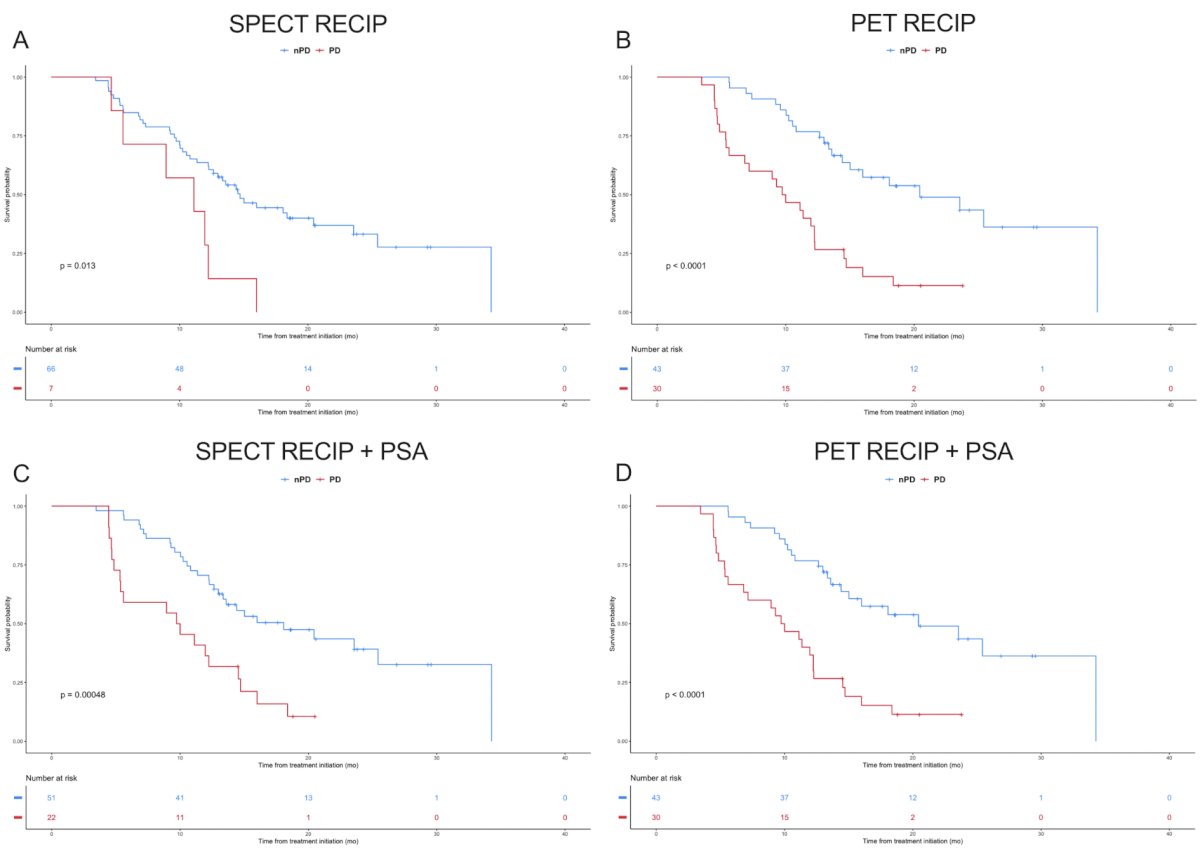
Dr. Djaileb concluded this presentation discussing clinical protocols to monitor efficacy of 177Lu-PSMA radiopharmaceutical therapy in mCRPC with the following take-home points:
- Post-therapeutic 177Lu-PSMA-SPECT/CT by RECIP 1.0 after two therapy cycles is prognostic for overall survival
- 177Lu-PSMA SPECT/CT identified significantly fewer patients with RECIP-progressive disease; however, 177Lu-PSMA-SPECT/CT + PSA achieved similar prognostic accuracy to PSMA-PET/CT + PSA for response evaluation during 177Lu-PSMA radioligand therapy
Presented by: Loic Djaileb, Ahmanson Biological Imaging Center, UCLA, Los Angeles, CA
Written by: Zachary Klaassen, MD, MSc – Urologic Oncologist, Associate Professor of Urology, Georgia Cancer Center, Wellstar MCG Health, @zklaassen_md on Twitter during the Society of Nuclear Medicine and Molecular Imaging (SNMMI) 2025 Annual Meeting, New Orleans, LA, Sat, Jun 21 – Tues, Jun 24, 2025.
Reference: