

(UroToday.com) The 2025 SESAUA annual meeting featured a prostate cancer session and a presentation by Dr. Arjun Pon Avudaiappan discussing survival outcomes of radical prostatectomy versus dose-escalated radiation with ADT in node-positive prostate cancer. Over the years, PSA screening and advancements in imaging helped in the early diagnosis of prostate cancer and a decline in the incidence of metastatic prostate carcinoma. However, 13% of patients still have clinically node-positive prostate cancer at the time of diagnosis, which has been considered to be associated with a higher likelihood of systemic disease. Thus, the use of radical prostatectomy has been limited. In the literature, only a few studies evaluate the effectiveness of radical prostatectomy in treating clinically node-positive prostate cancer. In this study, Dr. Avudaiappan utilized the National Cancer Database to compare the survival outcomes in patients treated with radical prostatectomy versus dose-escalated radiation with ADT.
This study focused on individuals aged 60-75 years diagnosed with clinically node-positive prostate cancer (cT1-3N1M0) and adenocarcinoma between 2004 and 2019. These patients were categorized into two primary cohorts: the radical prostatectomy cohort, which included patients who underwent radical prostatectomy, and the dose-escalated radiation cohort, which included patients who received both radiation >=79.2 Gy and ADT. The investigators also performed a propensity-matching with age, race, ethnicity, comorbidity index, clinical T stage, Gleason pattern, and a Kaplan-Meier analysis to compare both cohorts' overall survival.
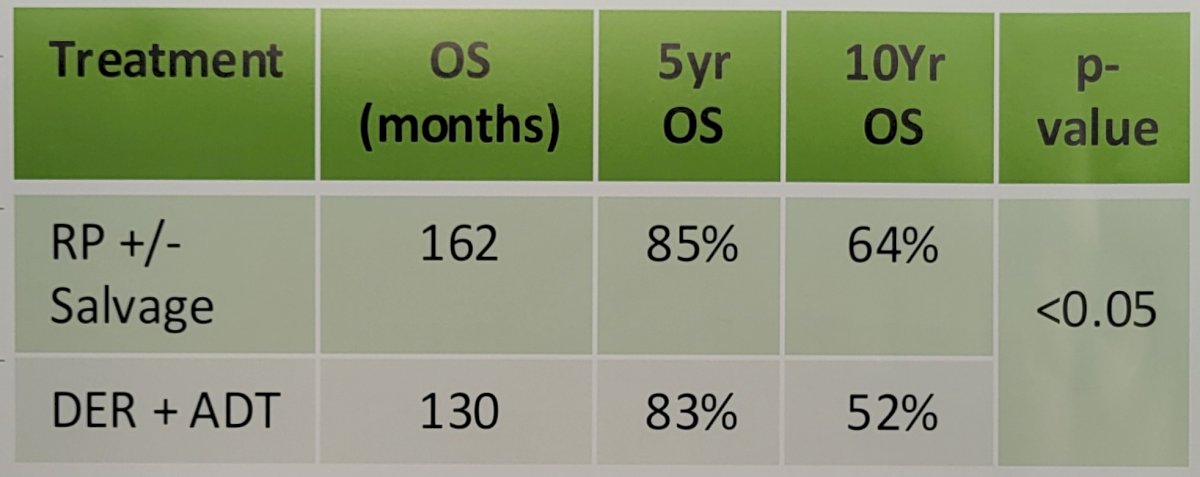
Among 18,788 patients with clinically node-positive prostate cancer, 2,990 patients met the selection criteria. There were 1,482 (49.5%) patients treated with radical prostatectomy and 1,508 (50.5%) patients that received dose-escalated radiation + ADT. In the radical prostatectomy cohort, 446 (30.1%), 265 (17.9%), and 105 (7.1%) had multimodal treatment with ADT, ADT + radiation, and radiation, respectively, while 666 (44.9%) had no adjuvant treatment. After propensity-matching, the overall survival of patients undergoing radical prostatectomy with or without salvage therapy and dose-escalated radiation + ADT was 162.1 months and 130 months, respectively (p < 0.05):
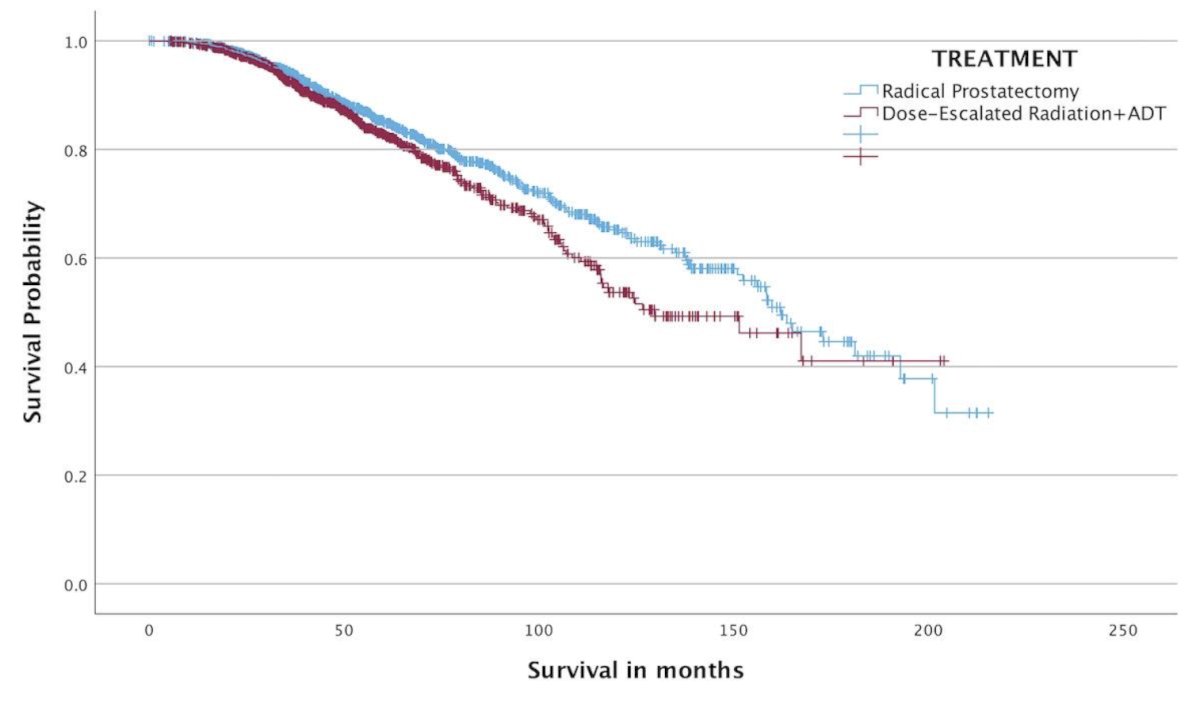
The multivariate Cox regression showed an increased mortality risk with dose-escalated radiation + ADT compared to radical prostatectomy with or without salvage therapy (HR 1.2, 95% CI, 1.1-1.5; p < 0.05):
Dr. Avudaiappan concluded his presentation by discussing survival outcomes of radical prostatectomy versus dose-escalated radiation with ADT in node-positive prostate cancer with the following take-home points:
- In this study on clinically node-positive prostate cancer, radical prostatectomy with or without salvage therapy had better overall survival than dose-escalated radiation + ADT, suggesting radical prostatectomy may have survival benefits in carefully selected individuals
- Therefore, a multimodal approach incorporating radical prostatectomy as an initial treatment followed by salvage radiation and ADT may improve survival outcomes
Written by: Zachary Klaassen, MD, MSc – Urologic Oncologist, Associate Professor of Urology, Georgia Cancer Center, Wellstar MCG Health, @zklaassen_md on Twitter during the American Urological Association (SESAUA) 2025 Annual Meeting, Nashville, TN, Wed, Mar 12 – Sat, Mar 15, 2025.