

(UroToday.com) The 2025 SESAUA annual meeting featured a prostate cancer session and a presentation by Dr. Siddharth Marthi discussing the results of an institution-wide prostate cancer screening intervention at a safety-net hospital caring for a high-risk population. The AUA, NCCN, and EAU guidelines all recommend screening for prostate cancer in high-risk patients, including those with Black ancestry, beginning between the ages of 40 and 45. However, because guidelines from the U.S. Preventive Services Task Force (USPSTF) do not directly address this, Black men frequently face delays in care and a greater burden of disease. Healthcare settings that primarily see high risk men are ideal targets for intervention to increase early screening rates and improve timely access to care. Grady Memorial Hospital in Atlanta, GA is a 953-bed safety-net hospital, an ideal location to understand the burden of prostate cancer within this patient population and to implement a system-wide initiative to reduce screening and access inequities.
An internal audit of all patients in the Grady Primary Care Active Patient registry was performed and identified the number of patients identifying as Black or African-American who received a screening PSA test. Dr. Marthi and colleagues then implemented an institution-wide initiative to recommend PSA screening for all male patients 40 years old or older, embedded as a reminder into the electronic medical record. This decision was made with multidisciplinary collaboration given the uniquely high-risk patient population served, in which >80% of patients identify as Black. Provider and community outreach efforts were conducted, and data was monitored to characterize rates of PSAs screened in men aged ≥40 years old prior to and after the intervention. PSA screening rates and rates of PSA >= 4.0 ng/mL were broken down by race and compared before and after the intervention.
Among Black men 40 years of age or older in the primary care registry (12,621 men), only 31.4% (3,961) of patients received a PSA test between September 1, 2021 and September 1, 2023:
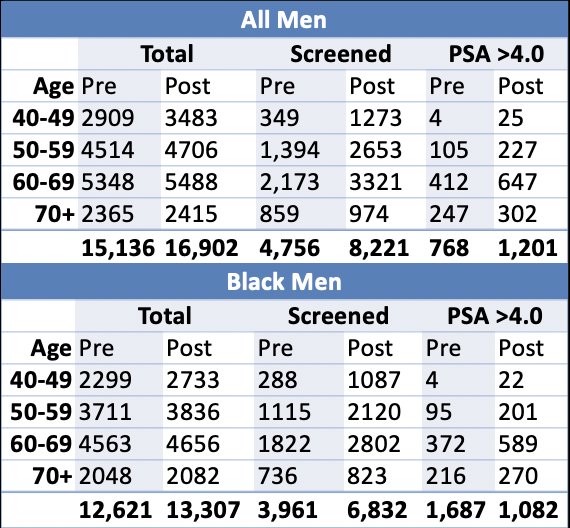
Following the system-wide initiative, between September 1, 2023, and September 1, 2024, 13,307 Black men aged 40 or older were in the primary care registry, of which 6,832 (51.3%) had a PSA drawn and were screened appropriately. Breakdown by age group and PSA testing are as follows:
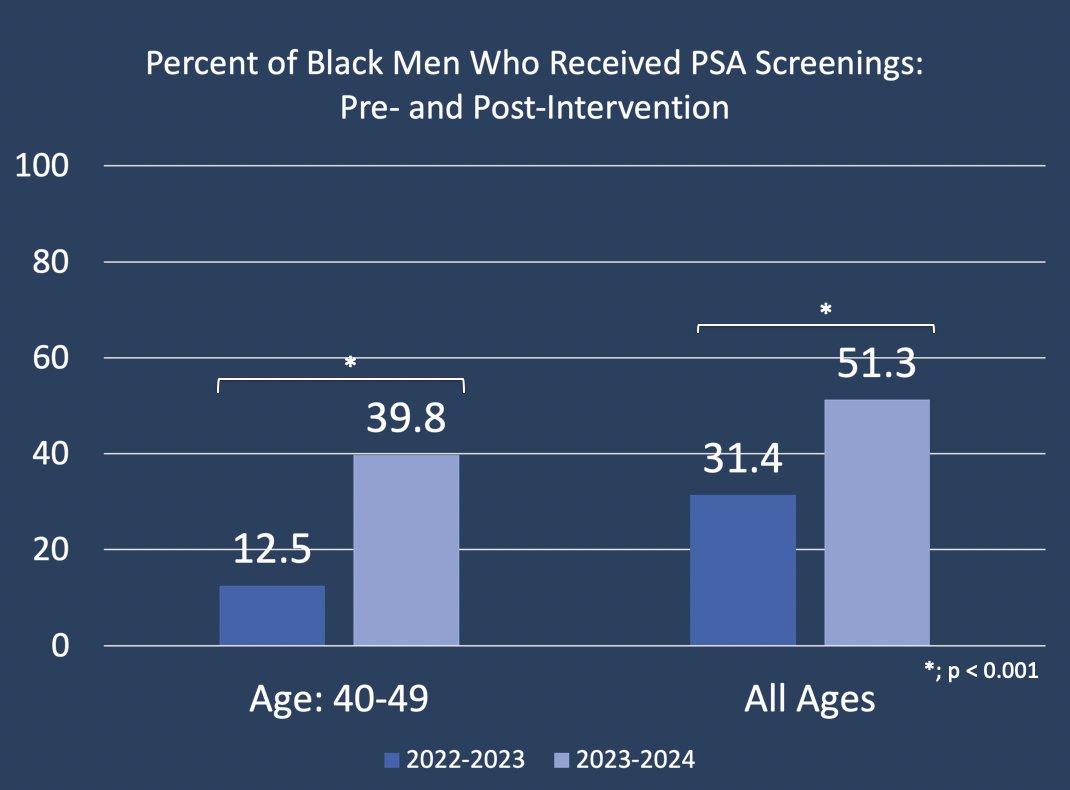
Of all screened men, a similar proportion was Black pre- and post-intervention. Moreover, the rate of PSA > 4.0 ng/mL in men aged 40-49 did not differ significantly, though it increased from 1.4% to 2.0%.
Dr. Marthi concluded his presentation by discussing the results of an institution-wide prostate cancer screening intervention at a safety-net hospital caring for a high-risk population with the following take-home points:
- For similar populations, interventions uniformly targeting all patients may improve screening and provision of timely care for high-risk patients
- Future research should evaluate detection rates of clinically significant cancer after such interventions
Presented by: Siddharth Marthi, MD, Department of Urology, Emory University, Atlanta, GA
Written by: Zachary Klaassen, MD, MSc – Urologic Oncologist, Associate Professor of Urology, Georgia Cancer Center, Wellstar MCG Health, @zklaassen_md on Twitter during the Southeastern Section of the American Urological Association (SESAUA) 2025 Annual Meeting, Nashville, TN, Wed, Mar 12 – Sat, Mar 15, 2025.