

(UroToday.com) The 2025 South Central AUA annual meeting included a session on bladder cancer, featuring a presentation from Dr. Yair Lotan discussing preliminary results from LEGEND, a phase 2 study of detalimogene voraplasmid, a novel, investigational, non-viral genetic medicine for high-risk non-muscle invasive bladder cancer. Bladder sparing therapies for high-risk non-muscle invasive bladder cancer address an important unmet need:

Detalimogene voraplasmid is a novel, investigational, non-integrating, non-viral genetic medicine-based immunotherapy carrying a plasmid that simultaneously expresses IL-12 and regulators of RIG-I. This simulates innate and adaptive immunity:

There is durable and promising efficacy in patients with high-risk non-muscle invasive bladder cancer, including BCG-unresponsive disease, while mitigating the risk of systemic toxicities from immune stimulation. The lyophilized powder is easily reconstituted in the clinic with sterile water, and no special handling or no ultra-cold chain storage is required (intravesical administration via a catheter). Results from the phase 1 portion of LEGEND demonstrated a promising safety and tolerability profile and an overall complete response rate of 73% in patients with non-muscle invasive bladder cancer with CIS. The pivotal phase 2 portion is ongoing, with outcomes from Cohort 1 (BCG unresponsive with CIS) reported at the 2025 South Central AUA annual meeting.
Patient eligibility criteria included (i) age ≥18 years, (ii) ECOG PS 0−2, (iii) BCG-unresponsive non-muscle invasive bladder cancer with CIS ± Ta/T1 disease, ineligible for, or elected not to undergo, cystectomy, and (iv) satisfactory bladder function with ability to retain study drug for ≥60 minutes. Based on the phase 1 portion of the study, a dose concentration of 0.8 mg/mL was administered at a four-dose 50 mL instillation schedule at study weeks 1, 2, 5 and 6 of a 12-week cycle. After completing the initial 12-week cycle, patients without progressive disease remained on detalimogene voraplasmid for up to three additional 12-week cycles: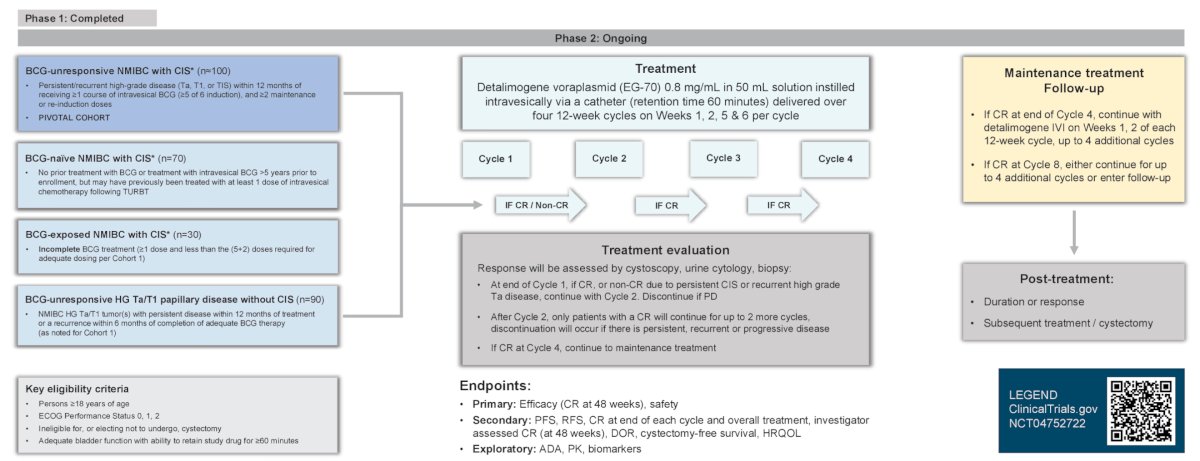
The primary endpoint was the week 48 complete response rate, and the secondary endpoints included safety and tolerability. Efficacy data on BCG-unresponsive patients with CIS (n = 21; Cohort 1) and safety data on all patients dosed (n = 42) are reported.
Twenty-one patients (15 males/6 females; median age 74 [range 59–92] years) have been enrolled in Cohort 1. The median number of prior BCG doses is 11 (range 8-33):
![Twenty-one patients (15 males/6 females; median age 74 [range 59–92] years) have been enrolled in Cohort 1. The median number of prior BCG doses is 11 (range 8-33):](/images/com-doc-importer/226-scs-aua-2025/scs-aua-2025-preliminary-results-from-legend-a-phase-2-study-of-detalimogene-voraplasmid-a-novel-investigational-non-viral-genetic-medicine-for-high-risk-nmibc/image-3.jpg)
Treatment-related adverse events (any grade) were reported in 20 (47.6%) patients and were all Grade 1/2 in severity. The most common treatment-related adverse events were dysuria in 9 (21.4%) patients, bladder spasm in 8 (19.0%), pollakiuria in 5 (11.9%), and fatigue in 5 (11.9%) patients:

In the efficacy-evaluable population for Cohort 1, the overall complete response rate was 71% (15/21), with a complete response rate of 67% (14/21) at 3 months, and 47% (8/17) at 6 months. The Kaplan-Meier estimate of the 6-month complete response is 51%:

Dr. Lotan concluded his presentation discussing preliminary results from LEGEND with the following take-home points:
- Preliminary data from the pivotal Phase 2 portion of LEGEND suggest a promising safety and tolerability profile
- Overall, 71% of patients achieved a complete response, with 67% achieving a complete response at 3 months and 47% achieving a complete response at 6 months
- All four cohorts continue to enroll, with a target accrual of approximately 300 patients
Presented by: Yair Lotan, MD, Urologic Oncologist, UT Southwestern Medical Center, Dallas, TX
Written by: Zachary Klaassen, MD, MSc – Urologic Oncologist, Associate Professor of Urology, Georgia Cancer Center, Wellstar MCG Health, @zklaassen_md on Twitter during the 2025 South Central American Urological Association (AUA) Annual Meeting, Orlando, FL, Wed, Sept 10 – Sat, Sept 13, 2025.