

(UroToday.com) The 2025 European Association of Urology (EAU) Annual Meeting held in Madrid, Spain between March 21st and 24th 2025, was host to the Abstract Session 05: On the Horizon: Ongoing Trials in Urology. Dr. Claudia Kesch presented Abstract A0079: A phase I/II study of neoadjuvant, intra-arterial administration of (177Lu) lutetium vipivotid tetraxetan in subjects with high-risk, localised or locally advanced prostate cancer (LUPUS).
LUPUS is a two-stage phase I/II safety and feasibility study evaluating (¹⁷⁷Lu)-Lutetium vipivotide tetraxetan as a pelvic intra-arterial infusion (internal iliac artery) in men with localized or locally advanced high-risk prostate cancer who are candidates for radical prostatectomy. Eligible patients must have at least one high-risk feature, including Gleason score ≥ 4+4=8, PSA ≥ 20 ng/mL, extracapsular extension on mpMRI/PSMA-PET, or cN+ disease on mpMRI/PSMA-PET.
- Gleason Score ≥ 4+4=8 and/or
- PSA ≥ 20 ng/mL and/or
- Extracapsular extension (mpMRI/PSMA-PET) and/or
- cN+ (mpMRI/PSMA-PET)
In the first stage, 10 patients will receive a single cycle of 200 mCi (7.4 GBq) of (¹⁷⁷Lu)-Lutetium vipivotide tetraxetan. If ≥4 of these 10 patients experience a delay in surgery or CTCAE Grade ≥3 adverse events (AEs) due to treatment, the study will be terminated. Otherwise, an additional 10 patients will be enrolled in the second stage and receive a single cycle of 400 mCi (14.8 GBq) of (¹⁷⁷Lu)-Lutetium vipivotide tetraxetan. At six weeks, patients will be reassessed and undergo radical prostatectomy.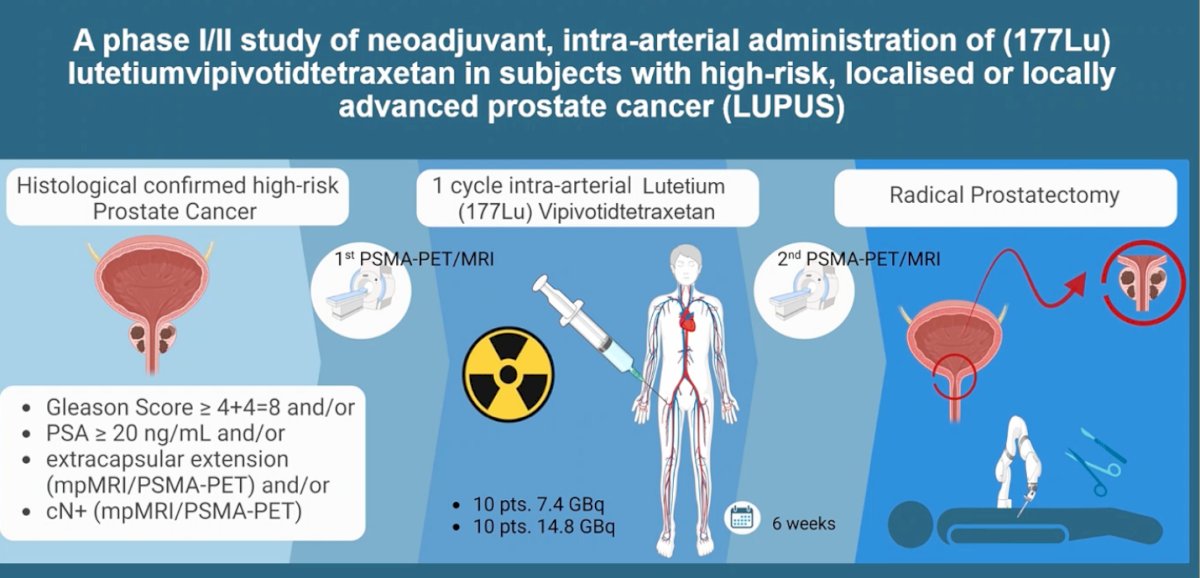
The primary endpoint of the study is feasibility. Intra-arterial (¹⁷⁷Lu)-Lutetium vipivotide tetraxetan therapy will be considered not feasible if ≥40% of patients require a delay in surgery due to treatment-related adverse events (AEs) or experience Grade ≥3 treatment-related AEs.
Key Secondary Endpoints include:
- PSA response
- Pathologic response as measured by pathological complete response (pCR)
- Minimal residual disease (MRD), defined as a tumour burden of ≤5 mm in greatest dimension
Other Endpoints are summarized below: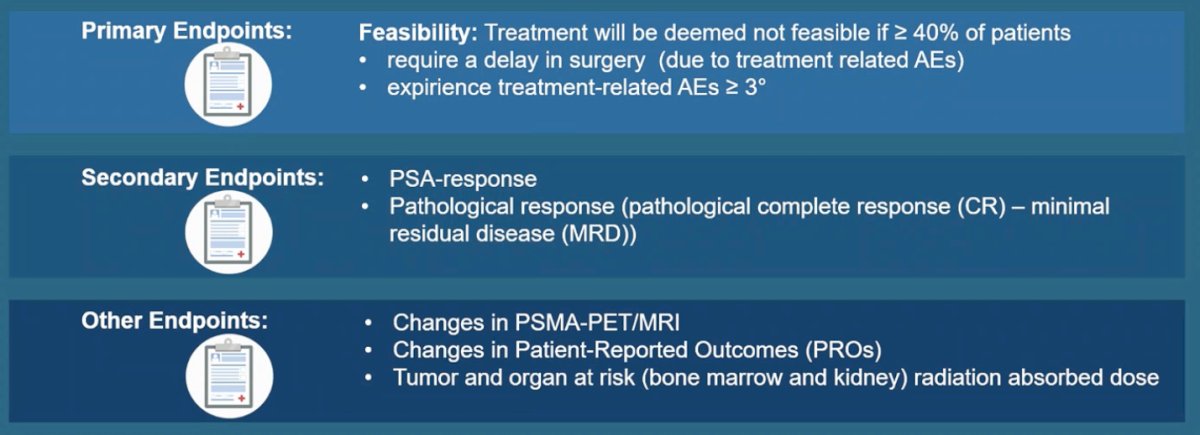
Dr. Kesch mentioned that for inclusion criteria they will only be enrolling patients with PSMA-positive disease on initial PSMA PET and concluded that LUPUS is the first trial investigating (177Lu) Lutetium vipivotide tetraxetan intra-arterial infusions and will help to evaluate if there is a role for neoadjuvant radioligand therapy in high-risk prostate cancer and if intra-arterial administration is the way to go.
Presented by: Claudia Verena Kesch, MD, Department of Urology, University Hospital Essen, Essen German Cancer Consortium (DKTK) University Hospital Essen, Essen, Germany
Written by: Julian Chavarriaga, MD – Urologic Oncologist at Cancer Treatment and Research Center (CTIC) via Society of Urologic Oncology (SUO) Fellow at The University of Toronto. @chavarriagaj on Twitter during the 2025 European Association of Urology (EAU) Annual Meeting held in Madrid, Spain between March 21st and 24th 2025