

(UroToday.com) The 2024 European Association of Urology (EAU) annual congress held in Paris, France between April 5th and 8th was host to a non-muscle invasive bladder cancer (NMIBC) poster session of studies evaluating the benefits and harms of various treatment options. Dr. Felix Guerrero-Ramos presented the first results of the phase Ib-II BladderGATE clinical trial, which evaluated intravenous atezolizumab + intravesical bacillus Calmette-Guérin (BCG) upfront combination in BCG-naïve, high-risk NMIBC patients.
Intravesical Bacillus Calmette-Guerin (BCG) currently remains the standard-of-care, guideline recommended treatment of choice in the adjuvant setting for intermediate- and high-risk NMIBC due to its ability to reduce the risk of disease recurrence and, more importantly, disease progression.1-3 However, despite adequate BCG treatment, defined as receipt of at least five doses of the initial six-dose induction course and at least 2/3 maintenance doses or at least 2/6 doses of the second induction course, up to 50% of such patients will develop a BCG-refractory, relapsing, or failure state.4 Currently, radical cystectomy remains the gold standard approach in this setting.1 However, many patients are either unfit or refuse cystectomy. As such, bladder-sparing approaches in this setting are of utmost importance.
Atezolizumab is an IgG1 monoclonal antibody targeting Programmed Death Ligand-1 (PD-L1) and is associated with long-term durable remissions in patients with metastatic urothelial cancer5 and for patients with unresponsive NMIBC with excellent results.6 Thus, atezolizumab in combination with standard BCG could provide a synergistic benefit for patients with NMIBC. BladderGATE (NCT04134000) is an open label, phase Ib-II, dose de-escalation clinical trial evaluating the safety and efficacy of upfront atezolizumab + intravesical BCG in patients with high-risk NMIBC.
In this trial, patients received atezolizumab 1,200 mg IV day 1 of each 21-day cycle (maximum 52 weeks) plus BCG weekly x 6 weeks (induction period) followed by maintenance weekly x 3 weeks at weeks 12, 24, and 48.
The study eligibility criteria are as follows:
- Histologically confirmed diagnosis of high-risk non-muscle-invasive (T1, high grade Ta - G3- and / or carcinoma in situ) urothelial carcinoma of the bladder
- No prior treatment with BCG or stopped >2 years prior with no previous radiotherapy to the bladder
- WHO performance status 0-1, life expectancy ≥ 5 years, and adequate hematologic and end-organ function
- Time elapsed between the TURBT and the start of the study treatment ≥ 4 weeks and < 12 weeks
- Tumor tissue biopsy at study entry or an archival specimen obtained within two months of study screening
The study objectives were as follows:
- Primary
- De-escalation phase: To determine the dose-limiting toxicity and minimum tolerated dose
- Expansion phase: To evaluate preliminary activity: high-grade bladder cancer recurrence-free survival
- Secondary
- To evaluate safety profile according to NCI-CTC v5.0 criteria
- To evaluate a preliminary assessment of patient-reported symptoms, function, and health-related quality of life, as measured by EORTC QLQ-C30 and EORTC QLQ-NMIBC24
The baseline patient characteristics are summarized below. 90% of patients had papillary disease. Multifocal tumors were present in 44% of patients.
With regards to study treatment, 56% of patients completed all six weeks of BCG and almost 90% received an adequate course, as per the FDA’s definition. 61% of patients received all planned doses of atezolizumab, with a median of 14.5 doses administered. The most common cause of atezolizumab non-compliance was immune-related adverse events (50%). Grade ≥3 immune-related events occurred in almost 20% of patients.
At a median follow-up of 31.5 months, the median disease-free survival had not been reached.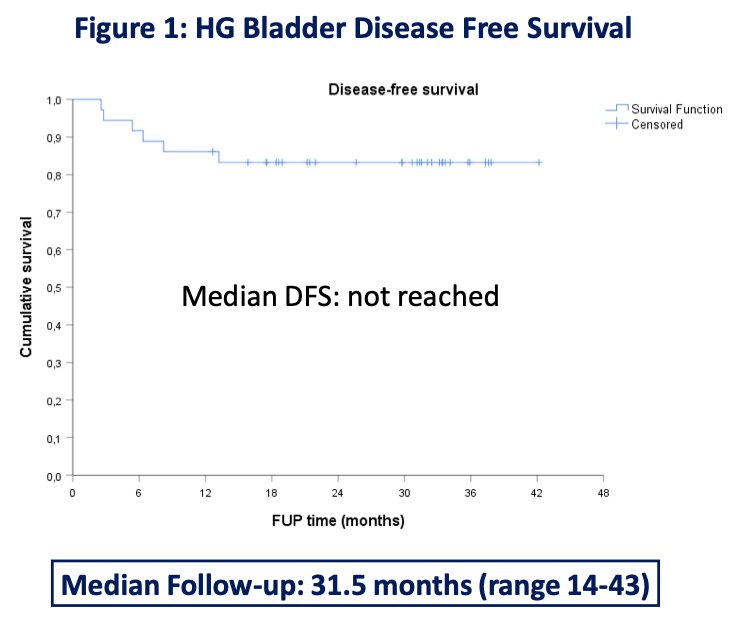
The 2-year high-grade bladder recurrence-free survival was 83.2%. Local recurrences were mostly high-grade (6/7 recurrences). There were two (5.6%) upper tract recurrences, and two patients progressed to muscle-invasive disease. 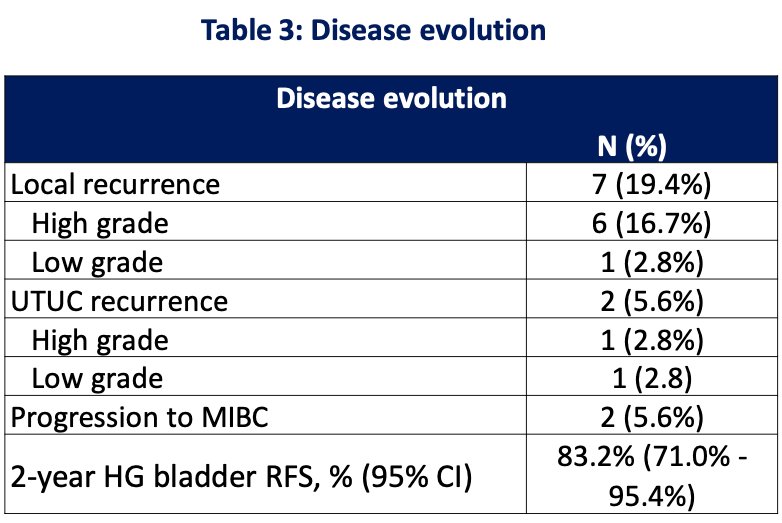
Dr. Felix Guerrero-Ramos concluded as follows:
- The combination strategy of atezolizumab + intravesical BCG upfront in high-risk NMIBC patients appears feasible and safe.
- The 2-year high-grade bladder recurrence-free survival was 83.2%, and only 5.6% of patients progressed to muscle-invasive disease.
- This combination will be further assessed in the phase 3 ALBAN study data (GETUG).
Presented by: Felix Guerrero-Ramos, MD, PhD, FEBU, Department of Urology, Hospital Universitario 12 de Octubre, Madrid Spain
Written by: Rashid Sayyid, MD, MSc - Society of Urologic Oncology (SUO) Clinical Fellow at The University of Toronto, @rksayyid on Twitter during the 2024 European Association of Urology (EAU) annual congress, Paris, France, April 5th - April 8th, 2024
References:
- EAU Guidelines: Non-muscle-invasive Bladder Cancer.
- Sylvester RJ, Brausi MA, Kirkels WJ, et al. Long-term efficacy results of EORTC genito-urinary group randomized phase 3 study 30911 comparing intravesical instillations of epirubicin, bacillus Calmette-Guerin, and bacillus Calmette-Guerin plus isoniazid in patients with intermediate- and high-risk stage Ta T1 urothelial carcinoma of the bladder. Eur Urol. 2010;57(5):766-73.
- Schmidt S, Kunath F, Coles B, et al. Intravesical Bacillus Calmette-Guérin versus mitomycin C for Ta and T1 bladder cancer. Cochrane Database Syst Review. 2020;1(1):CD011935.
- Babjuk M, Burger M, Comperat EM, et al. European Association of Urology Guidelines on non-muscle-invasive bladder cancer (TaT1 and carcinoma in situ) - 2019 Update. Eur Urol. 2019;76(5):639–57.
- van der Heijden MS, Loriot Y, Duran I, et al. Atezolizumab Versus Chemotherapy in Patients with Platinum-treated Locally Advanced or Metastatic Urothelial Carcinoma: A Long-term Overall Survival and Safety Update from the Phase 3 IMvigor211 Clinical Trial. Eur Urol. 2021;80(1):7-11.
- Black PC, Tangen CM, Singh P, et al. Phase 2 Trial of Atezolizumab in Bacillus Calmette-Guérin-unresponsive High-risk Non-muscle-invasive Bladder Cancer: SWOG S1605. Eur Urol. 2023;84(6):536-44.