

(UroToday.com) The 2025 AUA annual meeting featured an upper tract urothelial carcinoma session and a presentation by Dr. Brian Hu discussing long-term outcomes of treatment of recurrent or new-onset low-grade upper tract urothelial carcinoma with UGN-101. Endoscopically guided ablation is commonly used to treat low-grade upper tract urothelial carcinoma. While effective, ablation is not typically durable, requiring long-term endoscopic surveillance associated with potential complications. Topical adjuvant aqueous chemotherapy has a modest effect on disease recurrence following local ablation. In the phase 3 OLYMPUS trial, UGN-101, a reverse thermal gel containing mitomycin (4 mg/mL) used as primary treatment for low-grade upper tract urothelial carcinoma, resulted in clinically significant disease eradication.1 At the 2025 AUA annual meeting, Dr. Hu and colleagues reported data from a noninterventional study following the long-term outcomes of patients who achieved complete response following treatment with UGN-101 in the phase 3 OLYMPUS trial.
Patients who participated in the OLYMPUS trial and achieved a complete response after 6 weekly doses of UGN-101 were followed for up to 12 months after initial complete response. Those with complete response at study completion were eligible to enroll in a long-term follow-up study:

Outcomes included duration of response and disease recurrence or progression. There were no protocol-specified interventions or treatments, protocol-specified visits, or evaluations, and supervising physicians provided semiannual updates on patients’ disease status.
Of the 71 patients enrolled in OLYMPUS (68% male, 87% White, median age 71 years), 42 achieved complete response 4–6 weeks after the last dose of UGN-101, approximately 3 months after study start. Among 41 patients followed after initial complete response (1 withdrew consent), the median follow-up was 28.1 months (95% CI 13.1, 57.5), and the median duration of response was 47.8 months (95% CI 13.0, NE):

The Swimmer plot of duration of response in OLYMPUS and the long term follow-up cohort is as follows:
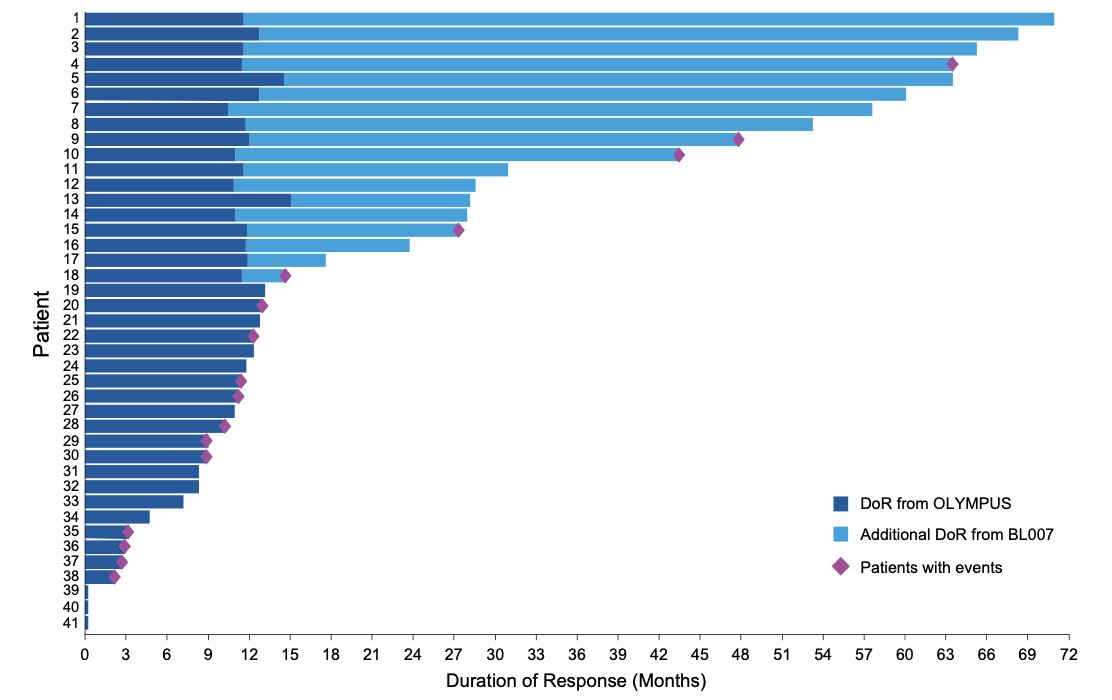
Among these patients, 21 had new-onset upper tract urothelial carcinoma, and 20 had recurrent upper tract urothelial carcinoma at baseline. Duration of response was the same for both groups, with 8 patients in each group experiencing recurrence or death. Twenty patients (49%) had long-term follow-up (median 53.3 months [95% CI 27.9, 65.3]), with 75% having no evidence of recurrence at the last follow-up, and a median duration of response not estimable (95% CI 43.5, NE) secondary to a low event rate. Among patients with a complete response at 3 months, the Kaplan-Meier estimate of duration of response in the long term follow-up cohort was 52% at 66 months:

Of the patients evaluated, 2 (10%) experienced upper tract urothelial carcinoma tumor recurrence, and 3 (15%) died: 2 secondary to unknown reasons, and 1 due to septic shock from E. coli bacteremia and acute hypoxemic respiratory failure. There were no deaths related to study treatment, and no reported progressions to high-grade disease.
Dr. Hu concluded his presentation discussing long-term outcomes of treatment of recurrent or new-onset low-grade upper tract urothelial carcinoma with UGN-101 with the following take home points:
- Patients with low-grade upper tract urothelial carcinoma who achieved complete response after receiving treatment with UGN-101 experienced a clinically meaningful long-term response
- The median duration of response of all patients achieving a complete response in OLYMPUS was 47.8 months, irrespective of whether their cancer was new onset or recurrent
- The ongoing uTRACT registry (NCT05874921) will provide an opportunity to collect and evaluate real-world data in a larger sample, to further inform the use of UGN-101 in upper tract urothelial carcinoma patients
Written by: Zachary Klaassen, MD, MSc – Urologic Oncologist, Associate Professor of Urology, Georgia Cancer Center, Wellstar MCG Health, @zklaassen_md on Twitter during the 2025 American Urological Association (AUA) annual meeting held in Las Vegas, NV, Saturday, April 26 - Tuesday, April 29, 2025