

(UroToday.com) The American Urological Association (AUA) 2025 Annual Meeting, held in Las Vegas, NV, between April 26th and 29th, 2025, was host to a non-invasive bladder cancer interactive poster session. Dr. Agustin Perez-Londono presented a predictive model of disease recurrence and progression risks in non-muscle invasive bladder cancer (NMIBC) patients undergoing blue light cystoscopy (BLC)-guided TURBTs.
Dr. Perez-Londono argued that the prediction of disease recurrence and progression risks is essential for risk-adapted management of NMIBC patients. Although BLC is recommended by several guidelines to potentially reduce subsequent recurrence rates, predictive models for patients undergoing BLC are currently lacking. Dr. Perez-Londono and colleagues evaluated clinicopathologic predictors of recurrence and progression in a contemporary cohort of patients who underwent a BLC and subsequently developed risk prediction models for disease recurrence and progression.
They identified patients aged 18–89 years from the multi-institutional Blue Light Cystoscopy with Cysview Registry who underwent a BLC-TURBT between 2014 and 2023. Recurrence-free (RFS) and progression-free survivals (PFS) were estimated using Kaplan-Meier curves. Predictors of RFS and PFS were evaluated using Cox regression models. Predictive models for RFS and PFS were built using Lasso regression to minimize overfitting, with performance characteristics assessed using the c-statistic and decision curve analyses.
The study cohort includes 1,109 patients. The baseline characteristics are summarized below. The median study follow-up was 18–24 months. Disease recurrence and progression events were observed in 32% and 7% of patients, respectively.

On multivariable analysis, significant predictors of an increased recurrence rate were a greater number of tumors (HR per each additional tumor: 1.09, 95% CI: 1.01–1.17) and recurrent disease (HR versus primary: 1.32, 95% CI: 1.04–1.66). Conversely, pure CIS (HR: 0.69, 95% CI: 0.48–0.98) and receipt of peri-operative intravesical chemotherapy were associated with lower recurrence rates.
Increased rates of progression were observed in patients with more advanced tumor stages (HR for T1 vs Ta: 3.88; HR for T1 + CIS vs Ta: 3.69) and lymphovascular invasion (HR: 3.88, 95% CI: 1.5–10.1).
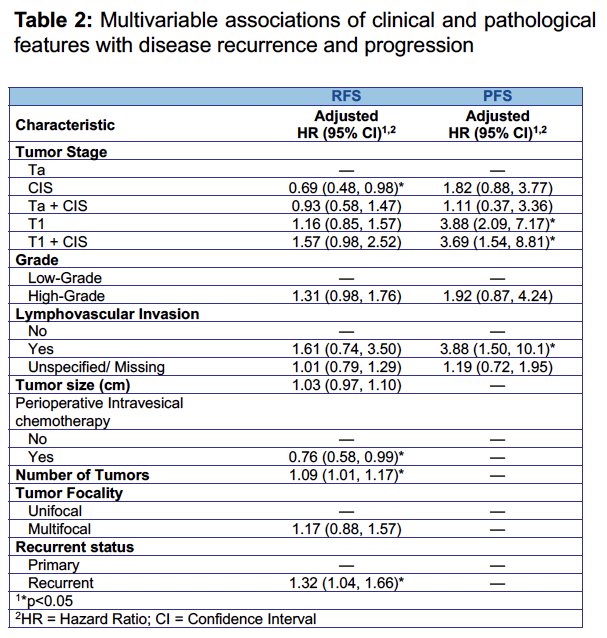
The β coefficients for each covariate in the Lasso regression models of RFS and PFS are summarized in the table below:
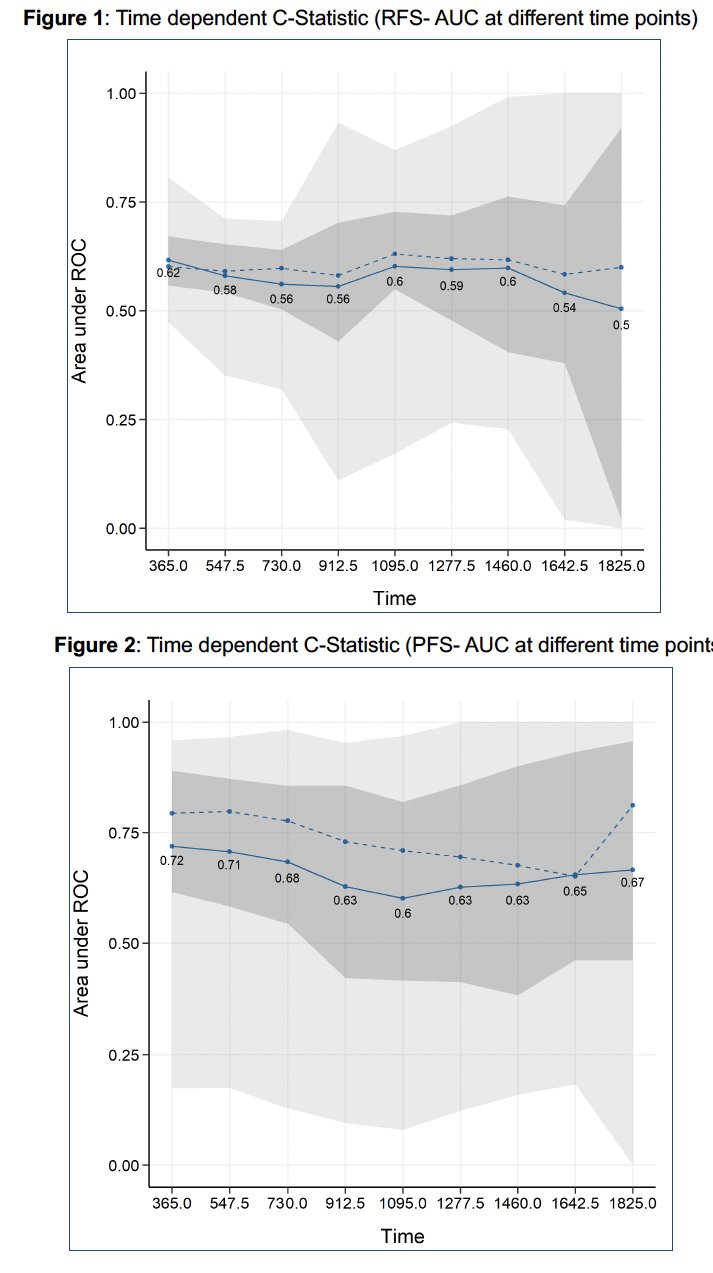
The time-dependent discriminations (C-statistics) for the RFS and PFS predictive models are summarized below:
Dr. Perez-Londono concluded as follows:
- Using a multi-institutional cohort, the study investigators developed predictive models for disease recurrence and progression in patients treated with BLC
- Although not yet externally validated, these models reflect contemporary treatment paradigms incorporating BLC and adjuvant therapies
- These models may potentially inform personalized, risk-adapted management of NMIBC
Presented by: Agustin Perez-Londono, MD, Post-doctoral Research Fellow, Beth Israel Deaconess Medical Center, Boston, MA
Written by: Rashid K. Sayyid, MD, MSc – Robotic Urologic Oncology Fellow at The University of Southern California, @rksayyid on Twitter during the 2025 American Urological Association (AUA) annual meeting held in Las Vegas, NV, Saturday, April 26 - Tuesday, April 29, 2025