

(UroToday.com) The Advanced Prostate Cancer Consensus Conference (APCCC) Diagnostics 2025 held in Lugano, Switzerland was host to a session addressing the contemporary management of biochemically recurrent prostate cancer patients. Dr. Hebert Vargas discussed what magnetic resonance imaging (MRI) can contribute in the biochemically recurrent setting.
While PSMA PET has emerged as the imaging tool of choice in the biochemically recurrent setting, several key questions remain:
- Can we combine PSMA and MRI?
- If so, which should be performed 1st?
- Should pelvic MRI only, targeted MRI or a whole-body MRI be performed?
What can an MRI contribute in the biochemically recurrent setting? MRI may be of value in cases of PSMA-negative recurrences. Approximately 12% of patients harbor PSMA-negative tumors (i.e., % negative PSMA expression on immunohistochemistry >50%).1

MRI can be used in this setting to detect soft tissue morphologic changes that would have otherwise been missed on PSMA PET. However, to date, there is no data on the prevalence of PSMA-negative, MRI-positive lesions or the outcomes of patients with PSMA/MRI-negative biochemical recurrences.

Another potential role for MRI in the biochemically recurrent setting is to provide anatomic clarification of PSMA avid findings.
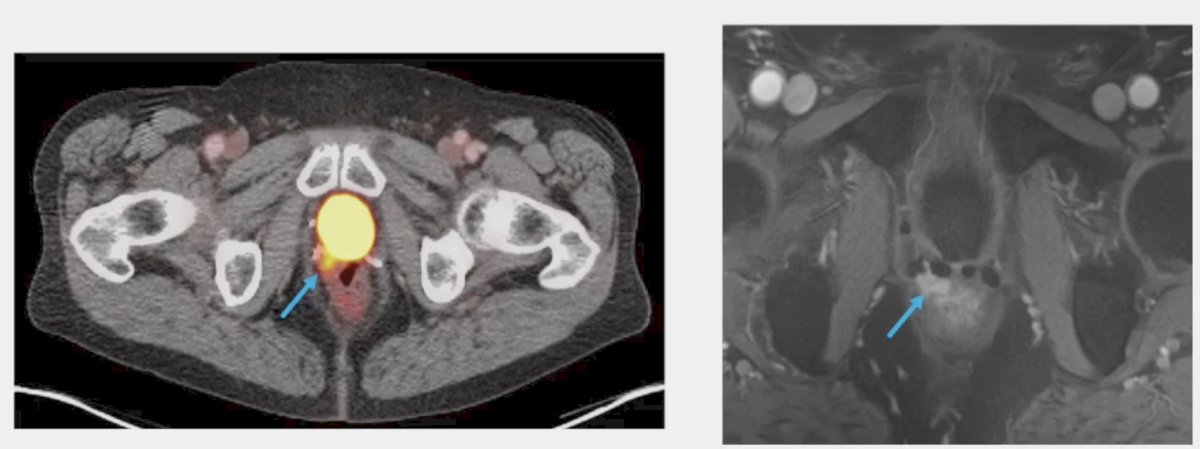
Additionally, MRI can be used to assess bone lesions (e.g., unspecified bone uptake, degenerative changes).

An MRI may also be used to morphologically evaluate lesions with high PSMA uptake in solid organs, such as the liver and kidneys.

In the salvage setting, MRI may also be used to define target volumes for salvage radiotherapy and salvage radical prostatectomy planning, such as evaluating posterolateral margins, extent of apical disease, and considering focal boosting to minimize future relapses, with the ESTRO ACROP consensus recommending dose-escalations to sites of recurrence if an anatomic correlate is visible.

In summary, does MR contribute to the biochemically recurrent setting? Dr. Vargas argued with a resounding yes in the following scenarios:
- PSMA negative recurrences
- Anatomic clarification of PSMA avid findings
- Assessment of bone lesions
- PSMA uptake in solid organs (e.g., liver)
- Target volume definition for salvage radiotherapy and salvage radical prostatectomy planning
Presented by: Hebert A. Vargas, MD, Department of Radiology, Oncologic Imaging Division, NYU Langone Health, New York, NY
Written by: Rashid K. Sayyid, MD, MSc – Robotic Urologic Oncology Fellow at The University of Southern California, @rksayyid on Twitter during the Advanced Prostate Cancer Consensus Conference (APCCC) Diagnostics 2025 Annual Meeting, Virtual and Lugano, Switzerland, Thurs, Feb 27 – Fri, Feb 28, 2025.
References:
- Ferraro DA, Ruschoff JH, Muehlematter UJ, et al. Immunohistochemical PSMA expression patterns of primary prostate cancer tissue are associated with the detection rate of biochemical recurrence with 68Ga-PSMA-11-PET. Theranostics. 2020; 10(14): 6082-94.