

(UroToday.com) At the 2025 PSMA and Beyond annual meeting, Dr. Tanya Dorff presents the latest data from the field of CAR-T and Bispecific antibodies targeting PSMA. First, she notes, this is a bustling field with multiple clinical trials.
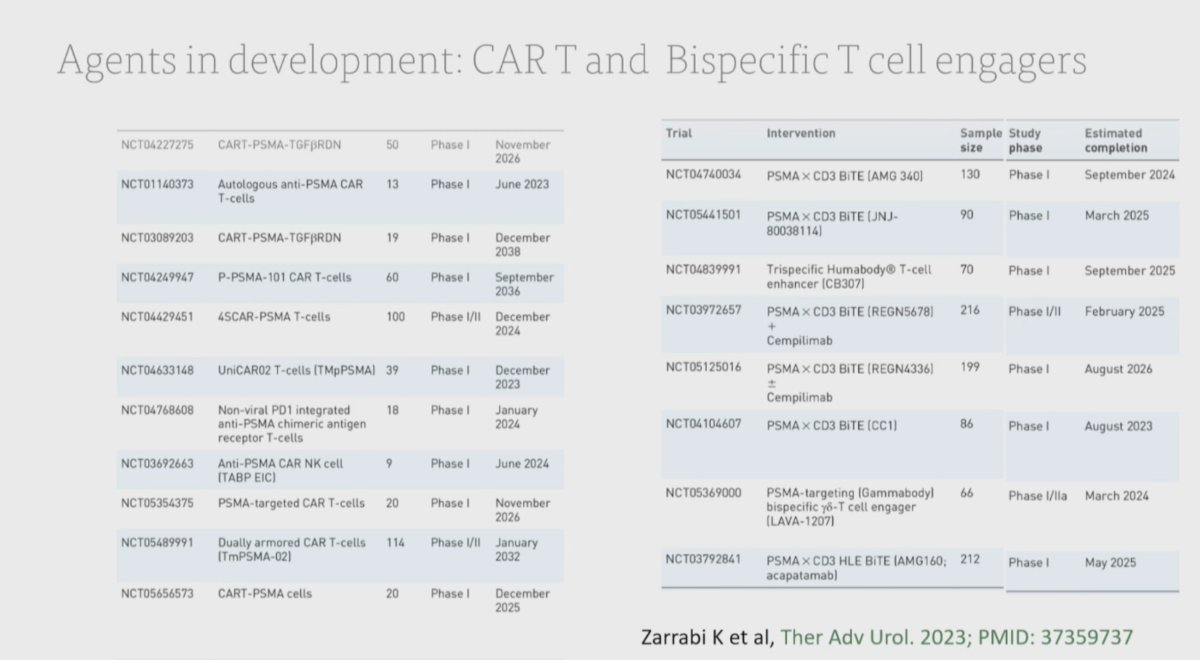
She discussed one of them in detail, the Poseida trial. This is a trial.
P-PSMA-101 is an autologously derived CAR-T product that has three major components. Dr. Dorff notes that this compound is known to have a high rate of producing naïve T-cells with more vigorous activity. It is designed with a kill switch due to concerns about its ramped up activity. 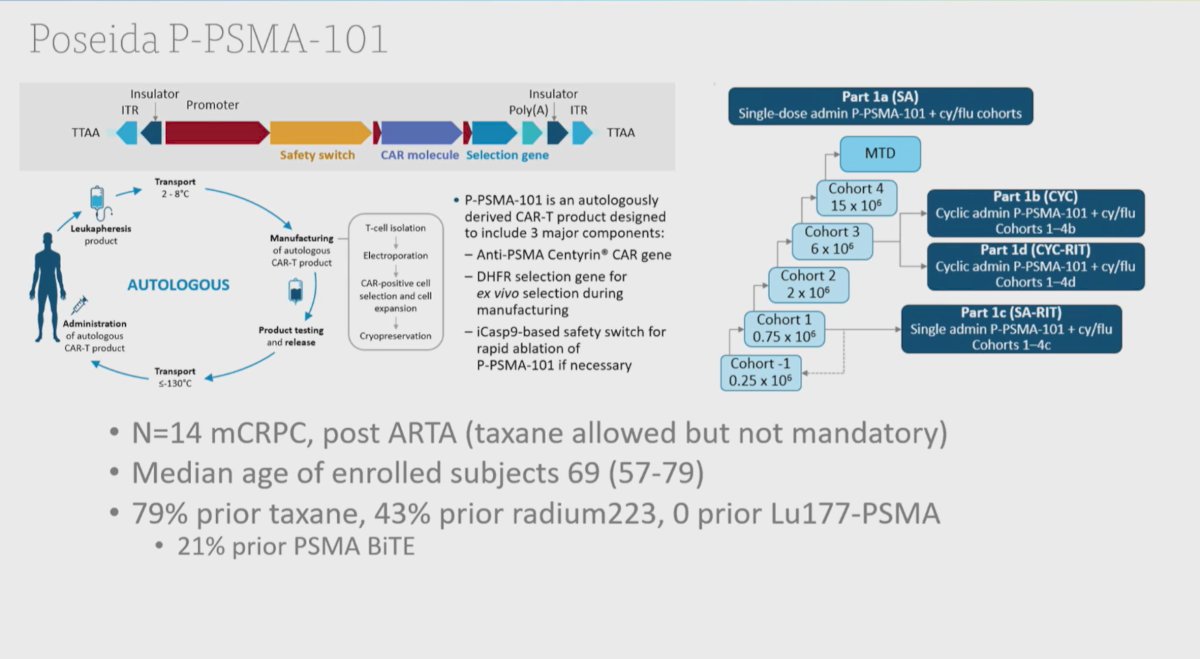
Unfortunately, there was a grade 5 (death) toxicity in the trial and Cas-9 kill switch was utilized on several occasions. She also brings our attention to the swimmers plot below, where the green and yellow dots represent response; however, shortly thereafter, black dots follow, denoting progression. This relatively short time with cancer control was a feature of this drug.

Another CAR-T was studied at UPenn, and a similar pattern of CRS and excessive proliferation of T-cells seen. Responses were seen, but a grade 5 tox (death) was also noted.1

Dr. Dorff concluded that PSMA CAR-T
- Can be effective but limited durability
- Mechanism of waning response is not well understood
- Toxicity is significant
- ICANS and HLH are the dominant concerns.
Moving on to PSMA bispecifics, Dr. Dorff showed two trials with high response rate, but also high toxicity. She notes for AMG 160, nearly every patient responded, but CRS was 100 percent. With greater than 50 percent of patients experiencing grade 3 or above CRS at higher doses. Antidrug antibodies can also be a concern as it limits the duration of response.2


Given the above, Dr. Dorff poses the question “is PSMA the best target for this type of therapy? She presents the latest response data utilizing AMG 509, a STEAP 1 2:1 T-cell engager. AMG 509, xaluritamig, is now in phase 3 trial with promising response rates. While CRS is present, it appears to be primarily a cycle 1 phenomenon.

STEAP-1 is not the only target with thought provoking data, Dr. Dorff noted UCSF (Aggarwal)’s work with DLL-3 target T-cell engagers for neuroendocrine prostate cancer. This is a difficult disease state to treat with minimal proven therapy. It is also known to NOT express PSMA nor STEAP-1; making DLL3 an attractive target.3

Dr. Dorff briefly touched upon a persistent question in the field; does the dosage of steroids matter in terms of efficacy. She notes we really don’t know, while there is preclinical suggestion that dexamethasone use can inhibit response, practically in trials and practice; it is difficult to state there is significant negative impact upon response.

In conclusion,
- Various factors in drug design remain unanswered.
- CD 28 versus CD 3?
- 2;1 versus 1:1
- Dual antigen target or single antigen target
- Patient selection is crucial
- High rate of CRS is seen in this type of treatment
- Limited durability of response
- Bispecifics due to drug antibodies
- CAR-T, due to tumor microenviroment
- And additional mechanisms?
Presented by: Tanya Dorff, MD, City of Hope, Los Angeles
Written by: Helen Moon, MD, Hematologist and Oncologist at the Kaiser Permanente Riverside Medical Center, Principal Investigator with the Cancer Clinical Trials Access Program, Southern California Permanente Medical Group, during the 2025 PSMA and Beyond Annual Meeting, Los Angeles, CA, Fri, Mar 28 – Sat, Mar 29, 2025.
References:
- Narayan V, Barber-Rotenberg JS, Jung IY, Lacey SF, Rech AJ, Davis MM, Hwang WT, Lal P, Carpenter EL, Maude SL, Plesa G, Vapiwala N, Chew A, Moniak M, Sebro RA, Farwell MD, Marshall A, Gilmore J, Lledo L, Dengel K, Church SE, Hether TD, Xu J, Gohil M, Buckingham TH, Yee SS, Gonzalez VE, Kulikovskaya I, Chen F, Tian L, Tien K, Gladney W, Nobles CL, Raymond HE; Prostate Cancer Cellular Therapy Program Investigators; Hexner EO, Siegel DL, Bushman FD, June CH, Fraietta JA, Haas NB. PSMA-targeting TGFβ-insensitive armored CAR T cells in metastatic castration-resistant prostate cancer: a phase 1 trial. Nat Med. 2022 Apr;28(4):724-734. doi: 10.1038/s41591-022-01726-1. Epub 2022 Mar 21. PMID: 35314843; PMCID: PMC10308799.
- Lim EA, Schweizer MT, Chi KN, Aggarwal R, Agarwal N, Gulley J, Attiyeh E, Greger J, Wu S, Jaiprasart P, Loffredo J, Bandyopadhyay N, Xie H, Hansen AR. Phase 1 Study of Safety and Preliminary Clinical Activity of JNJ-63898081, a PSMA and CD3 Bispecific Antibody, for Metastatic Castration-Resistant Prostate Cancer. Clin Genitourin Cancer. 2023 Jun;21(3):366-375. doi: 10.1016/j.clgc.2023.02.010. Epub 2023 Feb 28. PMID: 36948922; PMCID: PMC10219845.
- Nolan-Stevaux O, Li C, Liang L, Zhan J, Estrada J, Osgood T, Li F, Zhang H, Case R, Murawsky CM, Estes B, Moore GL, Bernett MJ, Muchhal U, Desjarlais JR, Staley BK, Stevens J, Cooke KS, Aeffner F, Thomas O, Stieglmaier J, Lee JL, Coxon A, Bailis JM. AMG 509 (Xaluritamig), an Anti-STEAP1 XmAb 2+1 T-cell Redirecting Immune Therapy with Avidity-Dependent Activity against Prostate Cancer. Cancer Discov. 2024 Jan 12;14(1):90-103. doi: 10.1158/2159-8290.CD-23-0984. PMID: 37861452.